English
 Español
 Português
 عربي
عربي 한국어
한국어

In stone buying, price matters.
No serious buyer ignores budget. Importers, contractors, developers, distributors, hotel buyers, and project teams all need competitive pricing. A supplier who cannot understand price pressure does not understand the market.
But there is a difference between a competitive price and a risky low price.
That difference is important.
In stone project supply, the lowest unit price is not always the lowest project cost. A cheaper quotation may look attractive at the beginning, but if it leads to material inconsistency, inaccurate cutting, weak packing, poor communication, slow replacement, or installation delay, the project may end up paying more in other ways.
The problem is not low price itself.
The problem is when buyers compare only the visible price and ignore the hidden cost behind project execution.
For stone projects, real cost is not only what is written on the quotation. It is also what happens after the order begins.

A stone quotation usually shows material name, size, thickness, finish, quantity, unit price, payment terms, packing, and delivery condition.
That is useful, but it does not show everything.
It may not show:
· how carefully the material will be selected
· whether the approved sample can be matched
· whether the slab range is stable
· whether shop drawings will be reviewed properly
· whether cut-to-size pieces will be checked before packing
· whether packing supports installation
· whether QC records will be shared
· whether communication will be clear after deposit
· whether replacement pieces can be handled quickly
These factors affect the real cost of the project.
A low price with weak control can become expensive later.
A fair price with better control may reduce risk, labor pressure, and after-sales problems.
This is why experienced buyers compare value, not only unit price.
Material selection is one of the first places where hidden cost appears.
For natural marble, lower-priced lots may include wider variation, more unstable color range, more resin treatment, more cracks, more unusable areas, or less predictable slab movement. That does not always mean the material is bad. But it means the buyer must understand what is being purchased.
For engineered materials, a very low price may sometimes reflect differences in raw material quality, production stability, surface finish, batch control, or long-term performance expectations.
For terrazzo, quartz, artificial marble, limestone, and other materials, the same logic applies: the visible sample may look acceptable, but the production range must still be checked.
A lower price is not automatically wrong.
But if the price is low because material selection is loose, the project may pay later through waste, re-selection, mismatch, or complaints.
In cut-to-size stone orders, fabrication accuracy matters as much as material price.
A small error can create large consequences.
One wrong sink cutout may delay a hotel bathroom installation.
One inconsistent edge profile may affect many repeated vanity tops.
One incorrect stair tread size may slow the entire staircase package.
One poorly checked wall panel may require site adjustment, replacement, or compromise.
These problems are not always visible in the quotation stage.
A supplier may quote a lower price because less time is spent on drawing review, dimension checking, edge inspection, or pre-packing confirmation. The buyer may save money at first, but the project may lose time later.
For project buyers, fabrication cost should not be judged only by the cutting price.
It should be judged by how much risk the supplier removes before the material reaches the site.
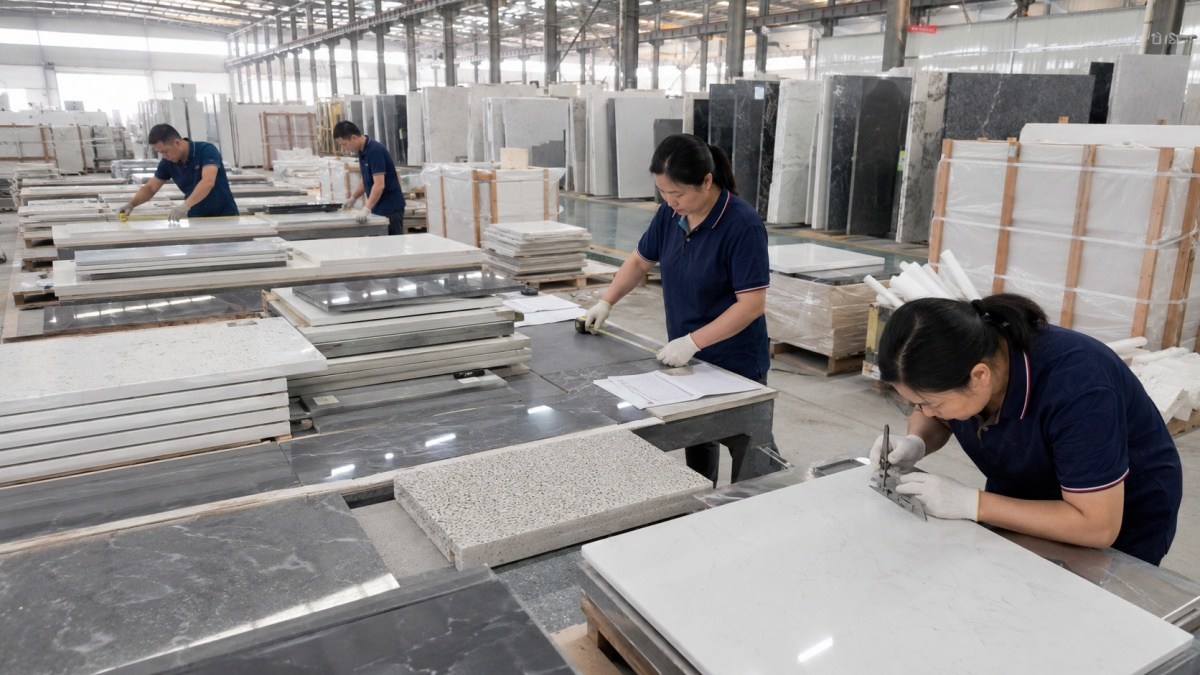
Packing is one of the most common areas where buyers underestimate cost.
If stone is packed poorly, the project may face:
· broken corners
· chipped edges
· scratched polished faces
· cracked fragile pieces
· mixed crate contents
· unreadable labels
· difficult unloading
· installation confusion
The supplier may say the goods were fine when shipped. The buyer may say the goods arrived damaged or impossible to sort efficiently. The project loses time either way.
This is why packing should not be seen as a simple place to save cost.
Good packing costs money because it uses better material, more labor, better labeling, stronger crate design, clearer packing lists, and more careful loading. But this cost may be much lower than the cost of replacement, delay, or dispute.
In project stone supply, good packing protects both the stone and the buyer’s schedule.
A stone project does not always go perfectly.
Questions appear.
Drawings change.
Site conditions shift.
Replacement pieces may be needed.
A buyer may require new photos, documents, packing records, or clarification.
When this happens, supplier responsiveness becomes part of project cost.
A cheaper supplier who responds slowly, avoids responsibility, or cannot provide clear records may cost the buyer time and pressure. A professional supplier who communicates clearly can reduce uncertainty even when a problem appears.
This matters especially for international trade.
The buyer is often far from the factory. They cannot inspect every piece personally. They rely on supplier communication, photos, QC records, packing lists, and honest updates.
Low price is helpful only if the supplier remains reliable after the order starts.
Some buyers save money by choosing the cheapest quotation, but then spend more time managing the supplier.
They need to chase photos.
They need to repeat details.
They need to check every dimension.
They need to ask again for packing information.
They need to explain the same drawing several times.
They need to handle site complaints themselves.
This is a hidden cost.
For importers, this cost appears as staff time and after-sales pressure.
For contractors, it appears as installation coordination and schedule risk.
For developers, it appears as delay and rework.
For designers, it appears as final presentation risk.
A good supplier should reduce the buyer’s workload, not transfer the factory’s uncertainty to the buyer.
Not every order needs the same supplier standard.
A simple stock slab order does not require the same level of coordination as a hotel bathroom package, a luxury villa staircase, a commercial lobby wall, or a cut-to-size apartment project.
The more complex the project, the more dangerous it becomes to choose only by lowest price.
Higher-risk orders may require:
· tighter material selection
· slab approval
· shop drawing review
· cut-to-size checking
· finish confirmation
· dry layout when necessary
· stronger packing
· clearer labels
· QC photo records
· replacement planning
These steps add cost, but they also reduce risk.
The right question is not always, “Who is cheapest?”
The better question is:
Which supplier can control this level of project risk at a reasonable cost?
A professional supplier should be able to explain why their price is what it is.
Not with empty claims like “best quality,” but with practical reasons:
· better material selection
· more stable batch control
· more careful fabrication
· stronger packing
· clearer documentation
· more detailed QC
· better project communication
· more reliable export experience
If a supplier cannot explain the value behind the price, the buyer has reason to question it.
At the same time, if a supplier’s price is far below the market, the buyer should ask what has been removed from the process.
Sometimes the answer is acceptable.
Sometimes the answer is risk.
A better comparison includes both visible and hidden factors.
Before choosing a supplier, buyers can ask:
· Is the material range clear?
· Are samples and slabs honestly represented?
· Are fabrication details confirmed?
· Is the supplier experienced with this application?
· Is packing suitable for export and installation?
· Are labels and packing lists clear?
· Are QC photos available?
· Can the supplier support replacement or future orders?
· Does the communication reduce or increase my workload?
This kind of comparison is more demanding than simply choosing the lowest number.
But it is closer to how real projects succeed.

Stone buyers should care about price. That is normal and necessary.
But price should be understood correctly.
The cheapest quotation is not always the lowest project cost. In stone supply, real cost includes material risk, fabrication risk, packing risk, communication risk, replacement risk, and installation risk.
A good supplier does not ask buyers to ignore price.
A good supplier helps buyers understand what the price includes.
For serious project buyers, the goal is not to pay more without reason. The goal is to avoid saving a little at the beginning and losing more later.
That is why the best stone purchasing decisions balance price with control.



 IPv6 network supported