English
 Español
 Português
 عربي
عربي 한국어
한국어

Packing photos are often treated as a small final step before shipment.
In stone projects, they should be treated more seriously.
A few photos taken before loading can help the buyer confirm whether the stone is protected, labeled, separated by area, matched with the packing list, and ready for shipment. They can also become useful records if questions appear later during unloading, arrival inspection, or installation.
For international stone orders, especially cut-to-size projects, packing photos are not just “factory updates.” They are part of project control.
If the buyer only checks price, material, and delivery date, but never checks packing logic, the project may still face problems after arrival: mixed crates, unclear piece numbers, wrong installation sequence, broken corners, missing pieces, or confusion between similar materials.
Stone packing photos before shipment should answer one basic question:
Can the receiving and installation team understand this shipment when it arrives?

1. Packing photos should show more than closed crates
A photo of closed wooden crates is not enough.
Closed-crate photos can show that the goods are packed, but they do not show whether the stone inside is protected correctly, whether piece numbers are clear, whether the packing follows the installation sequence, or whether the crate marks match the packing list.
Useful packing photos should include several stages:
stone pieces before packing
close-up of finished surfaces
edge and corner protection
labels or piece numbers
protective foam or padding
crate inside before closing
crate after closing
crate marks
packing list reference
loading preparation if available
For simple slab orders, fewer photos may be enough. For cut-to-size stone, hotel bathrooms, stairs, countertops, wall panels, flooring patterns, or custom pieces, buyers should request more complete packing records.
Good packing photos reduce uncertainty.
They do not replace inspection, but they help the buyer see whether the shipment has been prepared with a project mindset.
2. Start with the packing list
Before judging the photos, buyers should open the packing list.
A stone shipment document review should begin with the written record, not with random images.
The packing list should show:
project name or order reference
crate number
material name
size
thickness
quantity
finish
area or room code if needed
piece number if needed
net weight and gross weight if provided
package dimensions if provided
special notes for fragile or custom pieces
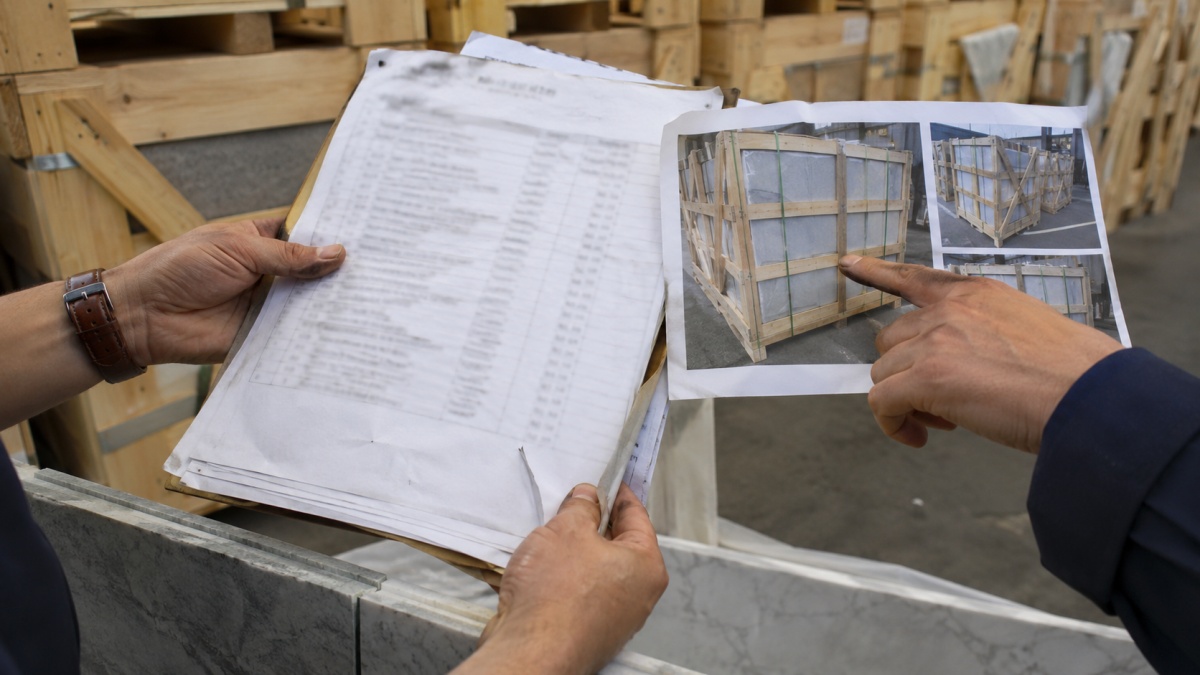
Then the buyer should compare the packing list with the photos.
The question is not only: “Are there crates?”
The better question is: “Can I connect each crate in the photos with the packing list?”
If crate 3 contains lobby wall panels, the photo record should make that easy to understand. If crate 5 contains bathroom vanity tops, the buyer should not need to guess. If a project has several floors or rooms, the crate logic should help the site team unpack in the right order.
For international stone project shipment coordination, the packing list and packing photos should work together. One without the other is incomplete.
3. Check whether crate marks are clear
Stone crate packing inspection should include crate marks.
Crate marks do not need to be beautiful, but they need to be clear enough for shipment, warehouse handling, unloading, and site sorting.
Useful crate marks may include:
crate number
project reference
destination or consignee reference if required
material or area code
gross weight
handling direction if needed
fragile mark if needed
piece group if needed
For many projects, the most important point is not whether the crate mark contains many words. The most important point is whether the crate number clearly matches the packing list.
If the packing list says Crate 1 to Crate 12, the photos should clearly show those crate numbers. If a crate mark is unclear, covered, handwritten too lightly, or inconsistent with the packing list, the buyer should ask for clarification before loading.
This is especially important when the shipment contains similar-looking stone pieces.
A crate full of white marble wall panels may look similar to another crate full of white artificial marble panels. A crate of beige limestone may look similar to another beige stone package. Without clear marks, the site team may waste time or open the wrong crate first.
4. Check internal protection before the crate is closed
The most valuable packing photos are often taken before the crate is fully closed.
These photos can show whether the stone has enough protection inside the crate.
Buyers should check:
Are polished faces protected?
Are corners protected?
Are fragile cutouts supported?
Are slabs separated properly?
Are thin panels supported safely?
Are finished edges protected from direct impact?
Is there enough padding between pieces?
Are pieces tightly fixed enough to avoid movement?
Are heavy pieces placed safely?
Are small pieces packed so they will not be lost or crushed?
The protection should match the material and the shape.
A thick granite tile order does not need the same protection as a thin sintered stone panel. A quartz countertop with sink cutout needs different protection from a simple rectangular tile. A carved limestone piece needs different packing from a standard artificial marble slab.
Packing is not one fixed formula. It should respond to material type, shape, finish, thickness, and risk.
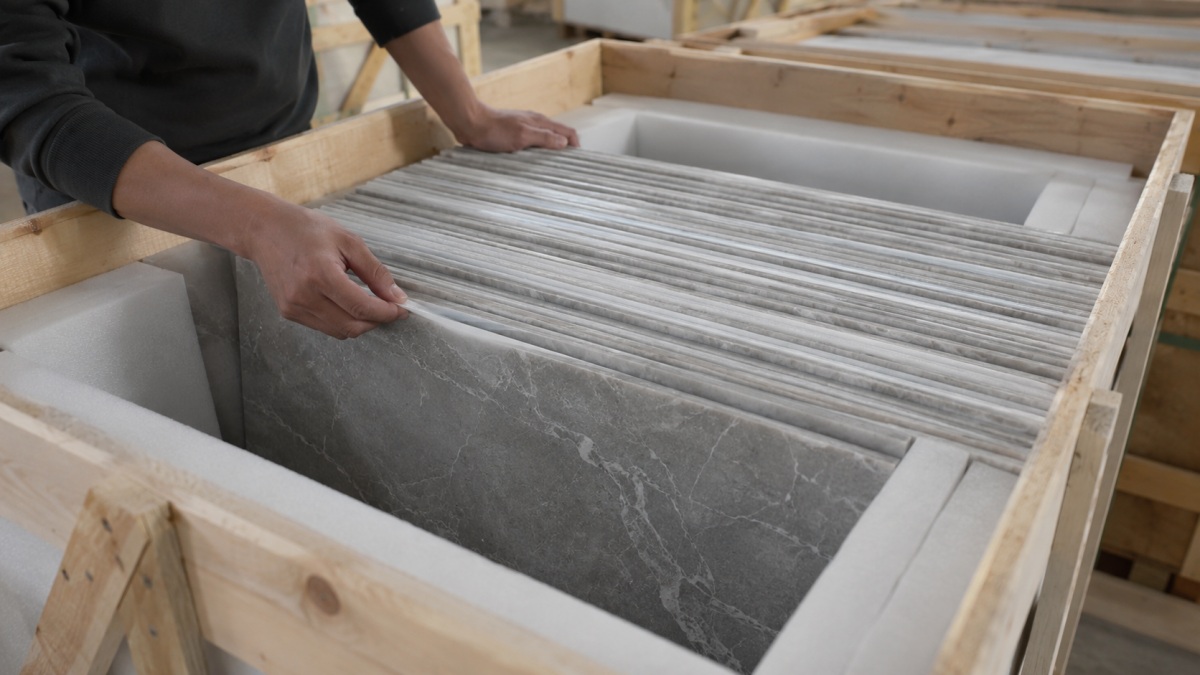
5. Natural marble needs surface and sequence protection
natural marble packing review should pay attention to both physical protection and visual sequence.
Marble can have polished surfaces, delicate veining, bookmatched panels, continuous layouts, or highly visible installation areas. If the marble is cut to size for a wall, floor, column, staircase, or feature area, the packing should help preserve the approved sequence.
For natural marble packing review, buyers should check:
polished surface protection
edge and corner protection
separation between pieces
visible face direction
piece numbers
dry lay sequence if required
bookmatch pair identification
crate grouping by area
whether high-visibility pieces are easy to identify
Natural marble should not be packed only as “stone pieces.” It should be packed as part of a layout.
If the dry lay was approved before packing, the buyer should ask whether the packing sequence follows that approval. Otherwise, the site team may receive correct pieces but lose the intended visual order.
6. Granite needs strong crate support and edge control
Granite is generally durable, but that does not mean packing can be careless.
Granite orders often involve flooring, exterior pieces, stairs, countertops, kerbs, cladding, or high-traffic project areas. The buyer should check whether the crate structure is strong enough for the weight and whether visible edges are protected.
For granite packing, useful photo checks include:
crate strength
bottom support
edge separation
corner protection
finish protection
anti-slip surface protection if relevant
piece count
size grouping
crate weight distribution
Granite may resist many types of use, but transportation can still damage corners, polished edges, or finished surfaces if the crate is not properly prepared.
Durable material still needs disciplined packing.
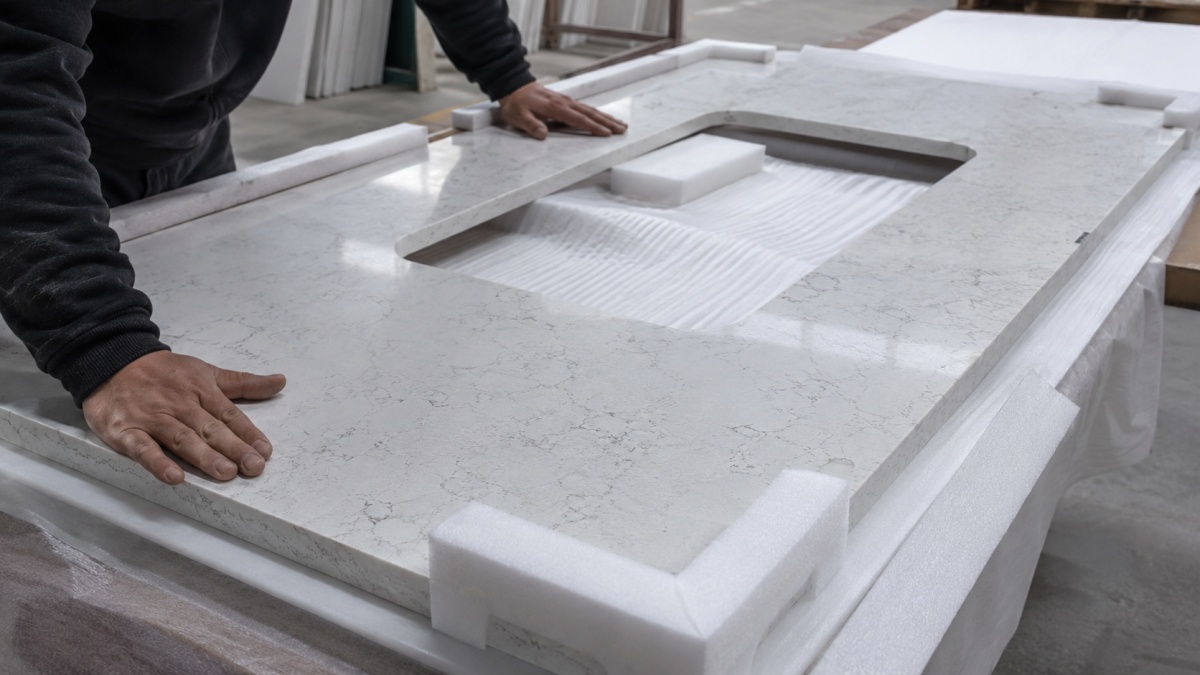
7. Quartz stone countertops need cutout protection
quartz stone countertop packing protection should focus on fabricated details.
Quartz stone is often shipped as countertops, vanity tops, islands, bar tops, or commercial surfaces. These pieces may include sink openings, cooktop cutouts, faucet holes, backsplash, overhangs, mitered edges, and polished profiles.
For quartz stone countertop packing protection, buyers should check:
sink cutout protection
faucet hole area support
cooktop opening support
edge protection
corner protection
finished surface protection
backsplash packing
piece labels
countertop direction
separation between tops
A quartz slab may be strong as a surface, but a fabricated cutout can become a risk point during transportation if it is not supported correctly.
Packing photos should clearly show how these details are protected before the crate is closed.
8. Artificial marble and agglomerated marble need batch and area control
Artificial marble and agglomerated marble are often selected for controlled color, marble-look appearance, and repeated commercial interior use. Their packing review should focus on batch consistency, area separation, labels, finish protection, and installation sequence.
For artificial marble and agglomerated marble packing control, buyers should check:
whether pieces from the same area are packed together
whether room codes are clear
whether repeated pieces are separated correctly
whether surface protection is suitable
whether edge polish is protected
whether crate numbers match the packing list
whether batch information is clear if needed
This is especially important for hotel rooms, apartment units, commercial corridors, retail interiors, and large repeated projects.
The material may be more visually consistent than natural marble, but the project can still become chaotic if packing sequence and labels are unclear.
9. Terrazzo stone packing should protect corners and finish
Terrazzo stone packing should protect both surface finish and edges.
Terrazzo can be used in commercial floors, wall panels, stairs, counters, and public interiors. Depending on chip size, finish, and piece size, the buyer should check whether the packing prevents corner damage, surface scratching, and area mixing.
Important photo checks include:
finished surface protection
corner protection
crate separation
piece grouping by area
label clarity
size grouping
skirting and stair piece separation
surface cleanliness before packing
whether pieces are packed according to installation sequence
Terrazzo is often judged by the final installed field. If pieces are mixed across areas, the visual balance and installation efficiency may be affected.
Packing photos should help the site team understand the project, not only confirm that the goods are inside crates.
10. Sintered stone and limestone require different packing caution
Sintered stone and limestone have very different material behavior, but both require careful packing logic.
Sintered stone may be large-format, thin, and sensitive around edges, cutouts, and corners during handling. Packing photos should show:
panel support
vertical or suitable crate positioning
corner protection
edge protection
separation between panels
cutout protection if present
handling direction
crate stability
Limestone, on the other hand, is a natural stone with pores, fossils, softer texture, and architectural surface character. Packing photos should show:
surface protection
edge and corner protection
protection against rubbing marks
correct face direction
separation between finished pieces
safe support for carved or shaped pieces
Sintered stone should not be packed as if it were a small ceramic tile. Limestone should not be treated as if natural surface character means it does not need protection.
Each material needs its own packing logic.
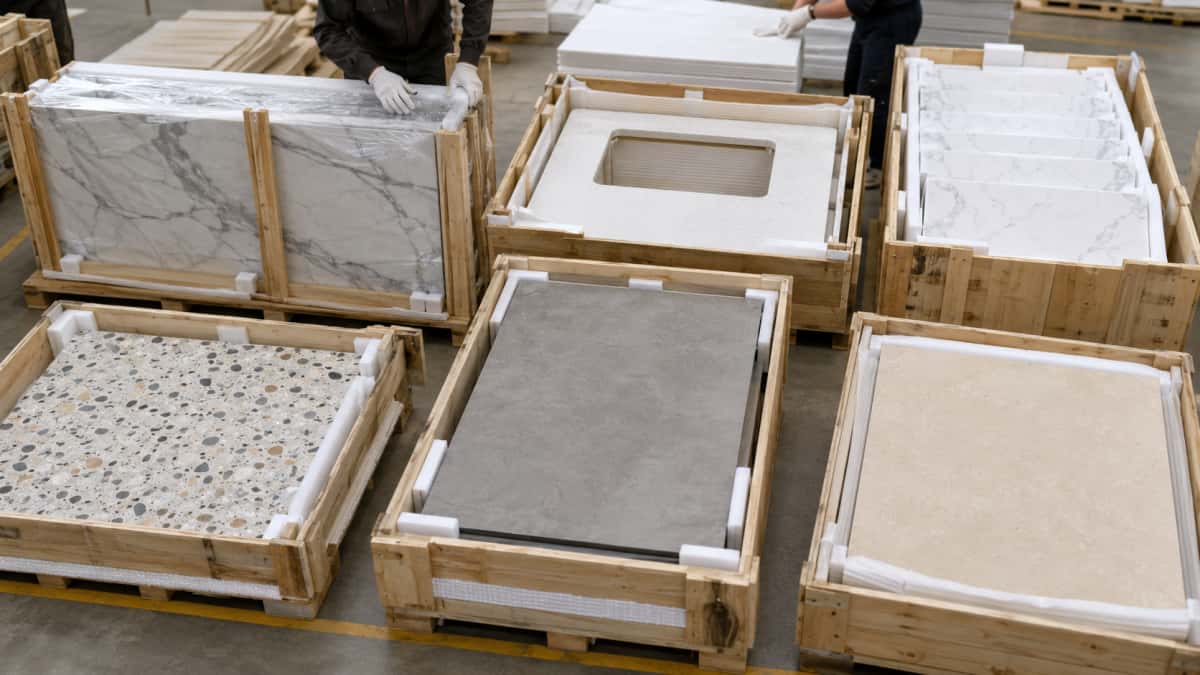
11. Check the cut-to-size stone packing sequence
For project orders, cut-to-size stone packing sequence is often more important than buyers expect.
If pieces are packed randomly, the site team may spend extra time sorting them after arrival. Worse, installers may install the wrong piece in the wrong area because several pieces look similar.
A good cut-to-size packing sequence should consider:
installation area
room code
floor number
wall elevation
stair sequence
countertop set
bathroom set
dry lay approval
visible face
fragile pieces
unloading order
site storage condition
For example, if a hotel project includes many bathroom vanity tops, it may be practical to pack by room or floor. If a lobby wall uses bookmatched marble panels, sequence should follow the approved layout. If terrazzo stair treads and risers are included, they should not be mixed with unrelated floor pieces.
This is where cut-to-size stone packing and fabrication control matters. Good fabrication is not finished when the stone is cut. It continues through labeling, protection, packing, and shipment preparation.
12. Ask for photos of the packing environment
The packing environment also matters.
Buyers do not need to demand perfect showroom conditions, but they should expect an organized, dry, and controlled packing area.
A clean factory packing environment helps reduce preventable risks during final preparation.
Packing photos should avoid signs of:
wet floors
muddy surfaces
dirty stone faces
broken crate materials
chaotic mixing of orders
unclear work areas
unprotected polished surfaces
pieces leaning unsafely
labels falling off
loose packaging materials
A dry and organized packing area does not guarantee zero damage, but it shows whether the supplier is managing the shipment carefully.
The buyer should not only look at the stone. The buyer should look at the process around the stone.

13. Check whether the photos support future claims or clarification
Packing photos can become important later.
If a crate arrives damaged, if a piece is missing, if the site team cannot find a certain panel, or if there is a question about whether a visible edge was protected, packing photos can help clarify what happened before shipment.
A useful photo record should make it possible to answer:
Was the piece packed?
Which crate was it in?
Was the surface protected?
Was the corner protected?
Was the label visible?
Did the crate mark match the packing list?
Was the piece already damaged before packing?
Was the packing sequence clear?
Did the supplier follow the approved layout?
This does not mean the buyer should prepare for conflict. It means the project should keep clear records.
Good records protect both buyer and supplier.
They also reduce emotional arguments because people can return to evidence.
14. What should buyers ask before container loading?
Stone container loading preparation should not begin until the buyer has checked the main packing questions.
Before loading, buyers should confirm:
1.Are all crates packed?
2.Do crate numbers match the packing list?
3.Are crate marks clear?
4.Are the packing photos complete enough?
5.Are fragile pieces protected?
6.Are visible surfaces protected?
7.Are cutouts supported?
8.Are special pieces clearly labeled?
9.Are areas or room codes separated?
10.Does the packing sequence support installation?
11.Is the packing environment clean and dry?
12.Are any missing or damaged pieces reported before loading?
13.Are shipment documents aligned with the packed goods?
14.Has the buyer approved shipment readiness?
Once the container is loaded, correcting packing questions becomes much harder.
It is better to pause before loading than to argue after arrival.
15. A practical stone export packing checklist
Before approving shipment, buyers can use this stone export packing checklist:
1.Packing list received and reviewed
2.Crate numbers confirmed
3.Crate marks visible in photos
4.Material name and finish confirmed
5.Quantity checked against order
6.Area or room codes confirmed if needed
7.Piece numbers visible or recorded
8.Polished faces protected
9.Edges and corners protected
10.Cutouts supported
11.Fragile pieces specially protected
12.Similar pieces separated clearly
13.Dry lay sequence followed if required
14.Packing photos taken before crate closing
15.Photos taken after crate closing
16.Crate structure checked visually
17.Packing environment clean and dry
18.Documents match packed goods
19.Questions clarified before loading
20.Shipment approval given clearly
This checklist is not complicated, but it can prevent many avoidable problems.
In international stone projects, small packing details often decide how smooth the receiving and installation process will be.
16. How buyers should communicate packing questions
Vague packing questions are hard to solve.
Instead of saying:
“The packing does not look good.”
A better message is:
“Please confirm Crate 4. The packing list says it contains vanity tops V-12 to V-18, but the photo only shows labels up to V-16. Can you send one more photo before closing the crate?”
Instead of saying:
“The stone may break.”
A better message is:
“Please add support around the sink cutout on piece Q-08 before closing the crate and send an updated photo.”
Instead of saying:
“The labels are unclear.”
A better message is:
“Please resend crate mark photos for Crates 6, 7, and 8. The numbers are not clear enough to match with the packing list.”
Clear questions lead to clear action.
For buyers who want to confirm packing logic, crate sequence, project labels, or shipment readiness before goods leave the factory, it is better to contact Aoli Stone before shipment and review the project details before loading.

What Buyers Should Remember
Packing photos are not just proof that goods are ready.
For stone projects, they are part of quality control, shipment control, and installation preparation.
Natural marble needs surface protection and sequence control. Granite needs strong crate support and edge protection. Quartz stone countertops need cutout and polished-edge protection. Artificial marble and agglomerated marble need batch, area, and label control. Terrazzo stone needs corner, finish, and layout grouping control. Sintered stone needs panel, edge, and handling protection. Limestone needs careful surface and edge protection because of its natural texture and pores.
Different stone materials need different packing attention.
But the buyer’s core question is the same:
When these crates arrive, will the site team understand what to do?
If the answer is unclear, the buyer should ask more questions before shipment.
A good packing photo record does not make the project perfect. But it gives the buyer, supplier, and installer a better chance to prevent avoidable confusion before the stone leaves the factory.



 IPv6 network supported