English
 Español
 Português
 عربي
عربي 한국어
한국어

When buyers compare terrazzo slab and terrazzo tile, the question should not be “Which one is better?” in a general sense. The better question is: which format fits the project area, installation method, handling condition, joint expectation, replacement plan, and international supply risk?

Terrazzo slab and terrazzo tile can be made from similar materials, but they behave differently in real projects. A slab may support larger surfaces, custom fabrication, countertops, wall panels, stairs, and furniture pieces. A tile may be easier to install, pack, replace, and control across large floor areas. Choosing the wrong format can create problems that are not visible in a sample: broken pieces, poor joint planning, site handling difficulty, lippage, higher waste, delayed installation, or unclear responsibility between supplier and installer.
This is why terrazzo format should be decided together with drawings, area size, site access, installation skill, and shipment requirements.
What Is a Terrazzo Slab?
A terrazzo slab is a larger factory-made terrazzo piece that can be used as a full panel or cut into project pieces. Depending on the project, terrazzo slabs may be fabricated into countertops, vanity tops, wall panels, stair treads, risers, tabletops, reception counters, skirting, thresholds, or cut-to-size floor pieces.
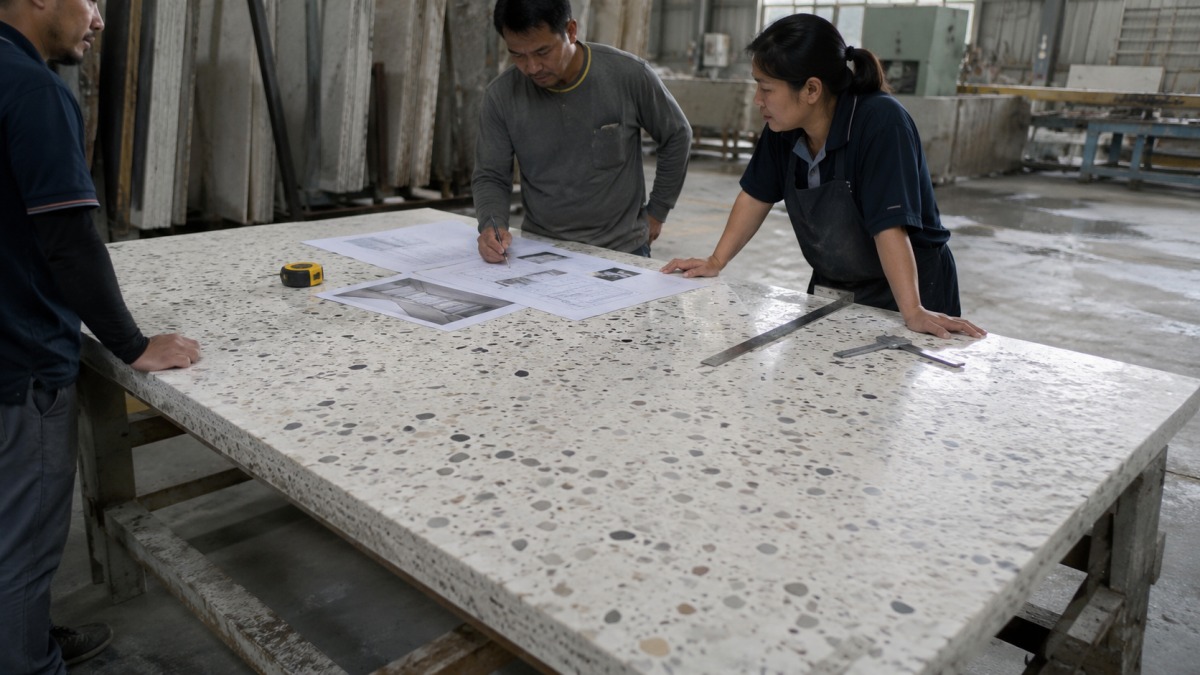
The main value of terrazzo slab is flexibility. It allows the project team to cut larger pieces, match areas more carefully, reduce the number of joints in selected locations, and fabricate custom shapes. For projects that need edge details, openings, profiles, or larger design surfaces, slab format can be useful.
But slabs also bring higher handling requirements. Larger pieces are heavier, more difficult to move on site, more sensitive to breakage during transport and installation, and more dependent on correct packing and lifting methods. A slab is not automatically the safest choice for every floor.
What Is Terrazzo Tile?
Terrazzo tile is a smaller modular format, usually supplied in repeated sizes for floor or wall installation. Tiles are easier to pack, count, install, replace, and distribute by area. For many commercial floors, hotel corridors, restaurants, retail spaces, bathrooms, and public areas, tile format can give better control.
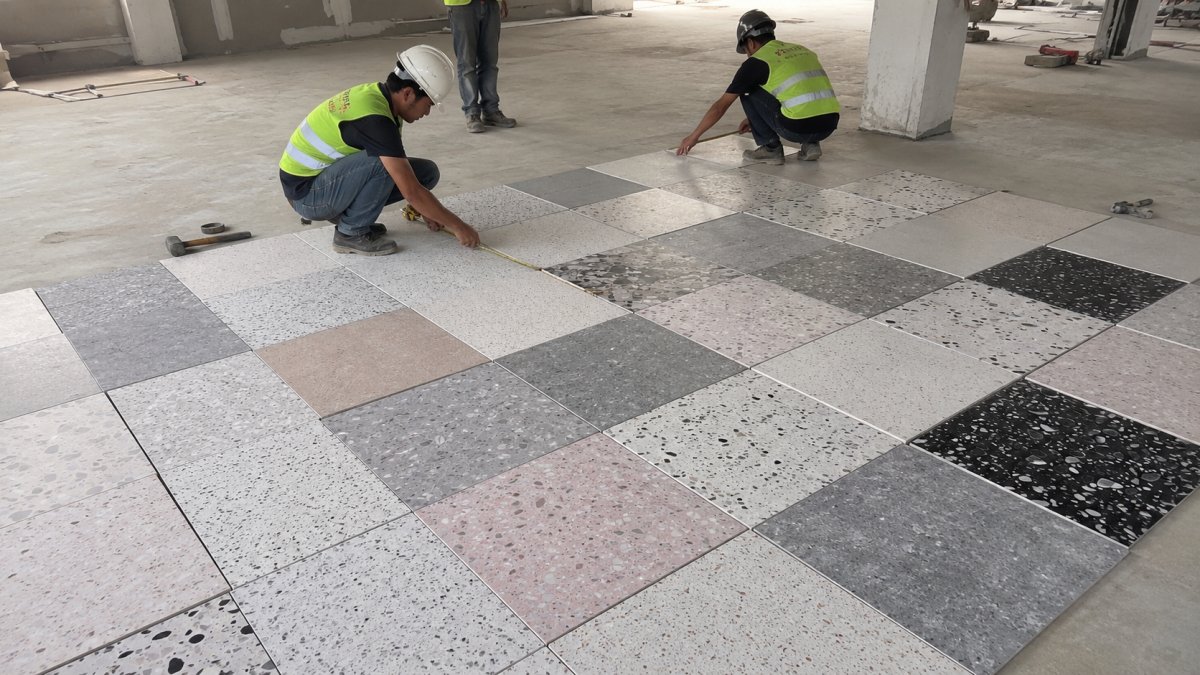
The main value of terrazzo tile is project management. Tiles can be packed by area, installed in sequence, replaced more easily if damaged, and handled by local installers with standard stone or tile installation experience.
The limitation is joint visibility. A tile system will have more joints than large slabs or in-situ terrazzo. If the design expects a nearly seamless look, the joint layout, grout color, tile size, and dry lay plan must be reviewed early.
Slab vs Tile: Key Comparison for Project Buyers
|
Decision Point |
Terrazzo Slab |
Terrazzo Tile |
|
Best use |
Countertops, wall panels, stairs, large cut-to-size pieces, furniture, custom fabrication |
Floors, corridors, bathrooms, retail areas, hotel rooms, modular wall areas |
|
Visual effect |
Fewer joints in selected areas, stronger large-panel feeling |
More regular joints, easier grid control |
|
Fabrication flexibility |
Higher; can be cut into custom shapes |
Lower; usually based on standard or repeated sizes |
|
Site handling |
More difficult; needs careful lifting and access planning |
Easier; smaller pieces are simpler to move and install |
|
Packing risk |
Higher if pieces are large or fragile |
Usually easier to pack and protect |
|
Installation speed |
Can be efficient for panels, but handling may slow the process |
Often easier for large floor areas |
|
Replacement |
Harder if a large custom piece is damaged |
Easier to replace individual tiles if spare pieces are available |
|
Waste control |
Depends on cutting plan and slab layout |
Usually easier to estimate by area and quantity |
|
Joint control |
Fewer joints, but each joint must be planned carefully |
More joints, but layout is more predictable |
|
International supply suitability |
Strong when fabrication drawings and packing are well controlled |
Strong when modular installation and replacement control are important |
The right format depends on the project. A hotel lobby floor may use tiles for installation control, while the reception counter may need terrazzo slabs for custom fabrication. A bathroom may use tiles on the floor and slab pieces for vanity tops or thresholds. A staircase may require slab-cut treads and risers rather than standard tiles.
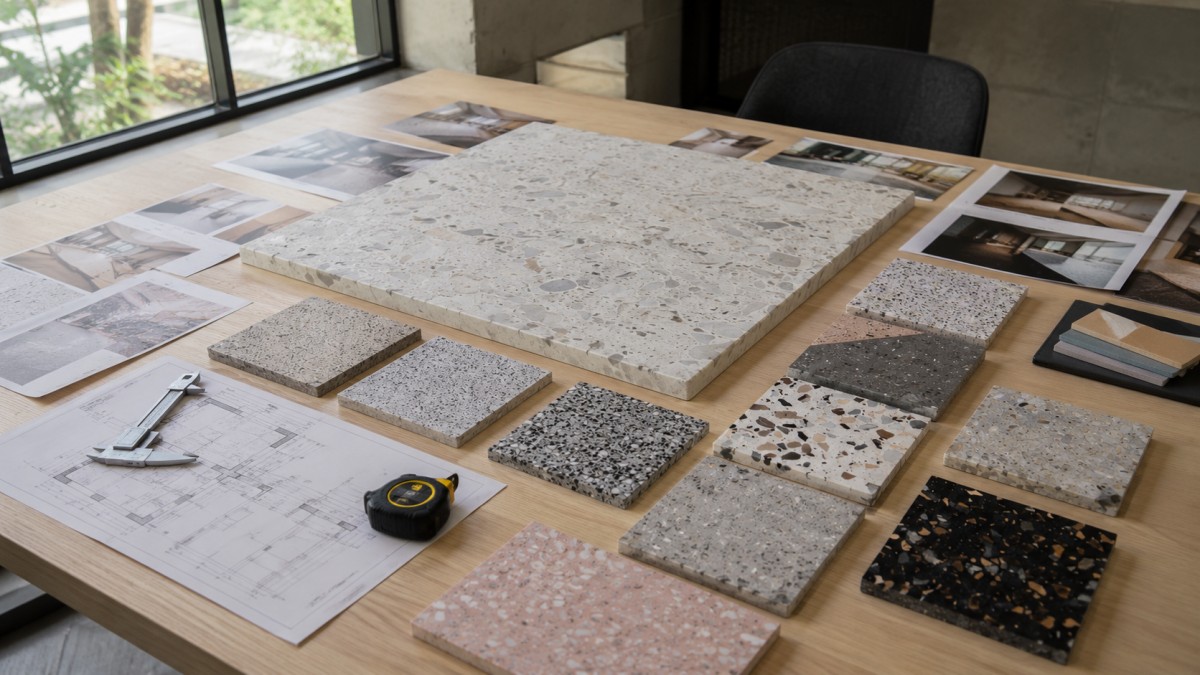
When Terrazzo Slab Usually Works Better
Terrazzo slab is often suitable when the project requires larger pieces, custom cutting, or visible design surfaces with fewer joints.
It may be a better choice for:
· Countertops and vanity tops
· Reception counters and service counters
· Large wall panels
· Stair treads and risers
· Tabletops and furniture pieces
· Cut-to-size thresholds, skirting, and special profiles
· Areas where fewer joints are important
· Projects where drawings define exact sizes and edge details
Slab format should be considered when the terrazzo is not just a floor covering but part of the architectural detail. However, buyers should confirm the maximum piece size that can be safely produced, packed, transported, moved into the building, and installed.
A large slab that cannot pass through the site entrance, elevator, stairwell, or installation route is not a practical slab.
When Terrazzo Tile Usually Works Better
Terrazzo tile is often more practical for large floor areas and projects that require modular installation.
It may be a better choice for:
· Hotel corridors
· Restaurant floors
· Retail floors
· Commercial bathrooms
· Apartment public areas
· Office floors
· Repeated room layouts
· Projects requiring easier replacement
· Orders that need clear packing by area and quantity
Tile format gives the project team more control over installation sequence and future maintenance. If one piece is damaged during installation or use, replacement is usually easier than replacing a large custom slab piece.
Tiles are also useful when the project has many repeated spaces. For example, hotel bathrooms, apartment corridors, and retail flooring can often be managed more efficiently with a tile system than with large custom-cut slabs.
The Main Risk: Choosing by Appearance Only
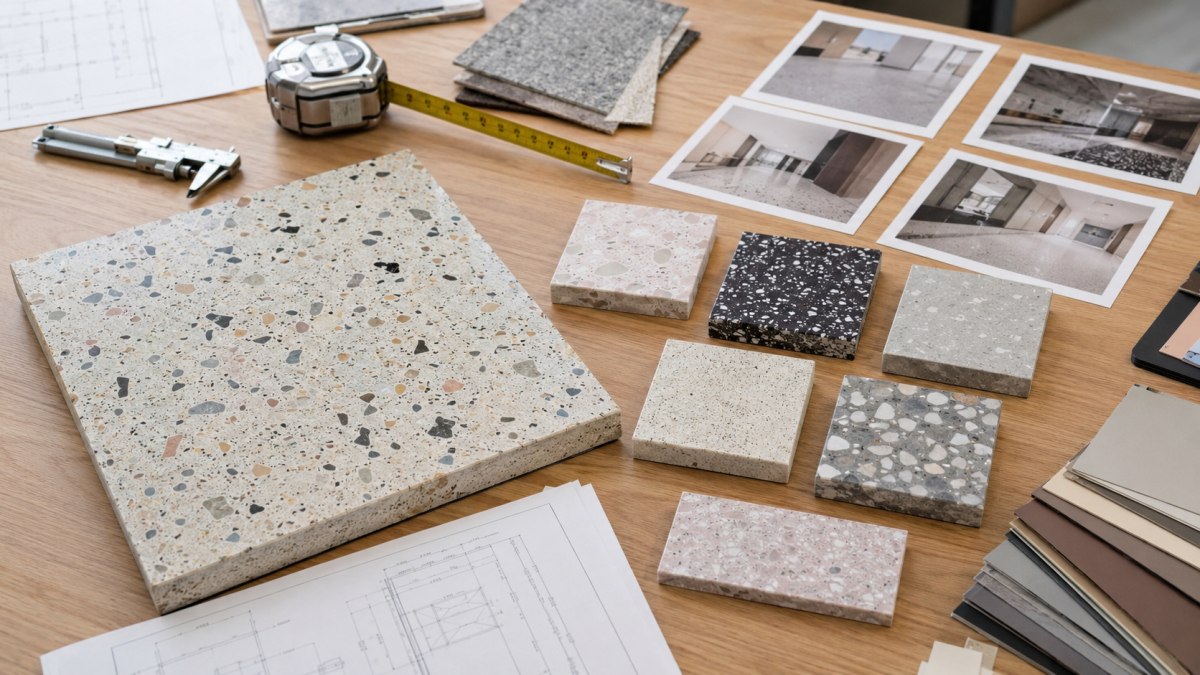
Many terrazzo decisions start with a sample. The buyer approves the color, aggregate, chip size, and surface finish. But a sample does not answer the real project questions:
· How large will each piece be?
· How many joints will appear?
· Can the material be moved safely on site?
· Who will cut openings or edge details?
· How will pieces be labeled and packed?
· What happens if one piece breaks?
· Can the installer achieve the expected joint quality?
· Is the surface finish suitable for the application area?
A terrazzo sample tells you what the material may look like. It does not prove that the format is correct for the project.
Buyer Checklist: How to Choose Between Slab and Tile
Before confirming terrazzo slab or terrazzo tile, buyers should clarify:
1. What is the application area: floor, wall, stair, counter, bathroom, lobby, or furniture?
2. Does the design require fewer joints, or is a regular tile joint acceptable?
3. What is the largest piece size that can be safely transported and installed?
4. Can the site handle large pieces through entrances, elevators, corridors, and staircases?
5. Are fabrication drawings available for cut-to-size pieces?
6. Are openings, edge profiles, sink cutouts, or special shapes required?
7. Does the project need dry lay photos before shipment?
8. How will pieces be numbered by area, room, floor, or drawing reference?
9. What packing method will protect edges and corners during export?
10. Does the installer have experience with large stone pieces or only modular tiles?
11. Are spare pieces required for future replacement?
12. What surface finish is required for slip resistance, cleaning, and maintenance?
If these questions are not answered, the project is not ready to choose slab or tile.
Red Flags Before Approving the Format
Be careful if any of the following situations appear:
· The project chooses slab only because it “looks more premium.”
· The project chooses tile only because it seems cheaper.
· The drawing does not show joint layout.
· The supplier quotes material without confirming application area.
· Large pieces are specified without checking site access.
· The buyer expects tile installation to look like a seamless poured terrazzo floor.
· No one has confirmed thickness, tolerance, edge protection, or packing.
· The installer has not reviewed the piece size before production.
· There is no plan for replacement pieces.
· The project includes stairs or counters but no fabrication drawings.
These are not small technical details. They can decide whether the material arrives safely, installs correctly, and performs as expected.
A Simple Decision Rule
Choose terrazzo slab when the project needs larger pieces, custom fabrication, fewer joints in selected areas, or architectural details such as counters, stairs, wall panels, and furniture.
Choose terrazzo tile when the project needs modular floor installation, easier handling, clearer quantity control, easier replacement, and lower site handling risk.
A strong terrazzo project may use both formats. The professional decision is not slab versus tile as a fixed rule. It is using the right format in the right area.
What Buyers Should Ask Before Production
Before ordering terrazzo slab, ask:
· What is the recommended maximum piece size for safe production and packing?
· Can the site receive and move this piece safely?
· Are shop drawings confirmed?
· Are edge details, cutouts, holes, and profiles clearly marked?
· Will dry lay photos be provided before shipment?
· How will each piece be labeled and protected?
· What happens if a custom piece is damaged during installation?
Before ordering terrazzo tile, ask:
· What tile size best fits the room layout?
· How will joint lines align with walls, doors, columns, or furniture?
· What grout color and joint width are expected?
· Will tiles be packed by room, floor, or area?
· Are spare tiles included?
· Does the installer understand the acceptable surface and joint tolerance?
· Is the finish suitable for the traffic level and cleaning method?
The earlier these questions are answered, the lower the risk during installation.
FAQ
Is terrazzo slab better than terrazzo tile?
Not always. Terrazzo slab is better for larger pieces, custom fabrication, counters, stairs, wall panels, and fewer joints in selected areas. Terrazzo tile is often better for modular floors, easier installation, replacement, packing, and quantity control.
Is terrazzo tile only for low-end projects?
No. Terrazzo tile can be used in high-quality hotels, retail spaces, restaurants, offices, and public areas. The final result depends on material quality, finish, joint layout, installation, and maintenance planning.
Can terrazzo slabs be used for flooring?
Yes, but the project must check piece size, thickness, handling, site access, installation skill, breakage risk, and joint layout. Large floor pieces are not always practical for every site.
Which format is better for international supply?
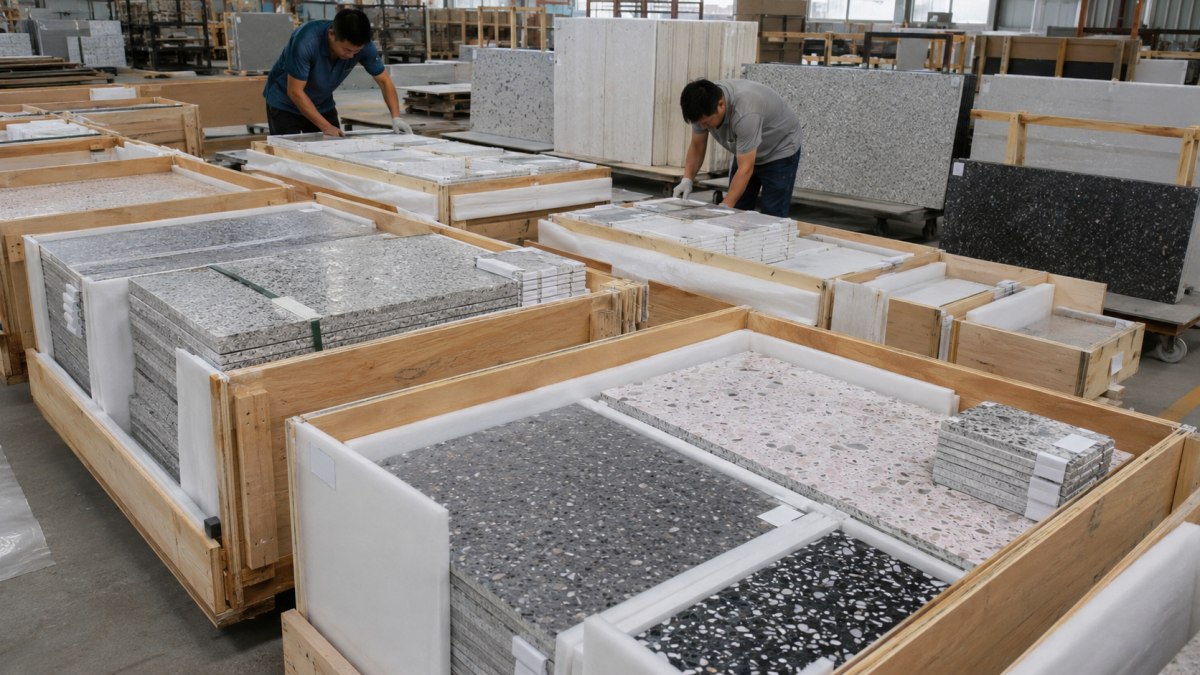
For many international projects, terrazzo tile is easier for large floor areas because it is simpler to pack, ship, handle, install, and replace. Terrazzo slab is better when the project needs cut-to-size fabrication, countertops, stairs, wall panels, or custom architectural pieces.
What should buyers confirm before approving terrazzo format?
Buyers should confirm application area, drawings, size, thickness, finish, joint layout, edge details, packing method, installation responsibility, site access, and replacement plan.
If your project is deciding between terrazzo slab and terrazzo tile, send the application area, drawings, preferred size, finish, thickness, quantity, and installation conditions. A format review before production can help clarify whether the project should use slabs, tiles, or a combination of both.



 IPv6 network supported