English
 Español
 Português
 عربي
عربي 한국어
한국어

Terrazzo can be supplied in different ways, but the supply method matters as much as the color, aggregate size, or surface finish. For international projects, the key question is not only “Which terrazzo looks better?” but also “Which terrazzo system can be produced, checked, packed, shipped, and installed with controlled risk?”

This is where the difference between precast terrazzo and in-situ terrazzo becomes important. In-situ terrazzo is created on site, usually by pouring, curing, grinding, and finishing the terrazzo surface directly in the building. Precast terrazzo is made in a factory as slabs, tiles, stair treads, wall panels, countertops, skirting, or other cut-to-size pieces, then delivered to the project for installation. Both systems can work, but they do not solve the same project problem.
For local construction teams with strong terrazzo installation experience, in-situ terrazzo may be suitable for large continuous floors. For international stone supply, however, precast terrazzo is often easier to control because the main production, inspection, finishing, numbering, and packing work happens before shipment.
Why the Supply Method Changes the Project Risk
A terrazzo sample can show color, aggregate mix, chip size, and surface feeling, but it does not fully explain how the final project will be delivered. A buyer may approve a beautiful terrazzo look, then later discover that the project requires site pouring, skilled grinding workers, curing time, dust control, water control, floor flatness coordination, and responsibility between supplier, contractor, installer, and site team.
This is why terrazzo should not be judged only as a surface design. It should be judged as a supply system.
In international projects, the supply chain is usually longer. The material may be produced in one country, packed in containers, shipped overseas, customs-cleared, delivered to site, and installed by a local contractor. Every extra handover creates risk. If the material can be inspected before shipment, clearly labeled, packed by area, and installed according to drawings, the project team has more control.
What Is Precast Terrazzo?
Precast terrazzo is produced before it reaches the jobsite. The terrazzo mix is cast, cured, calibrated, cut, finished, checked, and packed in a factory environment. Depending on the project, it can be supplied as floor tiles, wall panels, stair treads, risers, skirting, countertops, vanity tops, tabletops, or custom-shaped pieces.
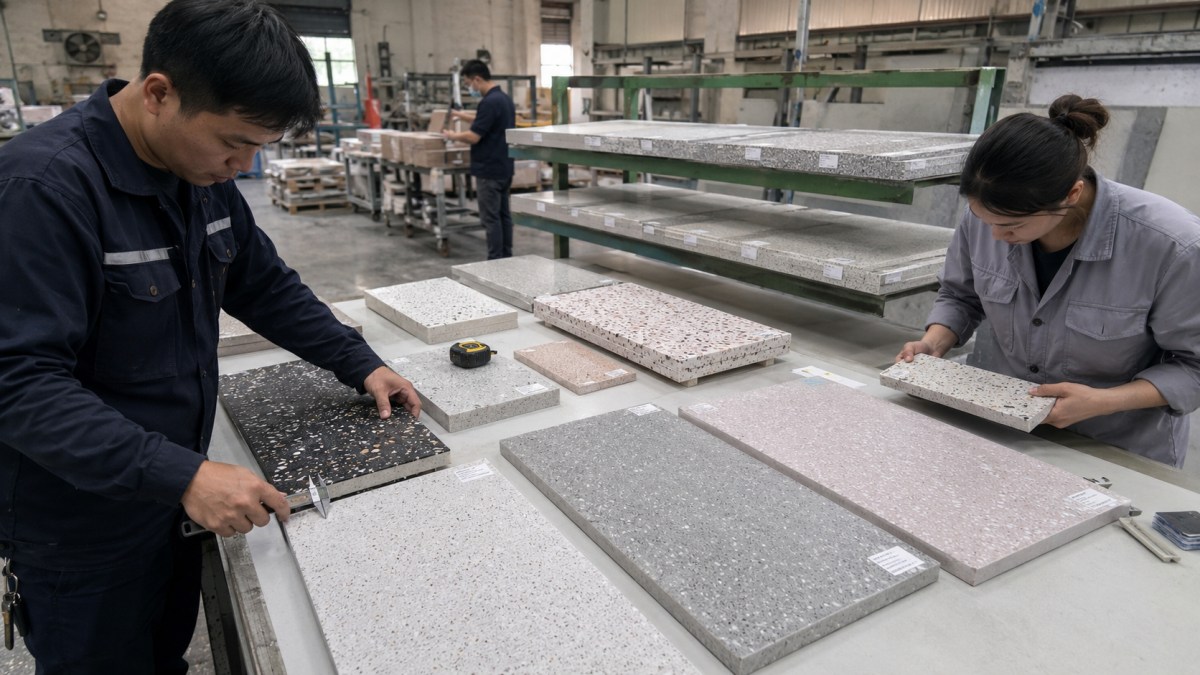
The main advantage is not simply “factory production.” The real advantage is that buyers can review the material before shipment. They can check color range, chip distribution, thickness, surface finish, edge details, dry lay layout, labels, and packing method before the goods leave the factory.
For export projects, this makes precast terrazzo more practical when the buyer needs predictable delivery, clearer installation responsibility, and better pre-shipment evidence.
What Is In-Situ Terrazzo?
In-situ terrazzo, also called poured-in-place terrazzo, is installed directly on site. The terrazzo mixture is placed over the prepared substrate, then cured, ground, filled, polished or honed, and sealed at the project location.
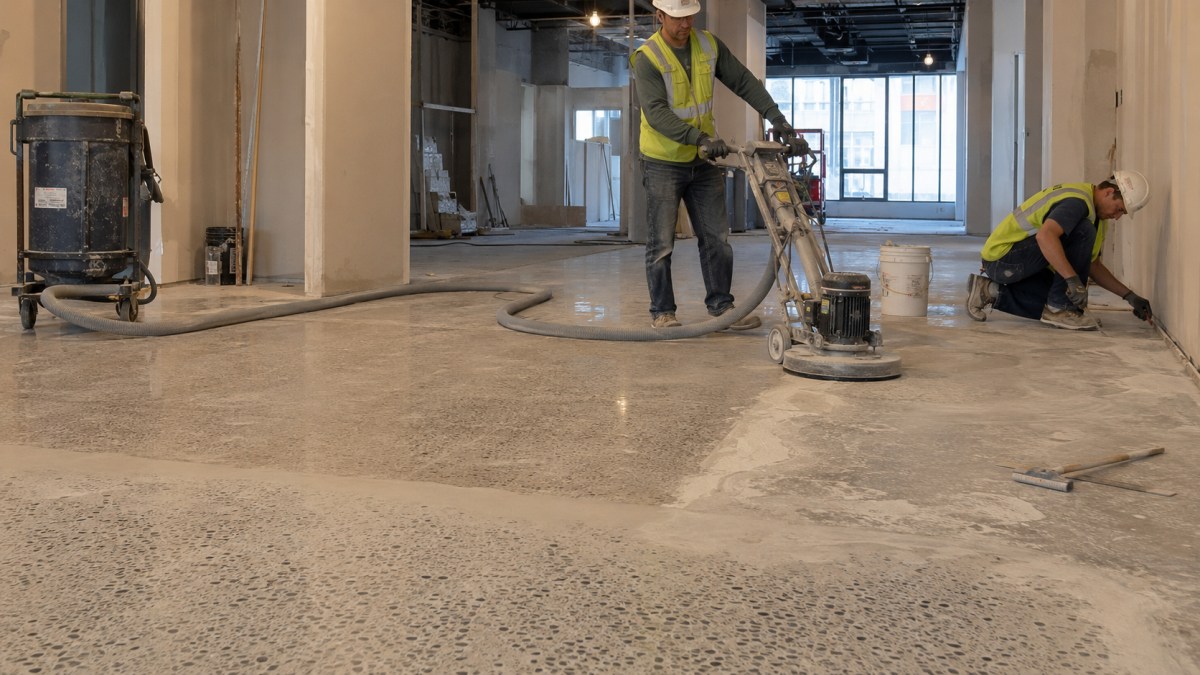
Its strength is visual continuity. It can create large seamless or semi-seamless floor areas, curved patterns, divider strip designs, and site-specific layouts that are difficult to achieve with individual prefabricated pieces. For airports, museums, civic buildings, and large commercial floors, in-situ terrazzo can be a strong option when the local installation team is experienced and the site conditions are well controlled.
But in-situ terrazzo is less suitable when the overseas buyer expects the stone supplier to deliver a finished product ready for shipment. The final quality depends heavily on site workmanship, substrate preparation, curing conditions, grinding skill, sealing, cleaning, and installation management.

Precast Terrazzo vs In-Situ Terrazzo: Key Comparison for International Buyers
|
Decision Point |
Precast Terrazzo |
In-Situ Terrazzo |
|
Production location |
Factory-made before shipment |
Made directly on site |
|
Best use |
Export supply, cut-to-size projects, stairs, wall panels, tiles, countertops, repeatable areas |
Large continuous floors, local landmark projects, custom on-site patterns |
|
Quality control timing |
Can be checked before shipment |
Final quality appears after site installation and finishing |
|
Pre-shipment inspection |
Easier to inspect thickness, finish, color range, labels, packing |
Limited, because most work happens on site |
|
Installation responsibility |
More clearly divided between supplier and installer |
More dependent on site contractor and terrazzo workers |
|
Logistics |
Can be packed, numbered, crated, and shipped |
Raw materials and site labor must be coordinated locally |
|
Schedule control |
Factory production schedule can be planned before shipping |
Depends on site readiness, curing, grinding, and finishing sequence |
|
Design continuity |
Has joints between pieces unless planned carefully |
Better for continuous poured surfaces |
|
Repair and replacement |
Individual pieces may be replaceable if well documented |
Repairs require skilled matching and site finishing |
|
Export suitability |
Usually stronger for international supply |
Usually stronger for local construction execution |
The right answer is not that one system is always better. The right answer depends on whether the project needs a site-formed continuous floor or an export-ready stone package.
When Precast Terrazzo Usually Fits Better
Precast terrazzo is often the better choice when the buyer needs finished material supplied across borders. It is especially suitable for projects where the stone package must be reviewed, approved, packed, and shipped before installation.
Typical situations include:
· Hotel bathrooms, corridors, lobbies, and public areas using terrazzo tiles or panels
· Retail floors and wall areas where consistent modules are easier to install
· Stair treads, risers, skirting, thresholds, and coping pieces
· Countertops, vanity tops, reception desks, and custom furniture pieces
· Projects where the buyer needs pre-shipment photos before container loading
· Projects where local installers are stone installers, not specialist terrazzo casting teams
· Export orders requiring labels, dry lay, numbering, wooden crates, and container loading control
Precast terrazzo is not automatically risk-free. It still requires correct drawings, thickness confirmation, edge protection, packing design, and installation planning. But the main production risk can be checked before shipment, which is a major advantage for international procurement.
When In-Situ Terrazzo May Be the Better Choice
In-situ terrazzo can be more suitable when the project requires a large continuous surface with fewer visible joints. It may also be preferred when the design includes complex divider strips, flowing patterns, or site-specific floor geometry that must be formed directly in the building.
It can work well when:
· The project has an experienced local terrazzo contractor
· The site schedule allows curing, grinding, polishing, and sealing time
· The substrate is properly prepared and stable
· Dust, water, noise, and site access can be controlled
· The designer prioritizes seamless visual continuity over prefabricated installation
· The responsibility for final surface quality is clearly assigned to the site team
The risk begins when an international buyer chooses in-situ terrazzo without a qualified local installation team. In that case, the overseas supplier may provide materials, but the final project quality depends on people and conditions outside the supplier’s direct control.
Buyer Checklist: How to Choose the Right Terrazzo Supply Method
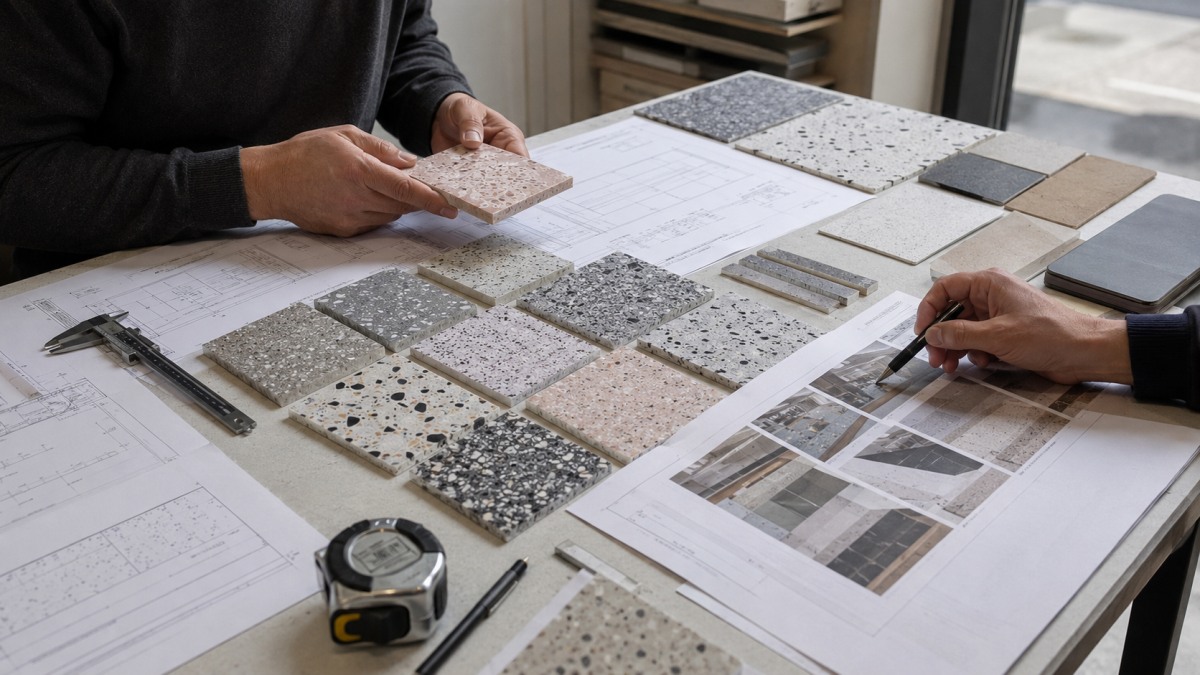
Before deciding between precast and in-situ terrazzo, project buyers should clarify the following questions:
1. Is the terrazzo required as finished pieces, or will it be created on site?
2. Does the project need a continuous floor with minimal joints?
3. Who is responsible for substrate preparation?
4. Who is responsible for grinding, polishing, sealing, and final cleaning?
5. Can the local installer handle poured terrazzo, or only install prefabricated stone pieces?
6. Does the buyer need pre-shipment photos, dry lay photos, labels, and packing evidence?
7. Are there stairs, counters, wall panels, skirting, or custom-shaped pieces that need factory cutting?
8. What thickness, finish, edge detail, and tolerance must be confirmed before production?
9. Will replacement pieces be needed later?
10. Is the project schedule flexible enough for on-site curing and finishing?
If the buyer cannot answer these questions clearly, the terrazzo choice is not ready for final approval.
Red Flags Before Approving a Terrazzo System
A terrazzo proposal should be reviewed carefully if any of the following situations appear:
· The supplier only shows a sample but does not explain the supply method.
· The project team does not know whether the terrazzo will be precast or poured on site.
· The quotation does not clarify thickness, finish, edge details, packing, or installation responsibility.
· The buyer expects seamless in-situ results but has no specialist local terrazzo contractor.
· The installer assumes terrazzo tiles can look exactly like poured-in-place terrazzo.
· No one has confirmed joint layout, dry lay sequence, or area numbering.
· The project requires stairs or counters, but no fabrication drawings are prepared.
· The supplier promises perfect consistency without explaining natural aggregate variation and batch control.
These are not small details. They can lead to color mismatch, uneven joints, installation delay, polishing problems, site disputes, or replacement cost.
A Practical Decision Rule
For international project supply, the simplest rule is this:
Choose precast terrazzo when the buyer needs a finished, inspectable, packable, and export-ready stone package.
Choose in-situ terrazzo when the buyer has a capable local terrazzo contractor and the project requires a continuous poured surface that must be created on site.
This rule is not about promoting one system over another. It is about matching the supply method to the project reality.
What Buyers Should Ask the Supplier Before Production
Before confirming a precast terrazzo order, buyers should ask:
· Can you supply full slab or tile photos before cutting?
· Can you provide dry lay photos for cut-to-size areas?
· How will pieces be labeled by area, floor, room, or drawing number?
· What packing method will be used for tiles, slabs, stairs, or countertops?
· How will exposed edges be protected?
· What surface finish will be delivered before shipment?
· What details must be finished by the installer after arrival?
· What color range or chip variation should be accepted?
Before choosing in-situ terrazzo, buyers should ask:
· Who provides the terrazzo mix design?
· Who controls site pouring, curing, grinding, polishing, and sealing?
· What substrate tolerance is required?
· How will cracks, joints, movement, and divider strips be handled?
· Who is responsible if the final surface does not match the approved sample?
· Is the site schedule long enough for curing and finishing?
· Does the local contractor have real terrazzo project references?
These questions help prevent the most common mistake: approving a terrazzo appearance without approving the delivery method.
FAQ
Is precast terrazzo the same as terrazzo tile?
Not always. Terrazzo tile is one form of precast terrazzo, but precast terrazzo can also include slabs, stair treads, risers, wall panels, countertops, vanity tops, skirting, and custom fabricated pieces.
Is in-situ terrazzo better because it has fewer joints?
It can be better for large continuous floors, but only when the site team has strong terrazzo installation experience. Fewer joints do not automatically mean lower risk.
Can precast terrazzo be used for hotel and commercial projects?
Yes. Precast terrazzo is often suitable for hotels, retail spaces, restaurants, offices, bathrooms, corridors, stairs, wall panels, and furniture applications, especially when the project needs export supply and pre-shipment inspection.
What is the main risk of choosing in-situ terrazzo for an overseas project?
The main risk is that final quality depends heavily on local site workmanship, substrate preparation, curing, grinding, polishing, and sealing. These factors may be outside the overseas material supplier’s control.
What should buyers confirm before ordering precast terrazzo?
Buyers should confirm drawings, thickness, finish, aggregate style, acceptable color range, edge details, piece numbering, packing method, pre-shipment photos, and installation responsibility.
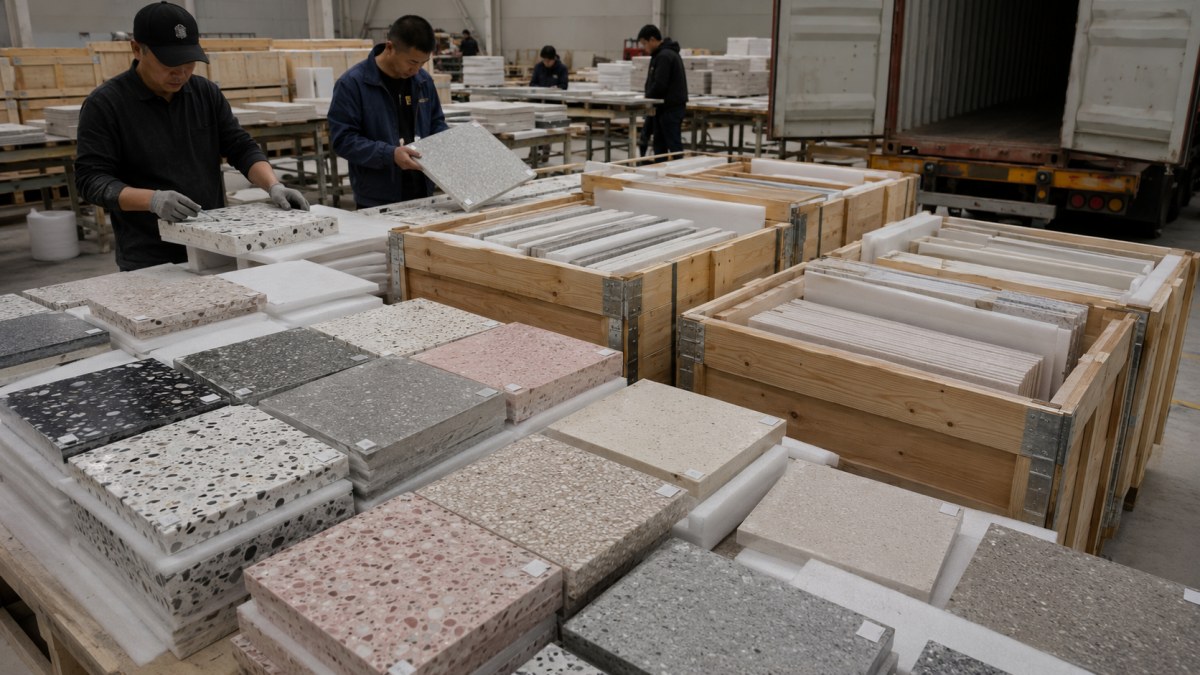
If your project is comparing precast terrazzo and in-situ terrazzo, send the application area, drawings, required finish, thickness, quantity, and installation plan. A technical review can help clarify whether the project is better suited to factory-made terrazzo pieces or a site-installed terrazzo system before production begins.



 IPv6 network supported