English
 Español
 Português
 عربي
عربي 한국어
한국어

Terrazzo design is often judged by color first, but color is only one part of the decision. Aggregate size and chip density can completely change how terrazzo feels in a real project. A terrazzo sample may look calm on a small board, but the same material may feel busy across a hotel lobby floor. Another sample may look too plain in hand, but become elegant when used across a large wall or commercial floor.

For project buyers, designers, and contractors, aggregate size and chip density should not be treated as decoration only. They affect visual scale, sample approval, cutting results, application suitability, maintenance perception, and how the material reads from different distances. Before approving a terrazzo material, the project team should ask whether the design works only as a sample, or whether it still works after being produced, cut, shipped, and installed.
What Aggregate Size Means in Terrazzo
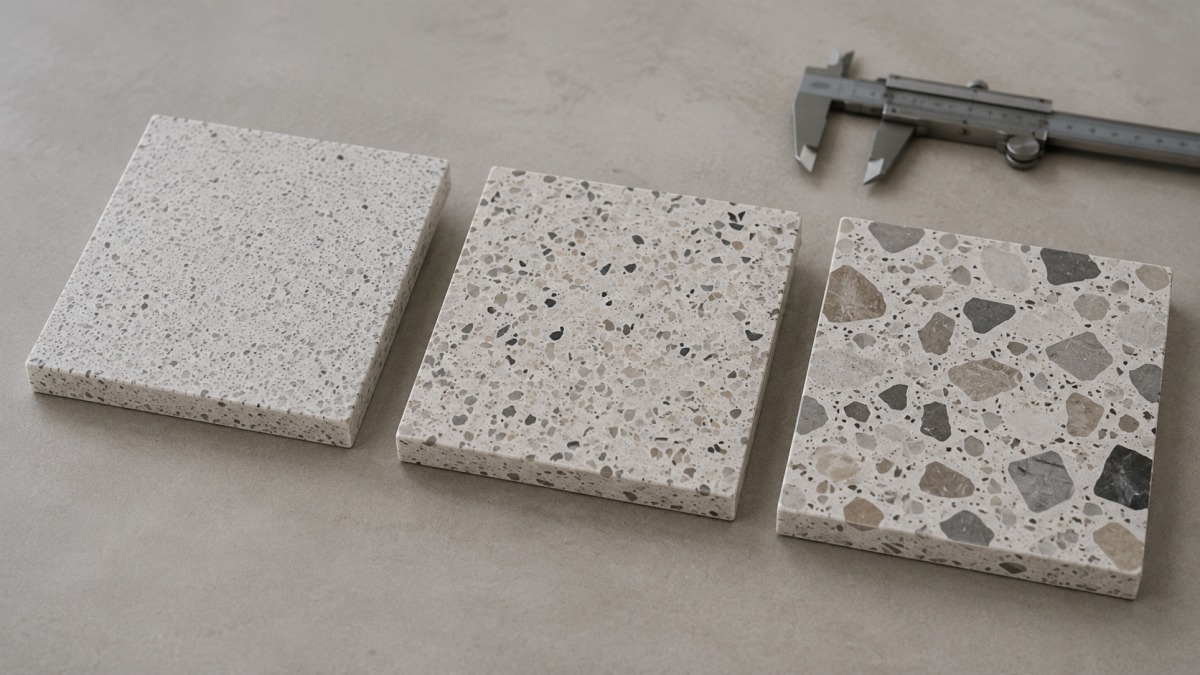
Aggregate size refers to the visible chips inside the terrazzo surface. These chips may be marble, stone, glass, recycled material, or other selected aggregates, depending on the terrazzo type and design. In project communication, aggregate size is usually described as small, medium, large, or mixed-size.
Small aggregate creates a finer and more uniform appearance. It usually feels quieter and is easier to use in repeated areas. Medium aggregate gives more visible texture without becoming too dramatic. Large aggregate creates stronger contrast and a more graphic design effect, especially when the chip color differs from the base color.
The important point is simple: larger aggregate does not only make terrazzo “bolder.” It changes the visual rhythm of the entire space.
A large-chip terrazzo may look impressive in a boutique store, restaurant counter, feature wall, or furniture piece. But it may feel too active in a small bathroom or narrow corridor if the color contrast is strong. A small-chip terrazzo may look too subtle on a sample photo, but it can be more comfortable for large floors, repeated hotel rooms, or public areas where the material should support the space rather than dominate it.
What Chip Density Means in Terrazzo
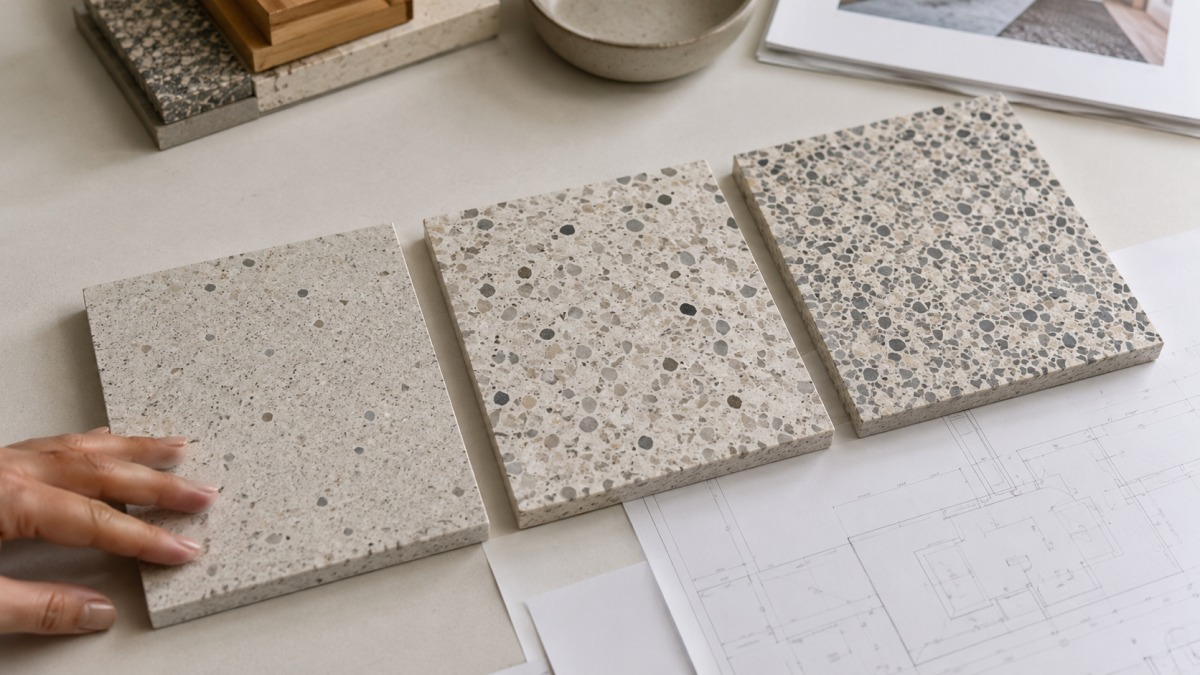
Chip density refers to how many chips appear across the surface and how much base color remains visible between them. Two terrazzo materials can use the same chip size but feel very different if one has high chip density and the other has low chip density.
High chip density means the surface is filled with more visible aggregate. This can create a rich, textured, and active appearance. It may also help reduce the visual impact of small stains, dust, or minor wear because the pattern is already busy.
Low chip density means more base color is visible. This usually creates a cleaner, calmer, more open feeling. However, it may also make surface marks, slight color variation, or isolated chips more noticeable.
Chip density affects how the terrazzo reads from a distance. A dense terrazzo can look like a continuous texture from far away, while a sparse terrazzo may show individual chips more clearly. Neither is automatically better. The right choice depends on the design intent, application area, lighting, viewing distance, and expected level of visual activity.
Why Small Samples Can Be Misleading
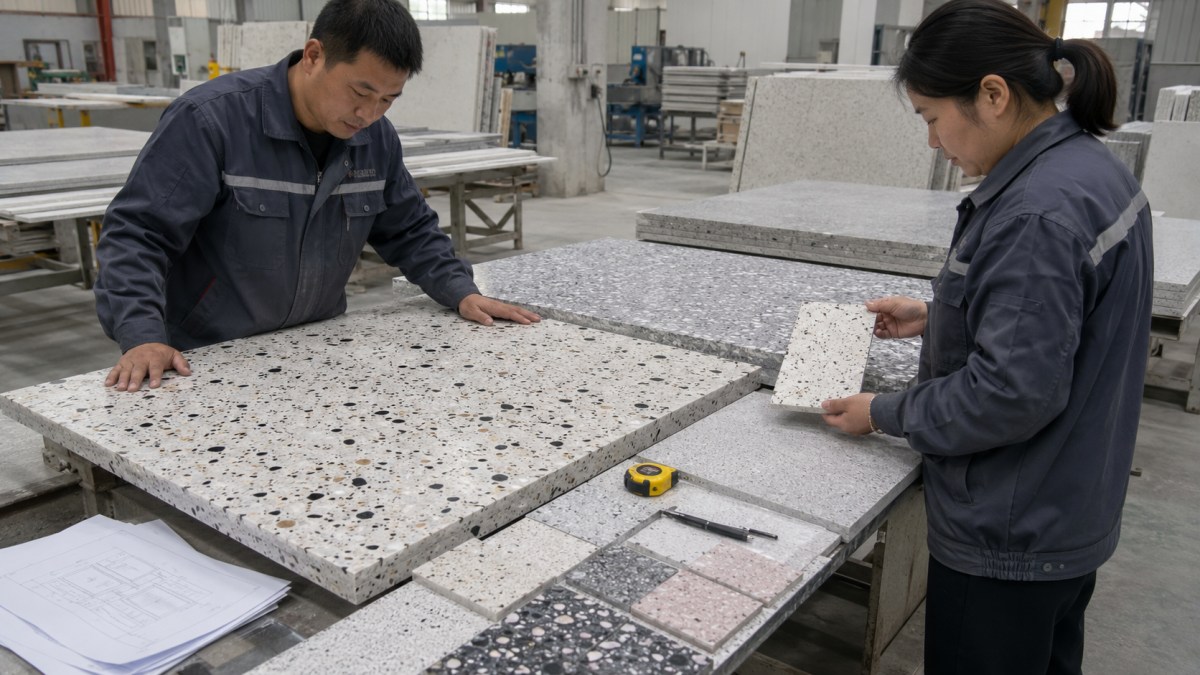
One of the most common mistakes in terrazzo approval is judging the material only from a small sample. A 10 cm or 20 cm sample can show chip color, base color, and surface finish, but it cannot fully show the rhythm of a large area.
A small sample may include only a few large chips. The buyer may approve it because the pattern looks clean, but a full slab or large floor may show a much stronger distribution. The opposite can also happen: a sample may look crowded, but when installed across a large lobby, the pattern becomes balanced and architectural.
This is especially important for terrazzo with large chips or mixed aggregate sizes. The buyer should review a larger sample, full slab photo, tile layout, or mockup when the aggregate size is visually strong.
A terrazzo sample shows the material language. It does not always prove the final design scale.
How Aggregate Size Changes the Design Effect
Aggregate size changes the visual character of terrazzo in several ways.
Small aggregate usually creates a soft and quiet texture. It is often suitable when the project needs a clean background material, especially for large floors, corridors, hotel rooms, apartments, and commercial interiors where the stone should not compete with furniture, lighting, or signage.
Medium aggregate gives a more recognizable terrazzo identity. It can work well in hospitality, retail, restaurants, offices, bathrooms, and public spaces because it offers visible character while still remaining manageable.
Large aggregate creates a statement effect. It can be suitable for feature walls, counters, tabletops, reception areas, boutique interiors, design-led restaurants, and selected flooring zones. But large chips need careful approval because cutting may expose partial chips at edges, joints, stair nosings, sink cutouts, or small fabricated pieces.
The larger the aggregate, the more important the cutting plan becomes.
How Chip Density Changes the Design Effect
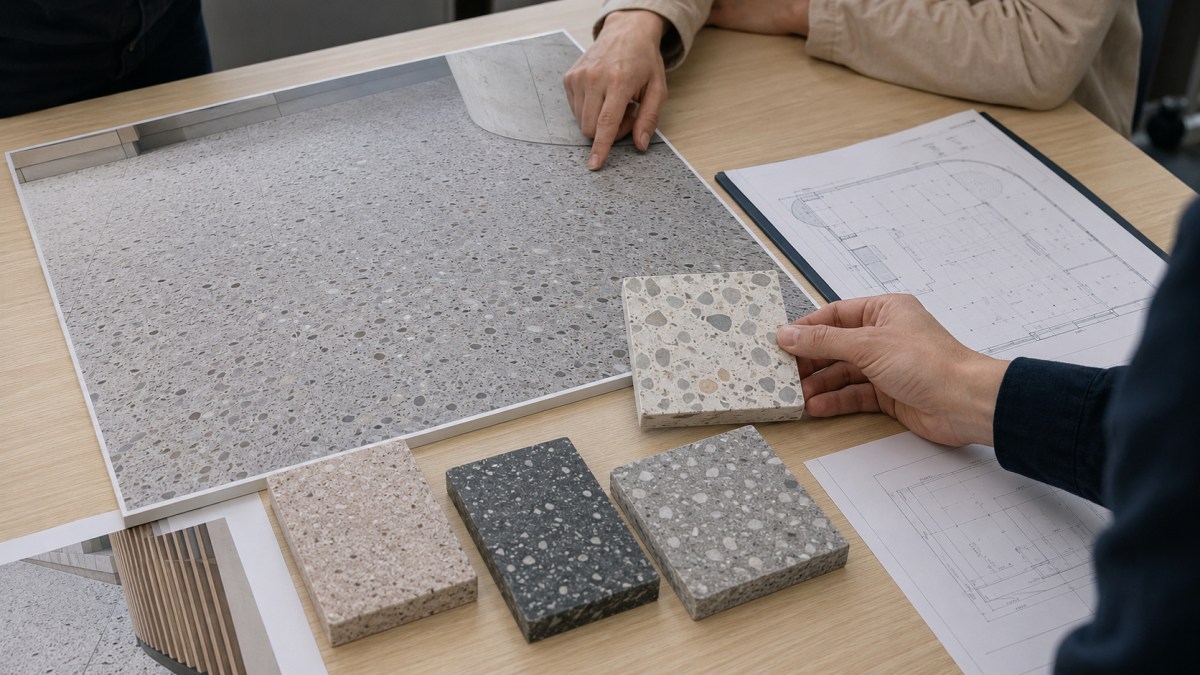
Chip density controls how busy or calm the terrazzo appears.
A high-density terrazzo can feel energetic, decorative, and material-rich. It may fit retail environments, restaurants, branded interiors, creative offices, and feature areas where the surface is part of the design identity. It can also help hide minor daily-use marks better than very plain surfaces.
A low-density terrazzo can feel more minimal, architectural, and calm. It may fit hotels, galleries, residential interiors, bathrooms, and projects where the base color is meant to define the atmosphere. But low-density designs need careful sample approval because the buyer may notice every individual chip more clearly.
The safest choice is not always the quietest design. A material that is too plain may look flat after installation. A material that is too dense may look noisy in a large area. The project team should review the terrazzo according to area size, lighting, and viewing distance.
Aggregate Size and Chip Density: Project Decision Table
|
Design Factor |
Small Aggregate / Lower Density |
Medium Aggregate / Balanced Density |
Large Aggregate / High Density |
|
Visual feeling |
Calm, fine, subtle |
Clear terrazzo character |
Bold, graphic, expressive |
|
Best application |
Large floors, corridors, bathrooms, repeated areas |
Hospitality, retail, offices, restaurants |
Feature walls, counters, furniture, statement floors |
|
Risk in small samples |
May look too plain |
Usually easier to judge |
May not show full distribution |
|
Risk in large areas |
Can feel flat if too quiet |
Usually balanced if color is controlled |
Can feel busy or overwhelming |
|
Cutting concern |
Lower visual impact at edges |
Moderate edge impact |
Higher risk of partial chips at edges and cutouts |
|
Replacement concern |
Usually easier to visually blend |
Depends on batch control |
More difficult if large chips vary strongly |
|
Buyer approval need |
Sample + finish review |
Sample + larger photo recommended |
Larger sample, slab photo, mockup, or dry lay strongly recommended |
This table is not a fixed rule. It is a decision tool. A large aggregate terrazzo can work beautifully in a large floor if the color palette is controlled. A small aggregate terrazzo can look premium if the base color, finish, and installation are well designed.
The key is not chip size alone. The key is whether the chip size and density fit the project intent.
Application Area Matters
The same terrazzo design can behave differently depending on where it is used.
For flooring, the project team should consider walking distance, joint layout, cleaning method, and how the surface looks from standing height. High contrast and high density may create strong energy, but they can also make a narrow space feel visually crowded.
For wall panels, the viewer sees the surface more directly. Larger chips may become more noticeable and can work as a design feature. However, panel size, joint alignment, and edge finishing become important.
For stairs, large aggregate requires special attention. Stair treads, risers, nosings, and edges may cut through chips in visible ways. A pattern that looks good on a flat sample may not look the same on a stair profile.
For countertops and furniture, large aggregate can be attractive because people view the surface at close range. But sink cutouts, edge profiles, and corner details must be reviewed before production.
For bathrooms, the project should avoid choosing a terrazzo that is too visually aggressive for a small space unless the design intentionally wants that effect. Surface finish and cleaning requirements should also be confirmed.
Buyer Checklist Before Approving Aggregate Size and Chip Density
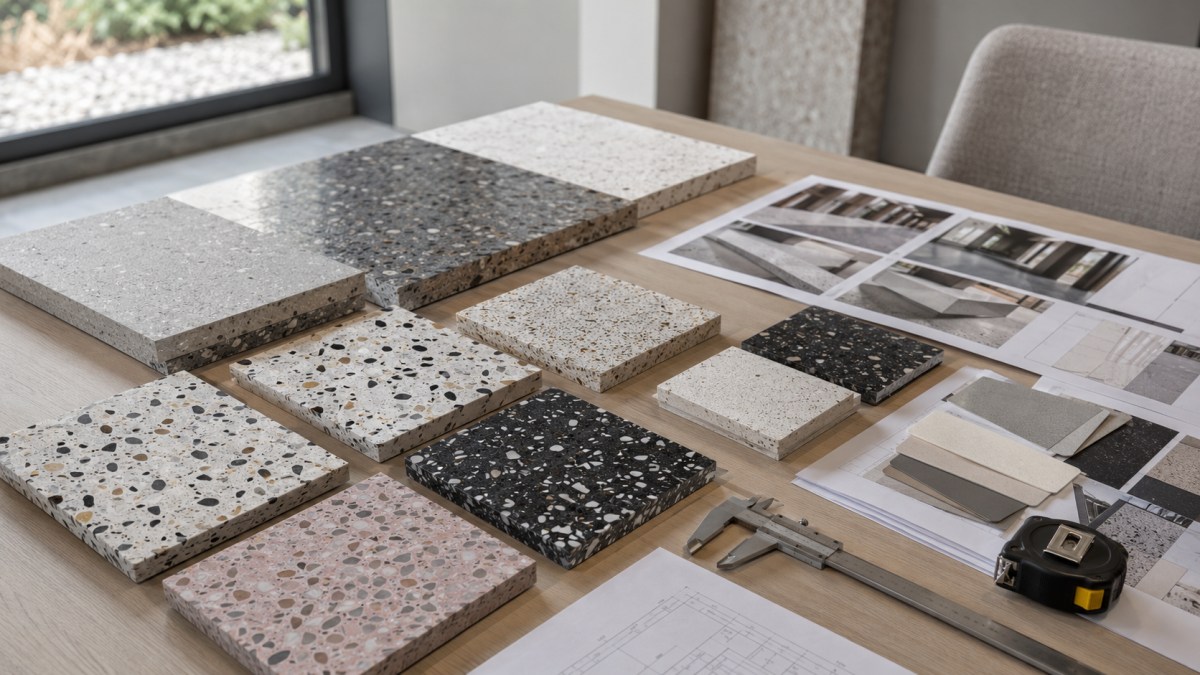
Before confirming a terrazzo design, buyers should clarify:
1. Is the terrazzo used for floor, wall, stair, counter, bathroom, furniture, or exterior-related area?
2. What is the viewing distance: close-up, walking distance, or large open-space viewing?
3. Is the project trying to create a calm background or a strong design feature?
4. Is the aggregate size small, medium, large, or mixed?
5. Is the chip density low, balanced, or high?
6. Does the approved sample show enough of the chip distribution?
7. Is a larger sample, full slab photo, tile layout, or mockup needed?
8. Will cutting expose large partial chips at edges, corners, stair nosings, or sink cutouts?
9. Does the project require batch consistency across multiple rooms or floors?
10. Will the surface finish change the visual contrast of the chips?
11. Does the grout or joint layout affect the final reading?
12. Has the designer approved how the terrazzo looks at full project scale?
If the buyer cannot answer these questions, the material may not be ready for production approval.
Red Flags in Terrazzo Design Approval
A terrazzo design should be reviewed carefully if any of the following situations appear:
· The project approves a large-chip terrazzo from a very small sample only.
· The buyer chooses chip density only because it looks attractive in a close-up photo.
· No one checks how the material will look across a full floor or wall.
· The design has large chips, but the project includes many small cut pieces.
· The terrazzo is used for stairs, but edge exposure has not been reviewed.
· The supplier and buyer have not clarified acceptable chip distribution.
· The project expects every tile or slab to look exactly the same.
· The designer wants a calm space but selects very high-density, high-contrast chips.
· The buyer expects dramatic aggregate but approves a low-density sample.
· No mockup or larger reference is requested for a visually strong terrazzo design.
These problems usually appear after production or installation, when they are much more expensive to correct.
A Simple Design Rule
For larger areas, review terrazzo from a distance, not only as a close-up sample.
For small spaces, check whether the chip scale feels too large.
For stairs, counters, and cut-to-size pieces, check how the aggregate will appear at edges, cutouts, and profiles.
For high-density terrazzo, confirm that the design does not become too noisy.
For low-density terrazzo, confirm that the surface does not become too plain or visually empty.
The best terrazzo choice is not the one with the most dramatic chips. It is the one whose scale still feels right after installation.
What Buyers Should Ask the Supplier Before Production
Before approving a terrazzo order, buyers should ask:
· Can you provide a larger sample or full slab photo for review?
· Can you show the expected chip size and density more clearly?
· Is the approved sample representative of normal production?
· What variation should be expected between pieces?
· Will large chips appear at cut edges or profiles?
· Can the material be dry laid or photographed before shipment?
· Is this aggregate size suitable for the application area?
· Is the selected finish likely to make the chips look stronger or softer?
· How should replacement pieces be managed if needed later?
These questions help turn terrazzo approval from a visual preference into a project decision.
FAQ
Does larger aggregate make terrazzo better?
No. Larger aggregate creates a stronger design effect, but it is not always better. It depends on the application area, viewing distance, cutting details, and design intent.
Is high chip density more durable?
Chip density mainly affects visual appearance, not automatically durability. A dense pattern may hide small marks better, but performance also depends on terrazzo type, finish, sealing, maintenance, and installation.
Why does terrazzo look different in a sample and in a full area?
A small sample cannot always show full chip distribution, pattern rhythm, or large-area visual scale. This is especially true for large aggregate or mixed-size terrazzo designs.
What aggregate size is best for commercial floors?
There is no single best size. Small or medium aggregate is often easier to control for large floors, while large aggregate can work when the design intentionally wants a strong visual statement and the layout is carefully reviewed.
Should buyers request a mockup before approving terrazzo?
For visually strong terrazzo, large aggregate, high contrast chips, or important public areas, a larger sample, slab photo, tile layout, or mockup is strongly recommended before final production.
If your project is reviewing terrazzo aggregate size and chip density, send the application area, design intent, sample preference, finish, thickness, quantity, and expected piece size. A material review before production can help confirm whether the selected terrazzo scale will work in the final project, not only on a small sample.



 IPv6 network supported