English
 Español
 Português
 عربي
عربي 한국어
한국어

A single attractive limestone sample should not be treated as the complete visual standard for a large natural-stone order.
Before fabrication begins, the project team should define a representative acceptable material range using current stone. That range should make clear which changes in background tone, fossils or grain, pores, natural markings and finish are acceptable—and where additional review is required.
This matters because natural stone is not a repeatable manufactured surface. Two pieces from the same limestone may belong to the same material family while still showing noticeable differences.
The practical objective is therefore not to eliminate all variation.
It is to define the variation the project can accept before production makes that decision expensive to change.
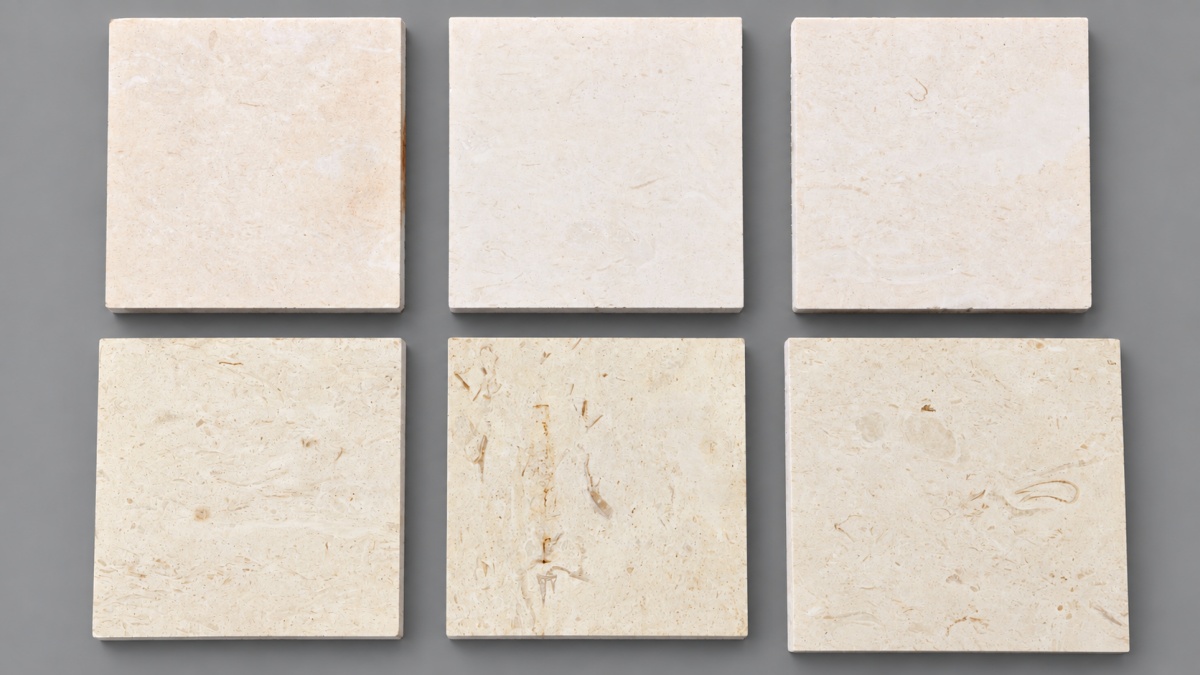
This article uses a practical review framework for limestone projects. It is not an industry testing standard and does not replace project specifications, physical sample approval or the responsible architect's or consultant's requirements.
A small sample is useful.
It can help a buyer review:
· General background color.
· Surface finish.
· Local fossil or grain character.
· Small pores and mineral features.
· Texture at close viewing distance.
But a small sample cannot show how these characteristics are distributed across dozens of slabs or hundreds of cut-to-size panels.
This difference has caused real project disputes.
Natural Stone Institute technical Q&A records a case in which a designer received a set of travertine range samples, selected the preferred piece and rejected the others, while the contractor expected the entire set to define the acceptable range.
The underlying problem was not whether one piece was more attractive.
It was that a single preferred piece and an approved production range perform different jobs.
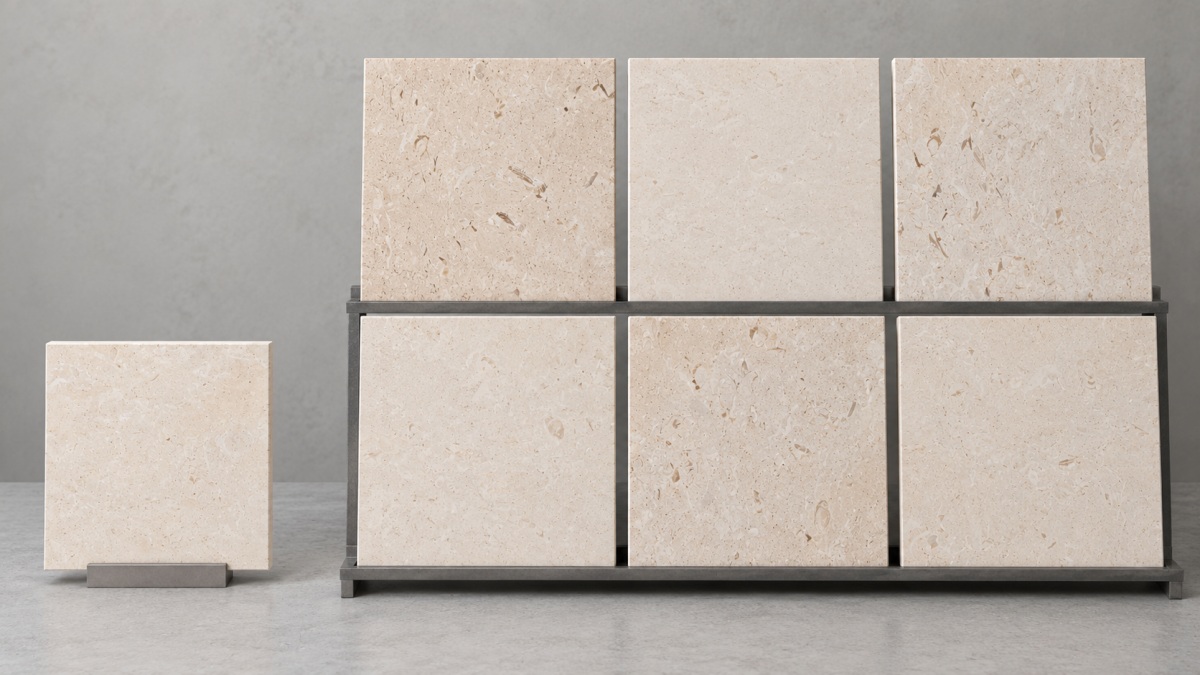
For limestone projects, the useful question is therefore not:
“Do I like this sample?”
It is:
“Does the material proposed for production remain inside the range the project has agreed to accept?”
An approved range is a visual reference for the natural variation that may reasonably appear in the material being supplied.
Depending on the limestone, that may include variation in:
· Background lightness and warmth.
· Fossil concentration.
· Fossil size or visual activity.
· Grain direction and grain density.
· Natural pores.
· Mineral speckles.
· Fine sedimentary markings.
· Local tonal clouds.
· Surface texture and finish response.
The relevant characteristics depend on the stone.
A fossil limestone such as Moonlight Beige should not necessarily be approved using exactly the same criteria as a strongly directional wood-grain limestone.
For Moonlight Beige, background tone, fossil distribution and pore visibility may be important.
For French Wood Grain Limestone, line direction, line density and panel-to-panel visual movement may deserve more attention.
This is why a useful range approval starts with the actual material character, not a generic natural-stone checklist.
A sample kept in an architect's library can remain useful for early material selection, but it may not represent the material available for the current project.
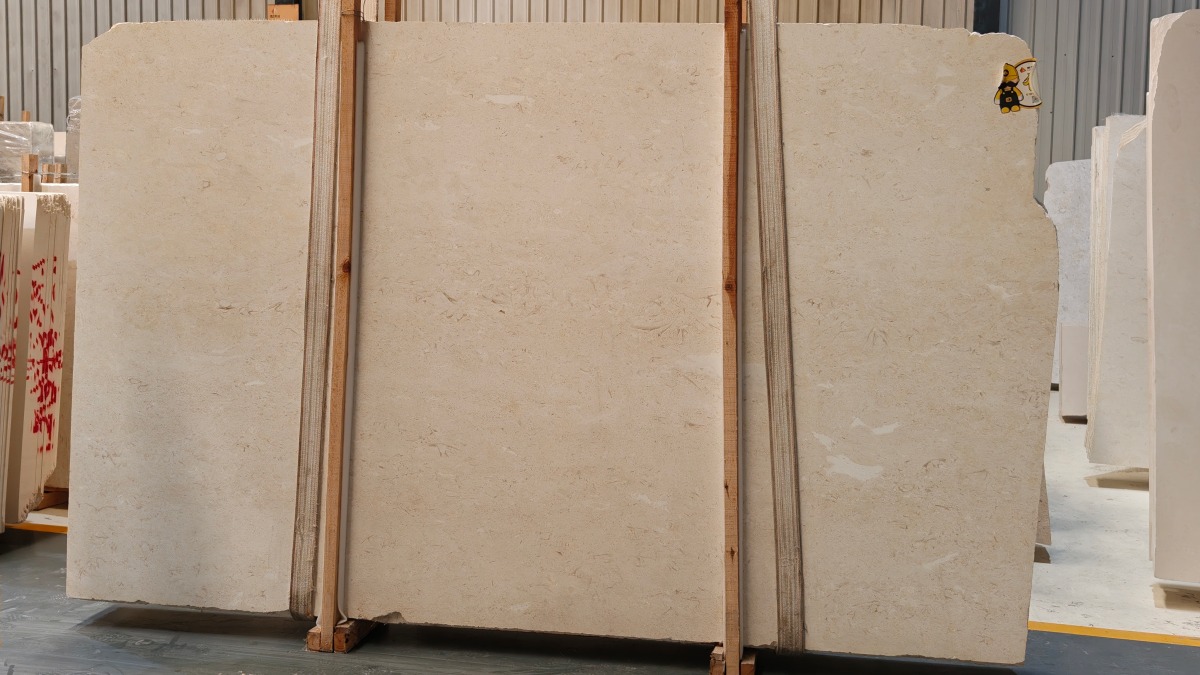
Quarry position, block availability and current slab selection can change.
For a project approaching quotation or production, review evidence from the material currently being proposed whenever possible.
Useful evidence can include:
· Recent full-slab photographs.
· Representative physical samples.
· Several pieces showing the proposed range.
· Current block or slab references where available.
· The actual selected finish.
· Current quantity and availability information.
Polycor's current guidance for design professionals similarly recommends working from current samples and defining a realistic acceptable range instead of assuming an old library sample still represents present quarry output.
The principle is simple:
Historical reference helps identify a stone. Current material should define the production decision.
“Beige limestone” is not a sufficiently precise approval instruction.
A useful review should consider the limits of the background tone.
For example:
Lightest acceptable direction → typical direction → warmest or darkest acceptable direction
The project does not necessarily need numerical color values.
It does need enough representative evidence for the buyer, supplier and fabrication team to recognize when a piece remains inside the agreed visual direction.
Questions to ask include:
· How light can the stone become?
· How warm can it become?
· Are cooler or greyer pieces acceptable?
· Are localized darker areas acceptable?
· Does the project require tone grouping between adjacent panels?
· Are some architectural zones more visually sensitive than others?
The objective is not perfect uniformity.
The objective is to avoid discovering during production that the buyer's meaning of “light beige” and the supplier's meaning of “light beige” are different.
Two limestone pieces can have a very similar background tone and still look very different because of their fossil or grain structure.
For fossil limestone, review:
· Fossil density.
· Fossil size.
· Distribution across the face.
· Areas with unusually concentrated fossil activity.
· Relationship between fossils and the surrounding quiet background.
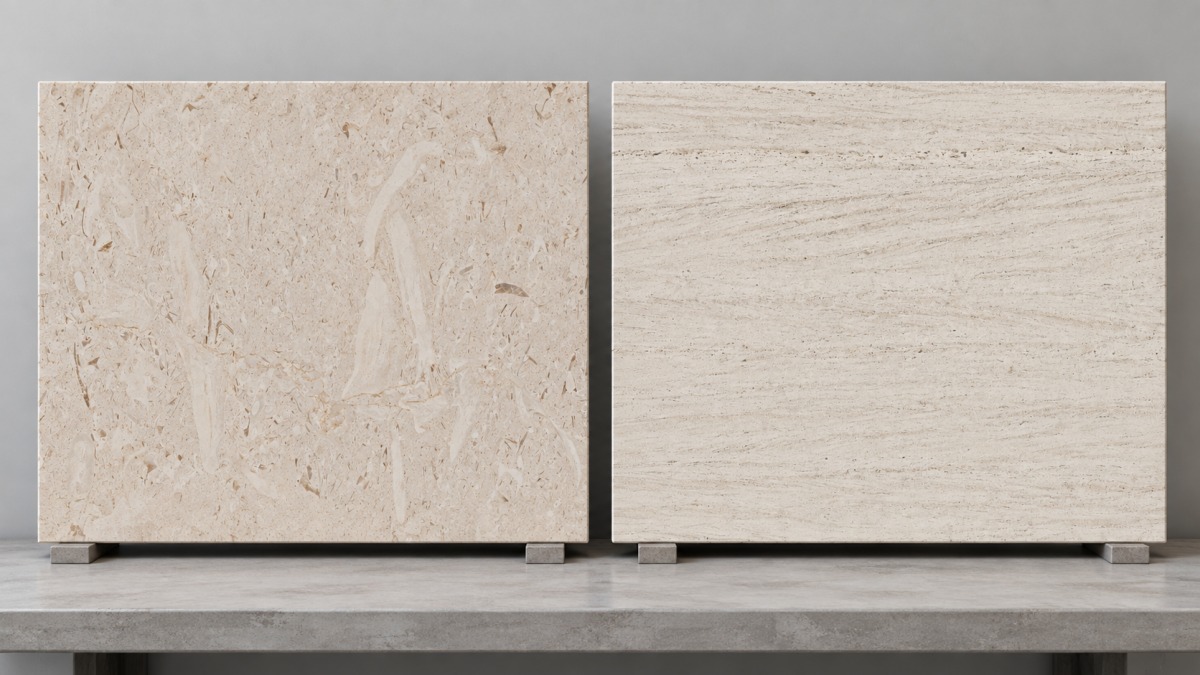
For directional limestone, review:
· Direction of movement.
· Strength of linear grain.
· Dark-to-light line contrast.
· Local changes in grain density.
· Whether adjacent pieces need coordinated orientation.
This distinction matters because “color approved” does not automatically mean “overall visual character approved.”
A project can receive the correct beige tone and still appear too active if the fossil concentration or directional movement differs from what the design team expected.
Natural pores, small open features, mineral marks and sedimentary details can be part of genuine limestone character.
But the phrase:
“Natural variation is acceptable”
is too vague to function as a production standard.
Natural origin does not automatically mean every visible feature is acceptable for every project.
A better approach is to review representative examples.
The project team can identify:
· Examples that are clearly acceptable.
· Typical examples.
· Stronger natural features that remain acceptable.
· Features that require separate review.
· Conditions the project does not wish to accept.
Avoid inventing universal limits such as:
“pores under X mm are acceptable”
unless those limits come from the actual project specification or an agreed written requirement.
Photographic and physical references are often more useful for visual characteristics than an undefined phrase such as “minor pores allowed.”
Material range and surface finish should not be treated as completely separate decisions.
The same limestone can appear noticeably different after:
· Honing.
· Brushing.
· Sandblasting.
· Bush hammering.
· Tumbling.
· Other mechanical surface treatments.
A finish may change:
· Apparent lightness.
· Fossil visibility.
· Pore visibility.
· Surface contrast.
· Texture.
· Reflection and sheen.
For this reason, a honed sample should not automatically define the final visual expectation for a sandblasted order.
Where practical, the range review should use the finish intended for production or clearly state when the visual reference uses a different finish.

Close-up photography is useful, but it can distort how important individual natural features feel.
A fossil that looks dominant from 20 cm away may become a minor detail once it is installed across a large wall.
At the same time, a slight background-tone shift that seems insignificant on two small samples may become obvious when repeated across many square metres.
A practical review can therefore consider three scales:
Close range
Review fossils, pores, grains, repairs if present, finish texture and natural surface details.
Panel or slab range
Review overall balance, tone, fossil or grain distribution and whether natural features are concentrated in particular areas.
Architectural distance
Review large-area tone, panel rhythm, grouping and whether the material supports the intended architectural effect.
No single viewing distance answers every approval question.
A common approval mistake is selecting the cleanest, lightest or most visually attractive piece and treating it as the standard for the entire order.
That changes a range approval into a cherry-picking instruction.
For some projects, a tightly controlled appearance is genuinely necessary.
But the project should understand the commercial consequence.
A narrower acceptable range can mean:
· More slab or block rejection.
· Lower usable material yield.
· More sorting.
· Reduced available quantity.
· Longer selection or production time.
· Greater difficulty finding future replacement pieces.
· Higher material cost.
Polycor's current stone-range guidance makes the same commercial point: tighter range control generally reduces usable quarry output and can increase cost and lead time.
The practical objective is therefore not:
“Approve the narrowest range possible.”
A better objective is:
“Approve the narrowest range the design actually requires and the supply can realistically support.”
The following framework can help a project team discuss natural variation before fabrication.
|
Character |
Lower / quieter limit |
Typical direction |
Upper / stronger limit |
Outside approved range |
|
Background tone |
Lightest accepted |
Typical project tone |
Warmest/darkest accepted |
Clearly outside agreed tone |
|
Fossil density |
Sparse accepted |
Typical fossil level |
Fossil-rich accepted |
Beyond agreed concentration |
|
Grain movement |
Lowest accepted activity |
Typical movement |
Strongest accepted movement |
Visually outside agreed direction |
|
Pores / natural features |
Low |
Typical |
Strongest accepted example |
Requires separate review |
|
Finish appearance |
Approved surface reference |
Normal production direction |
Allowed finish variation |
Visibly inconsistent with approved reference |
This is a practical project-discussion framework, not an international stone classification standard.
The categories should be adapted to the actual limestone and the project's design requirements.
A typical sample shows the centre of the range.
It does not show the boundaries.
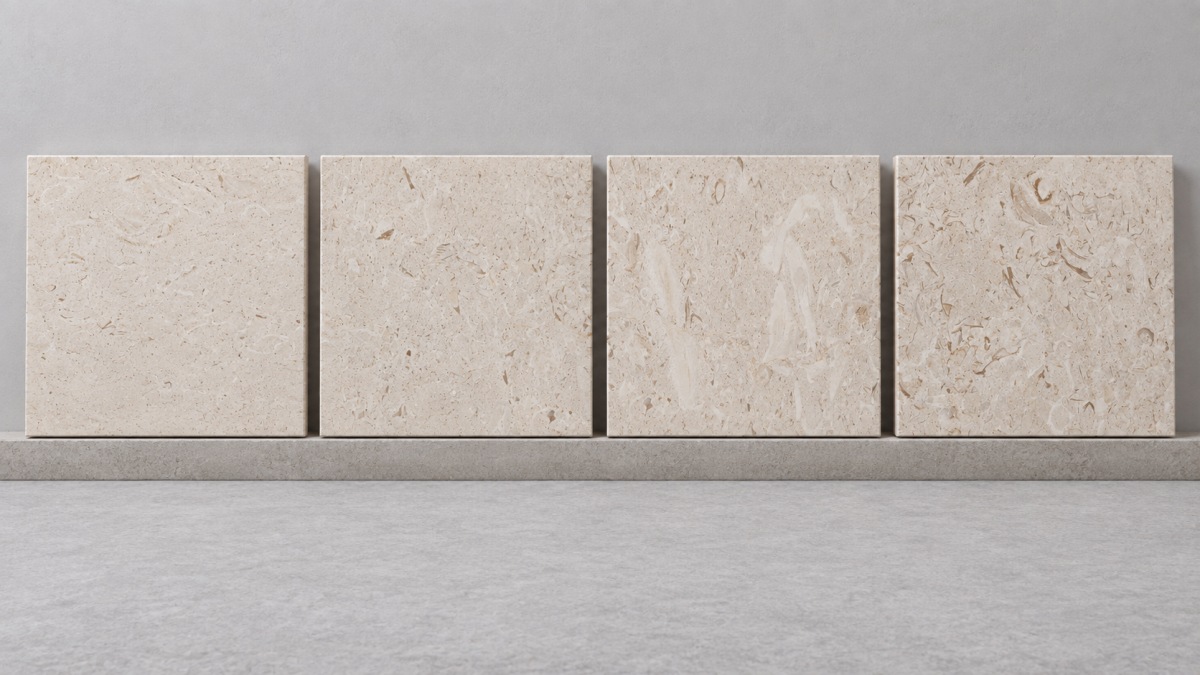
For production control, a more useful concept is an approval envelope:
lower acceptable limit → typical material → upper acceptable limit
For example:
Background tone:
light → typical → warm
Fossil character:
sparse → typical → fossil-rich
Natural pores:
low → typical → highest accepted reference
This approach reduces the risk of two different interpretations later.
The supplier understands what material can reasonably enter production.
The buyer understands that acceptable material is a range rather than a single cloned appearance.
A verbal “approved” message can become difficult to interpret several months later.
A better approval record can include:
|
Item |
Why It Matters |
|
Material name |
Identifies the stone being reviewed |
|
Current source / lot reference where relevant |
Connects approval with current supply |
|
Approval date |
Prevents confusion with older samples |
|
Surface finish |
Finish affects visual appearance |
|
Sample or photograph IDs |
Makes the references traceable |
|
Full-slab photographs |
Shows large-format character |
|
Range-set photograph |
Shows variation between pieces |
|
Light / dark tone references |
Defines color limits |
|
Fossil or grain references |
Defines visual activity |
|
Pore / natural-feature references |
Defines acceptable natural character |
|
Examples requiring separate review |
Clarifies the boundary |
|
Approval party |
Records who made the decision |
|
Approximate project quantity |
Helps judge whether the range is realistic |
The record does not need to become unnecessarily bureaucratic.
Its purpose is simply to ensure that the same visual decision can still be understood when production begins.
Range approval has limited value if it remains only in an email or sample room.
Once the visual range is agreed, it should inform the production process.
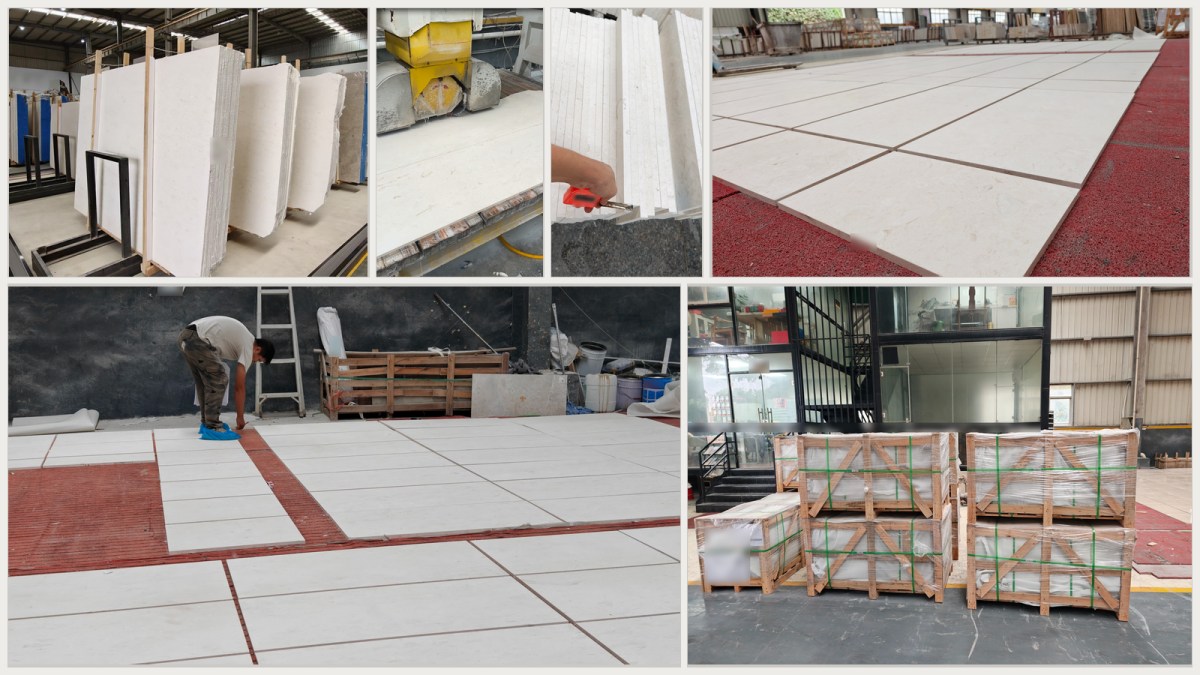
A practical stone production workflow can look like this:
1. Review current material
Confirm that the proposed slabs or blocks remain relevant to the approved direction.
2. Retain the approval references
Keep the approved samples, photographs or range documentation accessible to the people selecting material.
3. Select production material
Compare production slabs with the approved range instead of relying only on the product name.
4. Fabricate
Cut according to confirmed dimensions and drawings.
5. Review cut pieces where required
For visually sensitive projects, cut pieces may require additional grouping or review.
6. Dry lay where it adds value
Dry lay can help evaluate adjacent-piece relationships, tone grouping, fossil distribution and sequence.
It should not be represented as proof of structural or installed engineering performance.
7. Number pieces when sequence matters
Piece numbers can connect the approved arrangement to packing and installation information.
8. Pack according to the agreed project requirements
Packing should protect the pieces and, where necessary, maintain the information required for installation sequence.
The important principle is continuity:
Approval → selection → fabrication → visual review → numbering → packing
Each stage should preserve the decision made at the previous stage.
These two steps answer different questions.
Range approval asks:
What natural material variation may enter the project?
Dry lay asks:
How do the actual fabricated pieces relate to one another?
A stone may be inside the approved range but still benefit from rearrangement because several darker or more fossil-rich pieces have accidentally been grouped in one area.
Dry lay can therefore be useful after range approval.
But it should not be used as a substitute for defining the range in the first place.
Large and phased projects require additional care.
Suppose a project orders the first 800 m² now and another 500 m² later.
Natural stone supply should not automatically be assumed to remain visually identical indefinitely.
Future material may come from:
· A different block.
· A different quarry position.
· A different production period.
· A slightly different available tone range.
For phased work, discuss early:
· Whether all phases should be reserved or produced together.
· Whether replacement pieces may be needed later.
· Which areas are visually adjacent.
· Whether future material needs a new range review.
· How retained samples or approval records will be used.
The same principle applies to maintenance stock.
If future replacement is important, include that requirement during the original material discussion rather than assuming a future batch will duplicate the current one exactly.
Before authorizing fabrication, confirm:
· The actual limestone being supplied.
· The current available material range.
· The final surface finish.
· The acceptable background-tone limits.
· Fossil, grain or visual-movement limits.
· Pores and natural-feature expectations.
· Full-slab or full-format references where needed.
· Representative range samples or photographs.
· Any zones requiring tighter visual control.
· Project quantity.
· Whether the project is single-phase or phased.
· Whether future replacement material is expected.
· Whether cut-piece dry lay is required.
· How the approval references will be recorded.
· Who has authority to approve or reject visual range.
If several of these questions are still unresolved, beginning fabrication may simply transfer an approval problem into production.
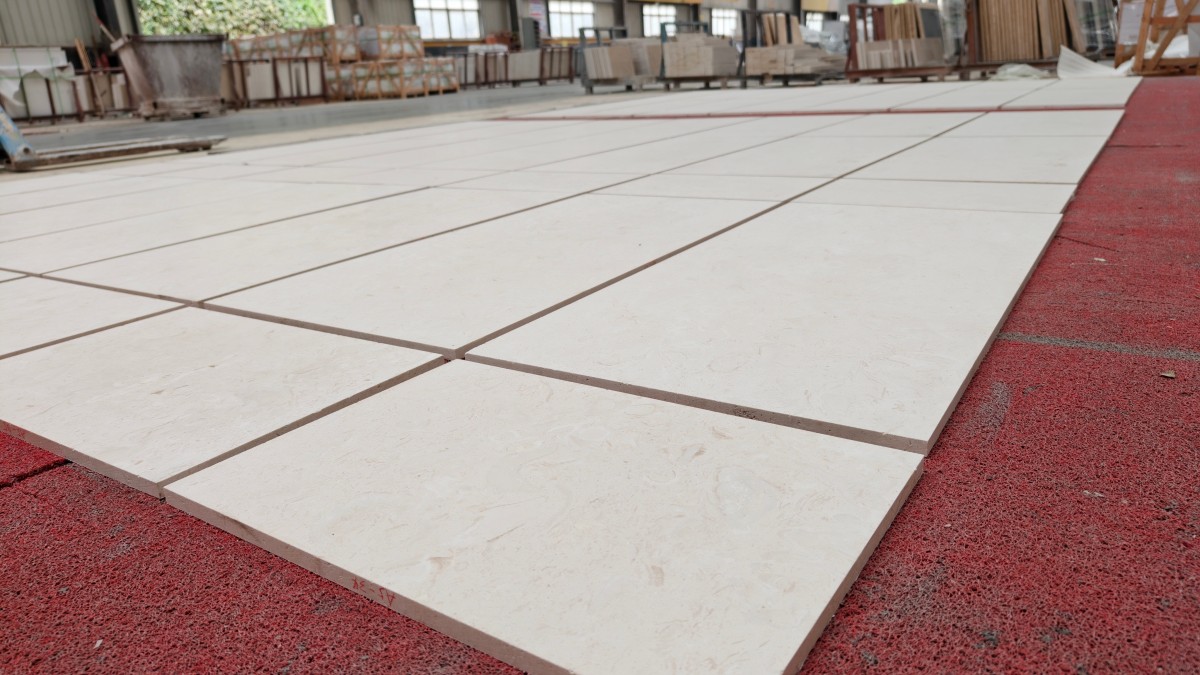
Natural limestone should neither be sold as perfectly uniform nor accepted without boundaries simply because it is natural.
A stronger project approach sits between those two extremes.
Accept genuine natural variation, but define the variation the project has actually approved.
That definition should be based on current representative material and should remain usable when slabs are selected, pieces are cut and finished work is reviewed.
For architects, contractors and project buyers, this creates a clearer basis for material approval.
For fabricators and suppliers, it creates a more workable production reference.
And for both sides, it reduces the risk that one attractive sample becomes an unrealistic expectation for an entire natural-stone project.
This guidance combines current natural-stone industry discussions about range approval with practical fabrication and material-review considerations.
Natural Stone Institute technical Q&A has documented disputes arising from misunderstanding range samples, while current commercial stone-specification guidance emphasizes reviewing representative current material rather than relying on a single promotional sample.
For Moonlight Beige Limestone specifically, project review should consider current slab appearance, background tone, fossil concentration, pore visibility and the required finish. Aoli Stone's existing material references also distinguish current Moonlight Beige source directions and recommend reviewing the actual proposed material rather than treating source names as permanent quality grades.
If you are preparing a limestone project for approval, send the supplier:
· Material reference.
· Required quantity.
· Application.
· Surface finish.
· Drawings or size information where available.
· Project visual target.
· Any previous approved samples or reference photographs.
Ask for current representative material evidence before defining the production range.
Where appropriate, Aoli Stone can provide current slab or material references for review and coordinate approved visual requirements with cut-to-size production, dry lay, numbering and export packing.
The final material range should remain a project approval decision—not a marketing photograph chosen after production has already begun.



 IPv6 network supported