English
 Español
 Português
 عربي
عربي 한국어
한국어

A stone project can still go wrong after the material arrives safely.
This is one of the most overlooked risks in international stone supply.
The supplier may produce the correct stone. The factory may dry lay the pieces, pack them carefully, load the container properly, and send clear shipment records. But when the crates arrive at the jobsite, the next stage begins: unloading, moving, temporary storage, sorting, protection, and installation preparation.
If this stage is handled poorly, good stone can still be damaged before it is installed.
Corners can chip. Polished faces can scratch. Cutouts can crack. Labels can fall off. Natural marble pieces can lose their sequence. Quartz countertops can be placed with poor support. Limestone can be stained by a wet site. Terrazzo pieces can be mixed between areas. Sintered stone panels can be handled like ordinary tiles and damaged at the edge.
This is why stone site storage before installation deserves serious attention.
It is not only a site management issue. It is part of the stone project quality-control chain.
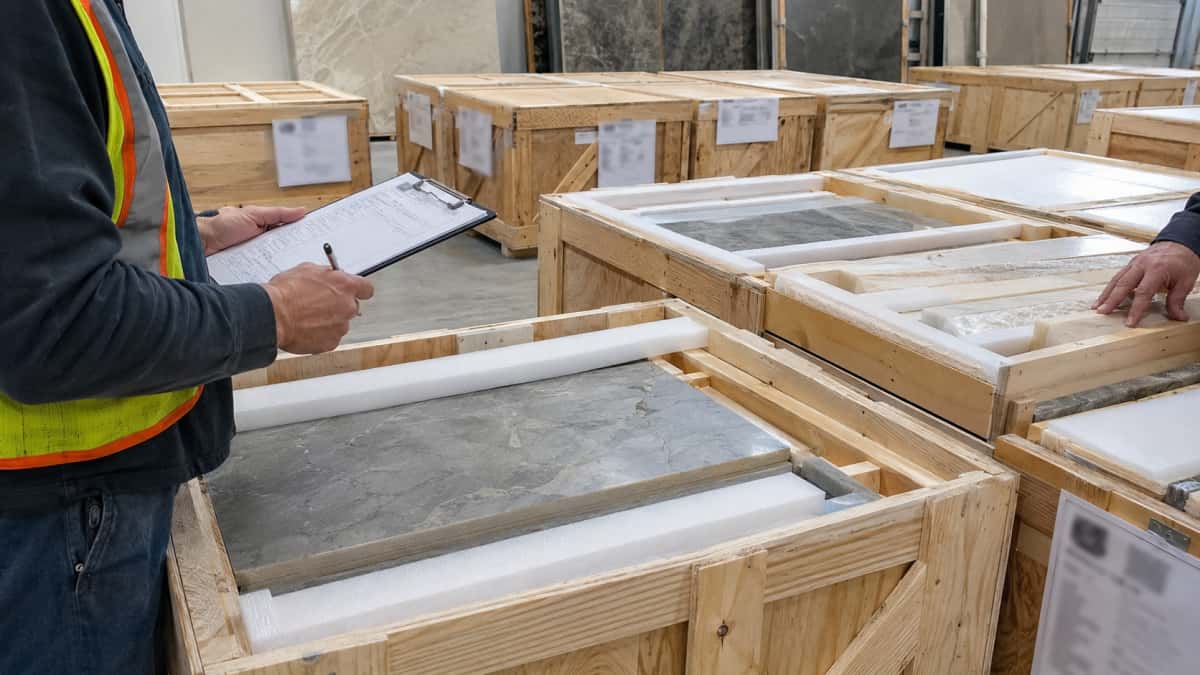
1. Unloading should be planned before the truck arrives
Stone unloading and storage should not be decided at the last minute.
Before the truck or container arrives, the buyer or contractor should already know where the crates will go, who will unload them, what equipment is needed, and how the site team will identify each crate.
This is especially important for heavy stone crates, large-format panels, countertops, stair pieces, wall cladding, or mixed-material shipments.
Before unloading, the project team should confirm:
access route to the site
unloading location
ground condition
forklift, crane, pallet jack, or other suitable equipment
trained handling team
temporary storage area
weather protection if unloading outdoors
crate sequence
packing list availability
installation area codes
safety responsibility
whether the site is ready to receive stone
The buyer should not assume that “the goods arrived” means “the site is ready.”
For international stone project receiving coordination, unloading should connect with the packing list, crate numbers, project drawings, and installation sequence. Otherwise, the site team may create confusion before installation even begins.
2. Check the unloading area before opening crates
The unloading area should be clean, dry, stable, and large enough for safe handling.
Stone is heavy and often fragile at finished edges, corners, cutouts, and polished faces. A narrow, wet, uneven, or chaotic unloading area increases risk quickly.
Before opening crates, the site team should check:
Is the ground dry and stable?
Is there enough space for moving crates safely?
Are walkways clear?
Are other trades working too close to the stone?
Is there protection from rain or site water?
Are crates being placed away from wet concrete, mud, paint, chemicals, or welding work?
Is there enough light to check labels and pieces?
Is the storage area separated from daily construction traffic?
A good unloading area does not need to look luxurious. It needs to be controlled.
Many stone problems happen because crates are placed in a random corner of the site and forgotten until installation day.

3. Keep the packing list with the crates
The packing list should stay close to the stone during unloading and sorting.
It should not remain only in the buyer’s email inbox or procurement folder. The site team needs it physically or digitally during receiving, unloading, and storage.
A practical stone crate unloading checklist should include:
total crate count
crate numbers
material type
size and quantity
area code
room code
piece number
special handling notes if provided
fragile pieces
installation sequence
missing or damaged crate record
If the packing list says Crate 6 contains lobby wall panels, the receiving team should not store it with bathroom vanity tops. If Crate 3 contains quartz countertops with sink cutouts, the team should not place heavy unrelated materials against it. If Crate 8 contains natural marble bookmatched panels, it should not be separated from its sequence without clear record.
Good storage begins with knowing what each crate contains.
4. Do not open all crates at once without a plan
Opening all crates immediately may feel efficient, but it can create chaos.
Once crates are opened, pieces may lose protection. Labels may be damaged. Stone surfaces may be exposed to dust, moisture, paint, tools, and other trades. Similar pieces may be mixed between areas. Installers may later struggle to identify the correct sequence.
A better approach is to open crates according to inspection and installation needs.
The site team should ask:
Which crates need immediate inspection?
Which crates should remain closed until installation?
Which pieces need photo documentation?
Which pieces belong to the first installation area?
Which pieces are fragile and should stay protected?
Which crates should be opened only under installer supervision?
Which labels need to be photographed before removal?
For cut-to-size stone site handling, opening sequence matters. A well-labeled shipment can still become disorganized if all pieces are unpacked and moved without control.
This is why cut-to-size stone fabrication and packing control should continue into site receiving. The factory can prepare piece numbers and packing logic, but the site team must preserve that logic after arrival.

5. Natural marble needs sequence and surface protection
Natural marble is one of the materials most affected by poor site storage.
The reason is not that marble is weak in every situation. The reason is that marble often carries visual sequence, vein movement, polished surfaces, bookmatch relationships, and natural variation that must be preserved until installation.
For natural marble storage precautions, the site team should pay attention to:
keeping numbered pieces in sequence
protecting polished faces
avoiding direct contact between finished surfaces
keeping marble away from wet or dirty areas
avoiding random leaning without proper support
separating visible panels from heavy site traffic
keeping bookmatched pairs together
protecting corners and exposed edges
avoiding stain sources such as oil, rust, paint, cement slurry, or dirty water
Natural marble should not be stored as random stone pieces.
If a marble feature wall, staircase, lobby floor, or bookmatched panel set has already been dry-laid and approved, that visual order should be protected on site.
A correct marble piece stored in the wrong place may still become a project problem if the installer cannot find it or if its sequence is lost.
6. Limestone should be kept dry, clean, and protected from site staining
Limestone has a different risk profile from marble.
Many limestone materials have pores, fossil marks, shell-like details, soft tonal movement, and a honed architectural surface. These features are part of its natural character, but they also mean site storage should be careful.
For limestone site handling and storage, buyers should avoid:
storing limestone on wet ground
exposing finished faces to dirty water
placing limestone near rusting metal
allowing cement slurry or paint to splash on the surface
leaving pieces uncovered in dusty construction areas
rubbing finished faces against each other
placing heavy materials against exposed edges
mixing limestone panels without area labels
Limestone is often selected for warm, calm architectural spaces. But if it is stored on a wet or dirty site before installation, stains and marks may appear before the project is even finished.
The safest approach is simple: keep limestone dry, supported, separated, and identifiable.

7. Granite is strong, but edges and finishes still need protection
Granite is often chosen for durability, heavy-use areas, exterior elements, stairs, flooring, countertops, and practical project applications. But strength does not mean careless handling is acceptable.
Granite pieces can still suffer from:
chipped corners
damaged polished edges
scratched finishes
broken thin sections
surface contamination
mixed pieces between areas
unsafe stacking because of weight
During site storage, granite should be placed on stable support. Heavy pieces should not be leaned dangerously. Finished edges should not be placed where forklifts, carts, or other trades may hit them.
If granite is for stairs or flooring, the site team should also keep treads, risers, skirting, and floor pieces separated by installation area. A strong material can still cause delay if the pieces are mixed.
Durability helps performance after installation. It does not replace organized site storage before installation.
8. Quartz countertops need support around cutouts
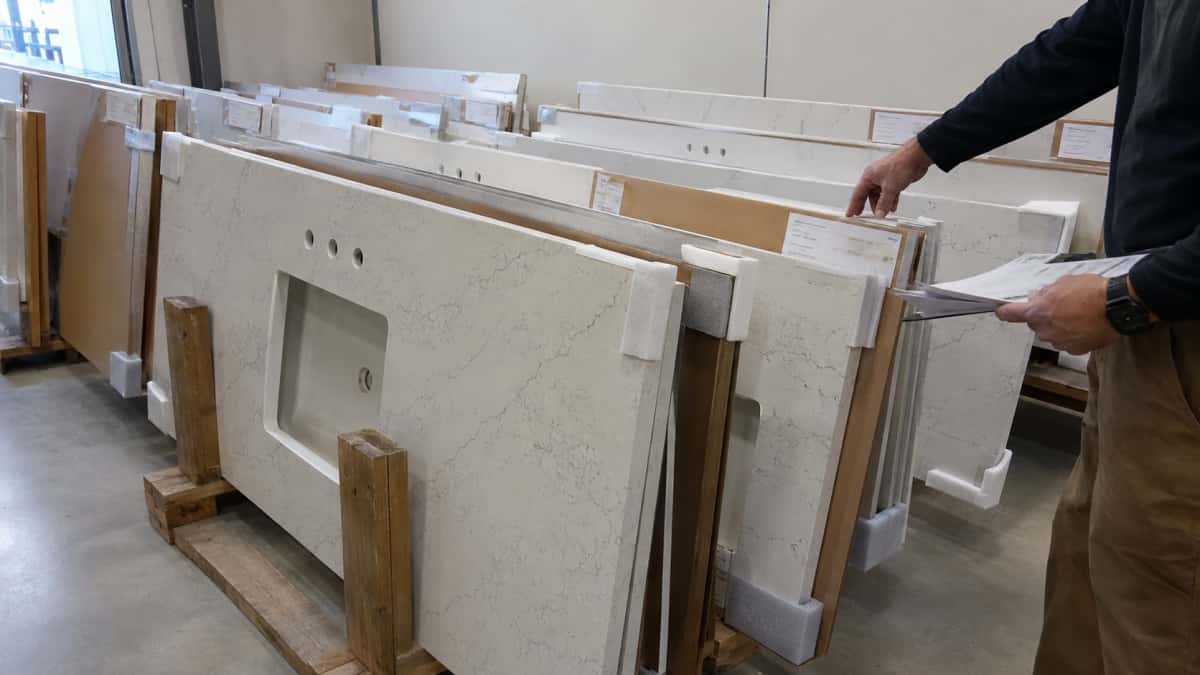
Quartz countertop storage before installation requires special attention to fabricated details.
Quartz stone is widely used for kitchen countertops, vanity tops, islands, bar counters, and commercial surfaces. These pieces may include sink cutouts, faucet holes, cooktop openings, mitered edges, polished profiles, backsplash pieces, and overhang details.
For quartz countertop storage before installation, the site team should check:
Are cutouts supported?
Are tops stored vertically or horizontally according to safe handling practice and piece shape?
Are polished edges protected?
Are sink openings protected from impact?
Are backsplash pieces stored with the matching countertop?
Are faucet holes and cutout corners protected?
Are labels still visible?
Are pieces kept away from heavy site traffic?
Are tops stored in a dry interior area before installation?
Quartz stone is a practical engineered surface, but a fabricated countertop is not only a slab. The cutouts and finished details need protection until the installer is ready.
A large quartz top should not be casually leaned against a wall with no support and no edge protection.
9. Artificial marble and agglomerated marble need batch and label control
Artificial marble and agglomerated marble are often used in commercial interiors, hotel areas, apartment projects, wall panels, floors, counters, and repeated room packages.
Because these materials are engineered, buyers may assume site storage is simple. But project problems can still happen if pieces lose their labels or are mixed between areas.
For artificial marble and agglomerated marble, site teams should check:
batch or area grouping
piece labels
room codes
repeated unit separation
edge protection
finished surface protection
storage away from heavy traffic
protection from site dirt, paint, and wet work
correct grouping for installation sequence
The main risk is often not dramatic natural variation. The main risk is confusion.
If many pieces look similar, the site team may place the wrong piece in the wrong room, especially in hotel, apartment, retail, or corridor projects.
Controlled material still needs controlled storage.
10. Terrazzo stone needs corner, finish, and area protection
Terrazzo stone often depends on overall visual balance after installation. Aggregate distribution, background tone, chip size, finish, and joint layout all contribute to the final appearance.
For terrazzo stone project storage control, the site team should avoid:
mixing floor panels from different areas
placing finished faces against rough surfaces
stacking pieces in a way that chips corners
exposing pieces to wet construction dirt
losing skirting, stair, or border pieces
separating pieces from their layout sequence
storing terrazzo near cutting dust, paint, or cement slurry
Terrazzo may look robust, especially in commercial spaces. But before installation, edges, corners, and finished faces still need protection.
A terrazzo floor can look calm and balanced when the pieces are installed correctly. It can look disorganized if project pieces are mixed during site storage.
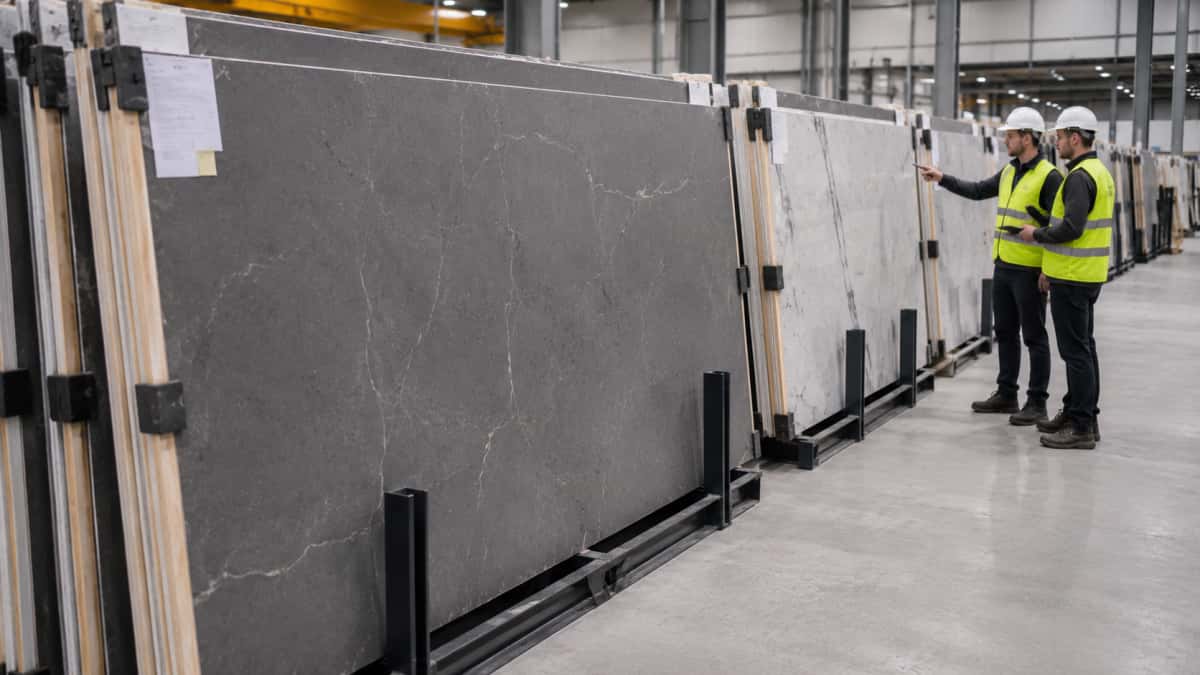
11. Sintered stone panels require careful handling and stable support
Sintered stone is often supplied in large-format panels or thinner pieces. These formats require a different site handling mindset.
The risk is not only surface damage. It can also include edge damage, corner impact, unsupported panel movement, and unsafe leaning.
For sintered stone site storage, buyers should check:
stable vertical support where appropriate
panel edge protection
corner protection
no point pressure on thin areas
no random leaning against uneven walls
safe route from storage to installation area
clear labels for panel direction and visible face
protection from other trades and moving equipment
Sintered stone should not be handled like small-format tile. Large panels need planning, equipment, space, and trained handling.
If the site is not ready to handle large panels safely, installation should not be rushed.
12. Keep stone away from wet work and dirty trades
Many site storage problems come from other construction work.
Stone may be delivered before painting, plastering, welding, waterproofing, flooring preparation, woodwork, ceiling installation, or mechanical work is finished. If the stone is stored in the wrong location, it can be affected by dust, water, cement slurry, paint, oil, rust, adhesive, or foot traffic.
Buyers and site teams should keep stone away from:
wet concrete areas
plastering zones
paint work
welding work
cutting dust
waterproofing chemicals
adhesive mixing areas
heavy traffic paths
open rain exposure
drainage points
rusty metal storage
unprotected scaffold movement
This matters for all stone materials, but especially for honed limestone, polished marble, light-colored artificial marble, quartz countertops, and terrazzo with light background tones.
Stone should be stored as finished material, not as rough construction material.
13. Do not remove labels too early
Labels may look unimportant, but they often carry the project logic.
A label may show the room number, piece number, area code, wall elevation, stair sequence, countertop set, or crate reference. If labels are removed too early, the site team may lose the connection between material, drawings, and installation location.
Before removing labels, the installer or site manager should confirm:
the piece has been photographed
the piece number is recorded
the installation area is clear
the drawing reference is available
the piece has been placed near the correct location
the label information is not needed later
For natural marble, labels can protect vein sequence. For artificial marble and agglomerated marble, labels help separate repeated units. For quartz countertops, labels can identify matching backsplash and sink cutout positions. For terrazzo stone, labels help preserve layout order. For limestone wall panels, labels help maintain panel sequence and visible face direction.
A small label can prevent a large site mistake.
14. Store pieces close to installation areas only when the site is ready
Moving stone close to the installation area can save time, but only if the area is ready.
If pieces are moved too early, they may block other trades, create safety issues, or become exposed to damage. If they are kept too far away, installers may waste time sorting and moving them later.
The site team should decide storage position based on:
installation schedule
site cleanliness
floor load capacity
access route
lifting equipment
weather exposure
other trades
security
piece size and weight
sequence of installation
For example, a hotel bathroom vanity top package may be stored by floor or room only when the rooms are dry and ready. A lobby marble wall panel set should not be moved into a busy public area where other trades are still working heavily. Large sintered stone panels should not be carried repeatedly across the site without need.
The fewer unnecessary movements, the lower the risk.
15. A practical stone unloading and storage checklist
Before installation begins, buyers and site teams can use this stone unloading and storage checklist:
1.Is the unloading area ready?
2.Is the ground dry and stable?
3.Is proper lifting equipment available?
4.Are trained handlers available?
5.Is the packing list available on site?
6.Are crate numbers checked?
7.Are crates photographed before opening?
8.Are damaged crates recorded before moving?
9.Are materials stored by area or room?
10.Are labels kept visible?
11.Are polished faces protected?
12.Are corners and edges protected?
13.Are cutouts supported?
14.Are natural marble sequences preserved?
15.Are limestone pieces kept away from wet and dirty areas?
16.Are quartz countertops stored with cutout protection?
17.Are terrazzo pieces grouped by layout or area?
18.Are sintered stone panels supported safely?
19.Are materials protected from other trades?
20.Is installation approval given only after storage and inspection are controlled?
This checklist is not complicated. But it can prevent many avoidable problems between delivery and installation.
16. How buyers should communicate site storage concerns
Good communication should be specific.
Instead of saying:
“Please tell us how to store the stone.”
A better question is:
“Crates 3 and 4 contain honed limestone wall panels. Should the site team keep them packed until the wall area is dry and ready for installation?”
Instead of saying:
“The quartz tops are fragile.”
A better question is:
“Please confirm whether the quartz vanity tops with sink cutouts should remain in the crate until the installer is ready, and whether the backsplash pieces are packed with each matching top.”
Instead of saying:
“The marble has many pieces.”
A better question is:
“Please confirm whether the natural marble panels should be stored by wall elevation and whether the labels should stay on until installation.”
Specific questions help the supplier give useful answers.
For buyers preparing complex stone projects, it is better to contact Aoli Stone before installation and clarify unloading, storage, piece sequence, and site handling expectations before the materials are moved around the jobsite.
Before the Stone Reaches Installation
Stone is not safe simply because it has arrived on site.
For many projects, the risky period starts after unloading and before installation. Crates may be opened too early. Pieces may be moved several times. Labels may be lost. Finished surfaces may sit near dust, moisture, paint work, welding, or other site activities. By the time installation begins, the problem may no longer look like a supply issue, but the cost is still real.
This is why stone should be stored as finished project material, not as ordinary construction cargo.
The site team should confirm where the material will be placed, how the pieces will be supported, which crates should be opened first, and how labels, corners, polished edges, cutouts, and finished faces will be protected. Marble, limestone, granite, quartz, terrazzo, artificial marble, and sintered stone do not all fail in the same way, so the storage method should follow the material and the application.
Before installation starts, it is worth checking one simple question:
Can every piece still be identified, inspected, protected, and moved into position without unnecessary handling?
If the answer is unclear, the storage plan should be corrected before the first piece is installed.



 IPv6 network supported