English
 Español
 Português
 عربي
عربي 한국어
한국어

Natural marble projects are often discussed in terms of slab selection, vein matching, dry lay approval, and installation quality. Yet one of the most expensive project risks frequently receives far less attention: reserve slab planning before production begins.
In many commercial, hospitality, residential, and luxury projects, reserve slabs are not simply extra material. They are a practical risk-control tool. When planned correctly, reserve slabs can help prevent future color mismatches, reduce replacement difficulties, protect bookmatched layouts, and simplify maintenance years after installation. The challenge is that many buyers only discover their importance after a damaged piece needs replacing and the original production batch is no longer available.
Natural marble is valued for its individuality. The same characteristic that makes each slab unique also means future replacement material may not perfectly match the original installation. Understanding when, why, and how to reserve additional slabs can help project teams avoid costly decisions later.
Reserve slabs are marble slabs intentionally retained from the approved project batch for future maintenance, replacement, renovation, or unforeseen project requirements.
Depending on the project strategy, reserve material may be:
· Stored as full slabs
· Kept as approved but unprocessed slabs
· Stored as selected cut pieces
· Reserved at the supplier’s facility
· Delivered with the original shipment and stored locally
The purpose is not to increase material consumption.
The purpose is to protect project continuity.

Unlike engineered materials, natural marble cannot be reproduced through a fixed manufacturing formula.
Several factors can influence future material appearance:
· Different quarry blocks
· Different extraction periods
· Natural vein movement
· Color variation between blocks
· Quarry depletion
· Inventory turnover
· Changes in supplier stock
A marble variety purchased six months or two years later may carry the same commercial name while displaying noticeably different color, movement, or background tone.
One practical observation applies to almost every marble project:
Replacement material is judged beside the existing installation, not beside the supplier’s inventory.
For highly visible areas, even small differences can become obvious.
Not every project requires the same reserve strategy.
The more visually sensitive the installation, the more valuable reserve slabs become.
Bookmatched walls are among the most difficult marble applications to repair.
A single damaged panel can interrupt an entire mirrored vein pattern.
If replacement material does not originate from the original slab batch, visual continuity may be impossible to recover.
Buyers reviewing complex feature wall projects often benefit from understanding the project fabrication process shown in the natural stone manufacturing workflow.
Large marble lobby floors experience wear over time.
Furniture movement, renovation work, or accidental impact may require localized replacement.
Reserve slabs can help maintain consistency between original and replacement sections.
Marble stair treads are vulnerable to edge damage during building operation.
When tread pieces were originally selected for vein continuity, matching replacements later becomes more difficult without reserved material.
Future plumbing modifications, sink replacements, or accidental breakage can create replacement needs.
For premium marble vanity and countertop projects, reserve material is often a practical long-term safeguard.
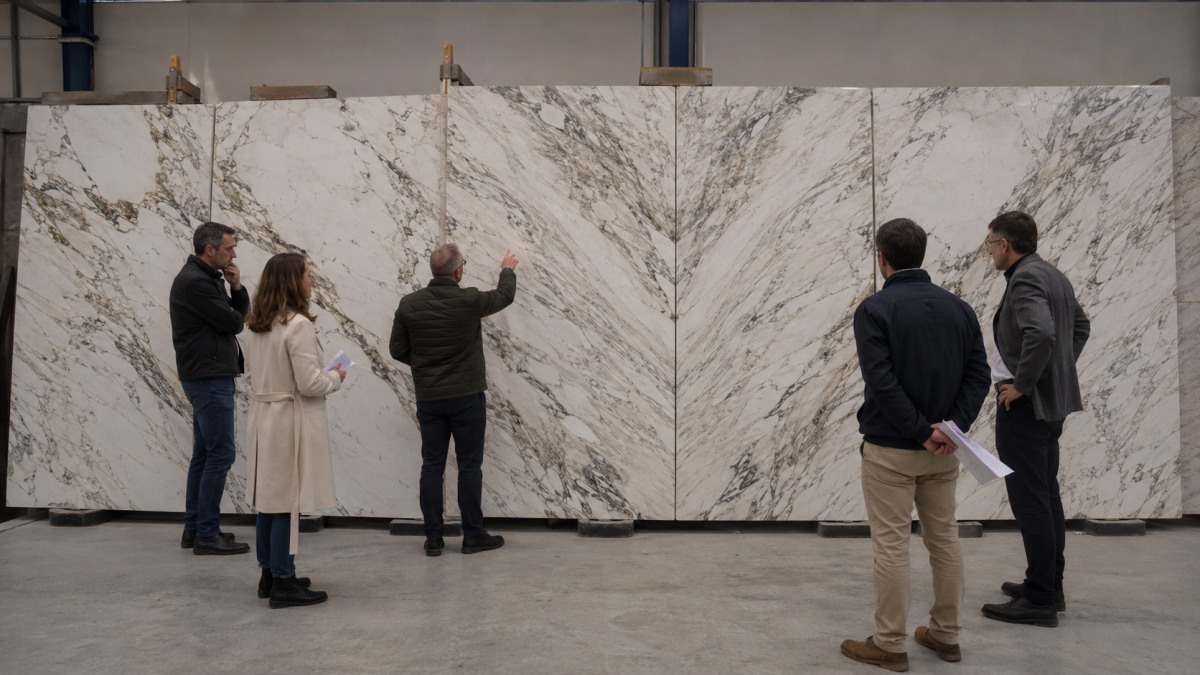
One of the most common misunderstandings in marble procurement is assuming reserve slabs can be selected after production is complete.
By that stage:
· The best matching slabs may already be processed
· Bookmatched pairs may already be consumed
· Vein continuity may no longer be available
· Replacement options become limited
Reserve planning should happen during slab approval, not after fabrication.
Projects that wait until packing or shipment frequently discover that the ideal reserve material is no longer available.
How Much Reserve Material Should Be Planned?
There is no universal percentage that applies to every marble project.
Instead, experienced project teams usually evaluate four factors.
Will the replacement area be highly visible?
Feature walls, lobbies, staircases, and reception areas generally require more careful reserve planning than secondary service areas.
Some marble varieties have stable long-term production.
Others depend on irregular quarry extraction schedules.
The more uncertain future availability becomes, the more valuable reserve material becomes.
Projects involving:
· Bookmatching
· Waterjet patterns
· Custom carving
· Curved fabrication
· Vein-matched layouts
typically carry higher replacement risk.
Hotels, commercial developments, public buildings, and luxury residences are often expected to operate for decades.
Long-term projects usually justify stronger reserve planning.
Many buyers ask whether reserve material should remain as full slabs or finished components.
In most situations, full slabs provide greater flexibility.
Future repair requirements are difficult to predict.
A full slab allows fabricators to produce replacement pieces according to future needs.
However, highly customized projects may also benefit from storing selected finished components alongside reserve slabs.
The best approach often depends on project complexity and available storage conditions.
|
Situation |
Without Reserve Slabs |
With Reserve Slabs |
|
Bookmatched wall damage |
Pattern disruption |
Better visual continuity |
|
Hotel floor repair |
Color mismatch risk |
Higher matching probability |
|
Stair tread replacement |
Vein inconsistency |
Similar appearance maintained |
|
Future renovation |
New batch required |
Original batch available |
|
Owner maintenance request |
Limited options |
Faster response |
A useful principle is:
Reserve slabs are usually inexpensive before a problem occurs and expensive after a problem occurs.
Before approving marble production, project teams should confirm:
□ Reserve slab quantity
□ Full slab or cut-piece strategy
□ Reserve slab numbering system
□ Slab photographs and records
□ Dry lay documentation
□ Packing list identification
□ Storage responsibility
□ Future replacement workflow
□ Related shop drawings
□ Approval records
Projects that document these details are generally easier to manage during future maintenance.
What Suppliers Should Provide
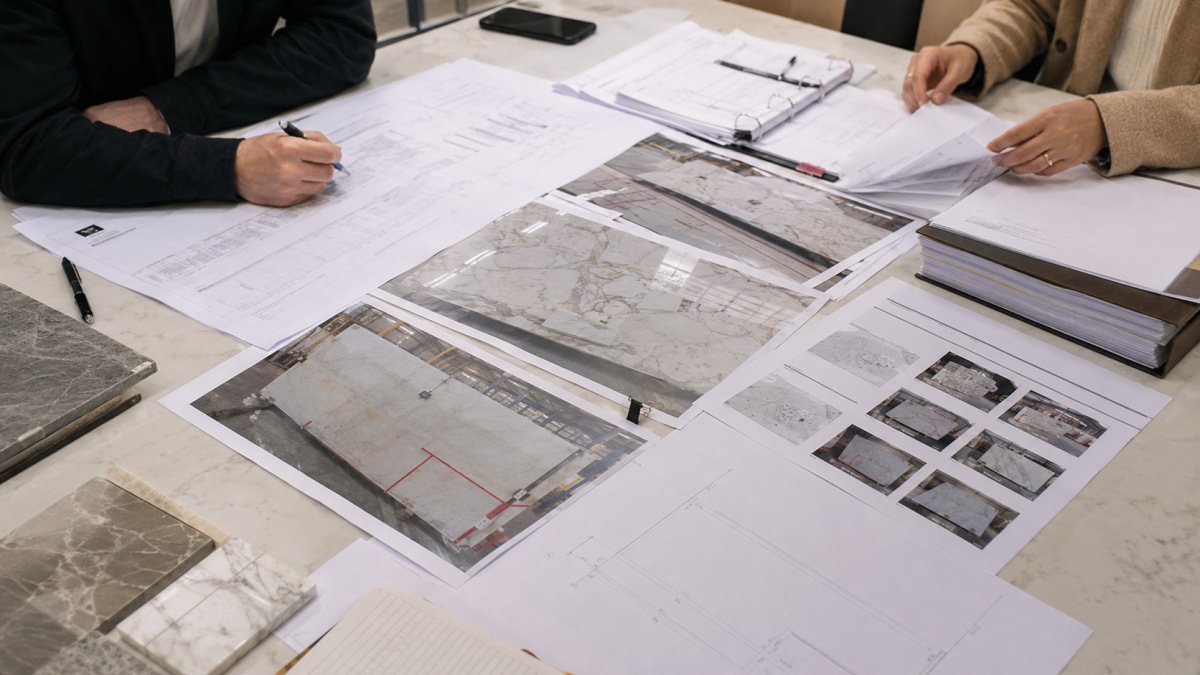
Reserve slab planning becomes more effective when suppliers provide clear project documentation.
Buyers should request:
· Approved slab photographs
· Slab numbering records
· Dry lay photographs where applicable
· Reserve slab identification records
· Packing list references
· Production tracking information
The objective is not paperwork for its own sake.
The objective is making future replacement decisions easier and more reliable.
For projects involving complex layouts, buyers may also review relevant stone project examples to better understand how slab selection and layout continuity influence long-term maintenance decisions.
Natural marble is valued because no two slabs are exactly alike.
That uniqueness creates beauty, but it also creates responsibility.
Reserve slabs are not purchased because problems are expected. They are retained because buildings change, maintenance happens, and future repairs rarely occur under ideal conditions.
A project team may never need every reserved slab.
But when a replacement becomes necessary years later, access to original material can make the difference between a seamless repair and a visible compromise.
Before production begins, reserve slab planning deserves the same level of attention as slab approval, shop drawings, dry lay review, quality control, packaging preparation, and shipment planning.
Projects that consider these details early often face fewer surprises later.
If you are preparing a natural marble project, project teams can discuss material type, application area, approved slab photos, drawings, size lists, finish requirements, quantity schedules, destination, packing expectations, and reserve slab requirements before production begins to establish a clearer project supply plan.
No. The need depends on project visibility, future maintenance expectations, design complexity, and material availability.
Yes. Bookmatched installations often rely on vein continuity that can be difficult or impossible to reproduce later.
In most cases, reserve planning is most effective when discussed and approved before production begins.
Both approaches are used. The decision depends on storage conditions, project schedule, accessibility, and long-term maintenance strategy.
Buyers should request slab photographs, numbering records, packing references, dry lay records where applicable, and approval documentation.
Sometimes, but not always. Natural marble varies between quarry blocks and extraction periods, which can create visible differences.



 IPv6 network supported