English
 Español
 Português
 عربي
عربي 한국어
한국어

In many stone projects, the real risk does not appear when the first shipment arrives. It appears later, when the second or third delivery no longer matches the original batch, the label logic has changed, or the site team cannot tell which crate belongs to which floor, room, elevation, or installation sequence. For natural marble, limestone, terrazzo, quartz stone, artificial marble, and other cut-to-size materials, phased stone deliveries need more than normal packing. They need clear batch control, consistent label management, and a delivery sequence that can still make sense months after the first container has left the factory.
A phased delivery is not simply “shipping the order in several parts.” It is a project supply method. The material may be produced in different weeks, packed in different containers, received by different site teams, and installed in different construction stages. If the supplier, buyer, and contractor do not control the batch and label system from the beginning, a project that looked well organized on paper can become difficult to install on site.

Why Phased Stone Deliveries Are More Difficult Than One-Time Shipments
A one-time shipment has one advantage: everything arrives together. The site team can open all crates, compare all materials, and solve most layout questions at once.
A phased delivery is different.
The first batch may include the lobby floor. The second batch may include corridor wall panels. The third batch may include stair treads, skirting, vanity tops, or replacement pieces. Some materials may be held for later installation. Some areas may be delayed by other construction work. Some crates may stay in storage for weeks before being opened.
This creates several project risks:
The color range may not remain consistent between deliveries.
The finish may look slightly different if production is not controlled.
Labels may be changed by different production or packing teams.
Crate numbers may not match the site installation sequence.
Replacement pieces may not be traceable to the original material batch.
The contractor may install materials from different batches in the same visible area.
In stone projects, a small control error can become visible after installation. A label mistake is not just a paperwork issue. It can become a color-matching issue, a dry lay issue, an installation delay, or a commercial dispute.
Batch Control Is Not Only About Color
Many buyers think batch control only means keeping the same color. That is too simple.
Color is important, especially for natural marble, limestone, and terrazzo. But batch control also includes thickness, surface finish, resin treatment, edge processing, vein direction, aggregate balance, slab source, and production timing.
For example, two limestone deliveries may both be described as warm cream beige, but one batch may show slightly more fossil texture while another has a calmer surface. Two terrazzo batches may use the same formula, but aggregate distribution may still need visual checking before the materials are packed. Two artificial marble batches may look close, but the tone and pattern density should still be reviewed if the pieces will meet in the same open area.
For quartz stone and engineered stone, buyers sometimes assume batch risk is lower. In many cases it is more controllable than natural stone, but it is not zero. Surface tone, slab lot, production date, and finishing consistency still matter, especially in large commercial interiors or repeated countertop areas.
A useful rule is simple:
If two stone pieces will be seen together, they should be controlled together.
This is why phased delivery planning should begin before production, not after the first shipment is already packed.
The Difference Between Batch Number, Crate Number, and Installation Label
A common mistake is using one label system to do three different jobs.
A batch number tells the supplier and buyer which production or material group the stone belongs to.
A crate number tells the logistics team which package is being shipped.
An installation label tells the site team where each piece should be installed.
These three things are related, but they are not the same.
For small orders, simple crate labels may be enough. For phased stone project supply, the label system should connect material batch, drawing reference, piece number, crate number, and installation area. If one of these links is missing, the project becomes harder to control once materials are separated across different shipments.
A better label should help answer five questions:
Which batch does this piece belong to?
Which drawing or area does it match?
Which room, floor, wall, elevation, countertop, or stair position is it for?
Which crate contains it?
Which shipment phase does it belong to?
If the label cannot answer these questions, it may be useful for the factory but not useful enough for the site.
Version Control Matters More Than Many Buyers Expect
In phased deliveries, label management is also a version-control problem.
Drawings may be revised. Site measurements may change. Some areas may be delayed. The buyer may add new pieces after the first shipment. A contractor may request replacement pieces. The supplier may need to adjust packing because of container loading limits.
If the label format changes halfway through the project, the site team may lose the connection between the first delivery and later deliveries.
That is why a master label logic should be agreed before the first shipment. It does not need to be complicated, but it must be stable.
For example:
Project code
Material name
Batch reference
Area code
Drawing reference
Piece number
Crate number
Shipment phase
When this logic stays consistent, the second and third deliveries can still be understood by someone who did not handle the first shipment. This is especially important in hotel, commercial, residential tower, and public-space projects, where procurement, logistics, and installation may be managed by different teams.
A good label system is not made for the person who packed the crate. It is made for the person who opens it on a busy construction site.
How Batch Continuity Affects Different Stone Materials
Different materials have different batch risks. Treating them all the same is not professional.
Natural Marble
Natural marble has the highest visual sensitivity in many projects. Vein direction, color movement, background tone, and block selection must be controlled carefully. If a lobby floor, feature wall, stair, or reception counter is supplied in phases, the supplier should clarify which areas need the closest visual matching.
For high-visibility areas, buyers should ask whether the material comes from the same block or a controlled slab selection. Natural marble cut-to-size supply needs stronger batch documentation when different deliveries will meet in the same visible zone.
Limestone
Limestone often has a calmer surface than dramatic marble, but it still has batch variation. Tone, fossil content, pore density, shell-like details, and surface finish can vary. For wall cladding, corridor flooring, façade panels, and courtyard paving, batch continuity is important because large quiet surfaces can reveal subtle differences.
A phased limestone project should define which areas can accept natural variation and which areas require closer matching. For limestone wall cladding and flooring projects, this distinction should be discussed before cutting.
Terrazzo
Terrazzo batch control is not only about color. It is also about aggregate distribution, chip size, resin or cement tone, surface finish, and visual balance after dry lay. If floor areas are shipped in different phases, the supplier should check whether panels from different batches will meet at open transitions, corridor intersections, or large public zones.
Terrazzo project material control should include dry lay review, batch photos, and clear area grouping before packing.
Artificial Marble and Agglomerated Marble
Artificial marble and agglomerated marble are more controlled than many natural stones, but batch difference can still occur through production lots, pigment tone, pattern density, and polishing finish. For repeated wall panels, commercial floors, vanity tops, and large public interiors, the safest method is to keep the same visible area within one controlled batch whenever possible.
If phased delivery is necessary, the supplier should document which batches were used for which areas, so that future replacement or extension work does not become guesswork.
Quartz Stone
Quartz stone is often used for countertops, vanity tops, commercial counters, and repeated unit projects. Phased delivery risk may come from slab lot difference, edge processing consistency, cutout positions, and packing sequence. For quartz slab logistics, large slabs should be packed on two large wooden A-frame racks, not described casually as ordinary wooden boxes. For cut-to-size quartz, each countertop, backsplash, side panel, and edge detail should be traceable.
For quartz stone project supply, phased delivery control is especially useful when one development has many similar units or repeated room types.
What Buyers Should Confirm Before the First Shipment
The first shipment sets the standard. If the first delivery uses weak labels, unclear batch records, or inconsistent crate logic, later deliveries will become harder to manage.
Before the first shipment, buyers should confirm:
Whether all visible areas have been grouped by batch logic.
Which areas must use the closest material match.
Whether reserve slabs or spare pieces are needed.
Whether the packing list matches the installation sequence.
Whether label names match the drawings and site language.
Whether each crate can be understood without asking the factory again.
Whether later shipments will follow the same label structure.
This is where many projects become either smooth or painful. Strong batch control does not slow the project down. It reduces repeated communication later.
What Should Be Included in a Strong Packing List for Phased Deliveries
A packing list for phased deliveries should do more than list crate numbers and quantities.
It should connect the shipment to the project.
A useful phased delivery packing list may include:
Shipment phase
Crate number
Material name
Batch reference
Finish
Thickness
Area or floor
Drawing reference
Piece number range
Quantity
Gross and net weight
Special notes for fragile, long, or shaped pieces
For large cut-to-size stone orders, this kind of packing list helps the buyer, logistics team, warehouse team, and installer read the shipment in the same way.
If the packing list only works for customs clearance but not for site installation, it is incomplete for a project order.
The Role of Dry Lay and Photo Records
Dry lay inspection becomes more valuable when deliveries are phased.
For one-time shipments, dry lay can confirm layout before packing. For phased deliveries, dry lay photos also become a memory system. They show how pieces were grouped, how the visual flow was approved, and how the first shipment should connect with later shipments.
The photo record should be clean, dry, and easy to understand. It should show piece sequence, joint logic, material tone, and area grouping. It should not rely on readable public text, logos, or messy workshop backgrounds. The purpose is not to create a beautiful marketing image. The purpose is to reduce misunderstanding.
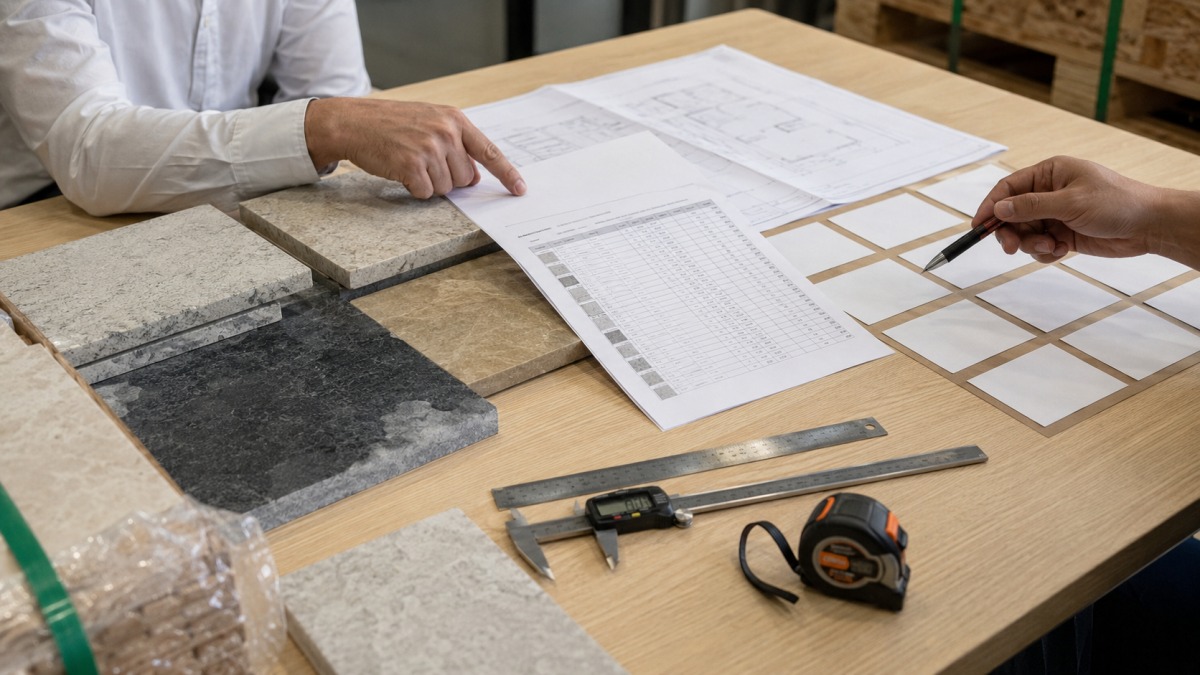
In quality control, details also matter. For thickness checking, a vernier caliper should clamp the edge of the stone and measure the board edge accurately, rather than floating loosely above the surface. Small details like this tell buyers whether the supplier understands real inspection work.
When Reserve Material Becomes Critical
Phased delivery projects should also consider reserve material.
Reserve slabs or spare pieces are not always necessary for every order. But they are important when the project has high-visibility stone, long construction periods, special cut-to-size shapes, or material that may be difficult to match later.
The key question is not only “How many spare pieces should we keep?”
The better question is:
Which future problem are we trying to protect against?
If the risk is installation breakage, the buyer may need spare cut pieces. If the risk is future repair, the buyer may need reserve material from the same batch. If the risk is design change, the buyer may need extra slabs before the material block is no longer available.
Reserve material should be connected to the batch record. Otherwise, spare material may exist physically but still be difficult to use correctly.
Common Mistakes in Phased Stone Deliveries
Some mistakes appear small at the beginning but become expensive later.
One common mistake is changing label formats between shipments. The first shipment uses room names, the second uses crate numbers, and the third uses drawing codes. Each system may be understandable alone, but together they create confusion.
Another mistake is separating material by container convenience instead of installation logic. A container may be easier to load this way, but the site may have to open too many crates to find one area.
A third mistake is assuming later batches will naturally match earlier batches. This is risky for natural stone and still worth checking for engineered materials.
A fourth mistake is not saving approval photos, batch records, or packing list versions. When a problem appears three months later, nobody remembers which document was final.
A fifth mistake is treating labels as factory paperwork. In phased deliveries, labels are part of the installation system.
Good project supply is not only about producing the stone correctly. It is about keeping the project understandable after the stone leaves the factory.
A Practical Buyer Checklist
Before confirming phased delivery, buyers can ask the supplier these questions:
Will all visible areas be grouped by batch and installation zone?
Can the same label logic be used across all shipment phases?
Will the packing list show batch reference, drawing reference, area, crate number, and piece number?
Are dry lay photos or layout approval photos available before packing?
Which areas need strict visual continuity?
Will spare pieces or reserve material be kept from the same batch?
How will revised drawings be reflected in label version control?
Can the site team understand the crate and piece sequence without asking for extra explanation?
These questions are not only for large luxury projects. They are practical for hotels, commercial interiors, apartment developments, villa projects, retail spaces, façade cladding, and any project where materials arrive in stages.

Before the Next Shipment Is Packed
Phased stone delivery is normal in real projects. Construction schedules change. Containers are split. Some areas are ready earlier than others. But the more a delivery is divided, the stronger the batch and label system must become.
A phased delivery without batch continuity is not a delivery plan. It is a future coordination problem.
For project buyers, the goal is not to demand perfect sameness from every stone material. Natural stone will always have its own character. The real goal is to control where variation is acceptable, where continuity is essential, and how every piece can be traced from production to installation.
When batch records, label logic, packing lists, dry lay photos, and shipment phases work together, the project becomes easier to install and easier to explain. That is the kind of control that protects both the buyer and the supplier.
For phased stone projects that require cut-to-size production, batch grouping, packing sequence, or project documentation review, buyers can contact Aoli Stone to discuss the material plan before production begins.
FAQ
Why do phased stone deliveries need stronger batch control?
Because materials are produced, packed, shipped, received, and installed at different times. Without batch control, later deliveries may not match the approved material range, surface finish, or installation logic of earlier deliveries.
Is batch control only important for natural marble?
No. Natural marble and limestone usually have higher visual variation, but terrazzo, artificial marble, quartz stone, and other engineered materials also need batch records when used in large visible areas or repeated project units.
What is the difference between a crate label and an installation label?
A crate label helps identify the package. An installation label helps the site team know where each piece belongs. In phased stone deliveries, both are needed, and they should connect to the batch record and packing list.
Should each shipment use the same label format?
Yes. A stable label format helps later shipments connect with earlier ones. If the label logic changes during the project, the site team may lose track of area, drawing reference, batch, or piece sequence.
What should buyers ask before the first phased shipment?
Buyers should confirm batch grouping, label format, packing list structure, dry lay photo records, reserve material planning, and how revised drawings will be controlled across later deliveries.
Can phased deliveries reduce project risk?
Yes, if they are planned properly. Phased deliveries can support real construction schedules, but only when batch continuity, label management, packing sequence, and documentation are controlled from the beginning.



 IPv6 network supported