English
 Español
 Português
 عربي
عربي 한국어
한국어

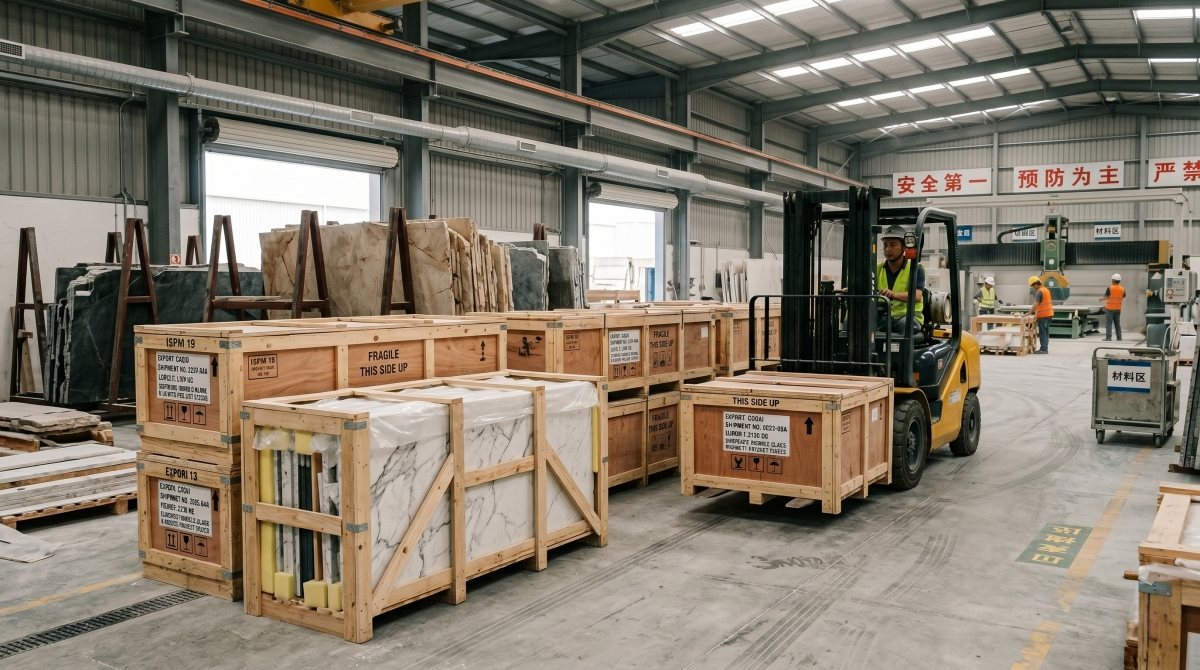
Stone buyers often judge quality by what they can see on the slab.
They look at color.
They look at veining.
They look at polish, finish, thickness, and surface defects.
They compare prices and ask about production capacity.
All of that matters.
But in export stone supply, another part of quality is often underestimated until something goes wrong: packing.
This is where many avoidable problems begin.
A stone order may be fabricated correctly, selected carefully, and approved confidently. Yet if the packing is weak, unclear, rushed, or not designed for the actual shipment and site conditions, the order can still create losses. Edge damage, broken corners, wet crates, mixed bundles, unreadable labels, difficult unloading, site confusion, and delayed installation are not simply logistics issues. They are quality issues that show up later.
That is why experienced buyers do not treat export packing as a final warehouse step. They treat it as part of the product delivery system.
In stone export, packing is not just about getting the material onto a truck or into a container. It is about protecting value, preserving organization, and reducing downstream risk.
Here is why export packing should be understood as part of stone quality, not just logistics.
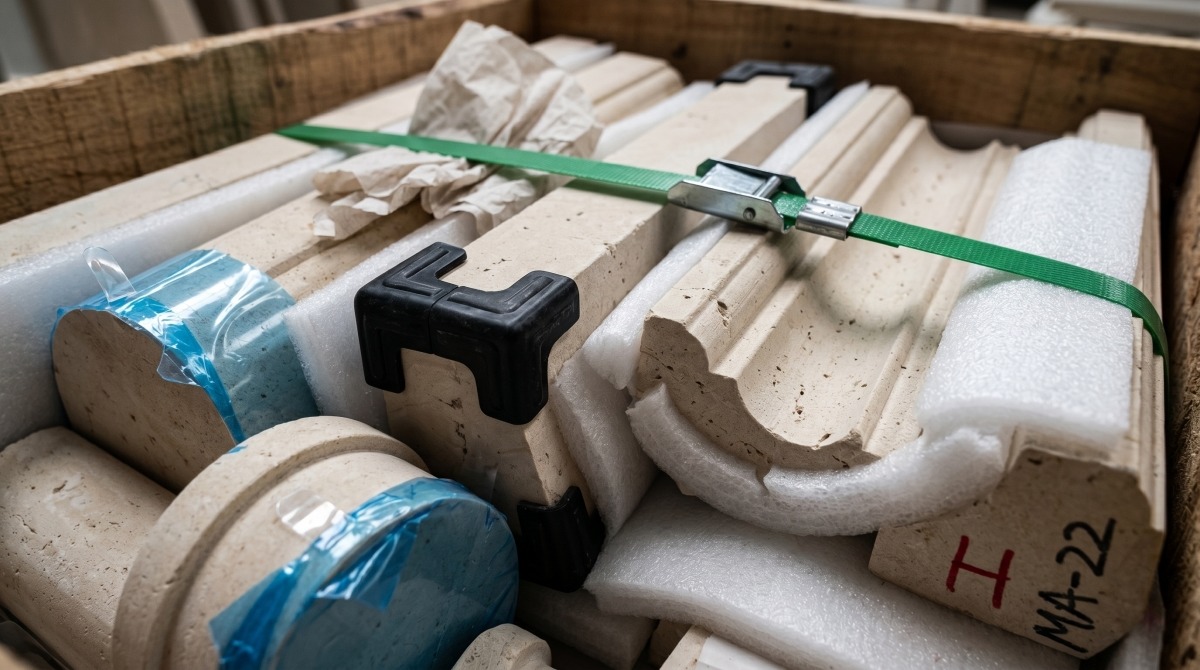
This is the most important point.
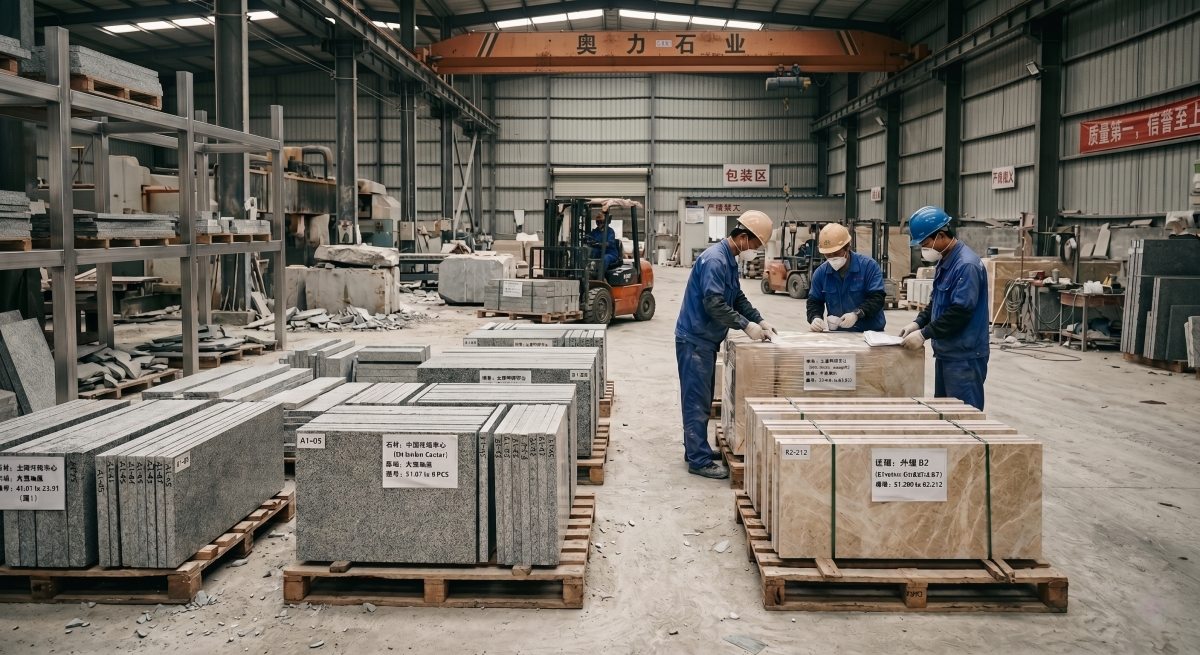
A well-fabricated stone piece does not stay “high quality” automatically once production is finished. From the moment it leaves the factory floor, it becomes vulnerable to handling, stacking, forklift movement, container loading, sea transport, unloading, site storage, and final installation preparation.
If the packing does not match those conditions, even a correct piece can arrive damaged.
That damage may not always be dramatic. Sometimes it is a chipped arris, a cracked corner, a scratched polished face, a stain caused by moisture, or a bundle that has shifted enough to create invisible stress. But small damage is still damage, especially when the stone is for a visible project area or part of a tight installation schedule.
The key point is simple:
quality that cannot survive transport is incomplete quality.
Many buyers think packing is mainly about preventing breakage.
Breakage matters, of course. But good packing should do more than that.
It should also protect:
In project supply, the goal is not only to keep the pieces intact. The goal is to make sure they arrive in a condition that is still usable, traceable, and manageable.
This is why packing should be planned according to the order type, not done by routine alone.
A crate suitable for random stock slabs is not always suitable for cut-to-size project pieces.
A bundle that works for domestic movement may not be enough for overseas container transport.
A package that survives the port may still create confusion on site if labeling and grouping are weak.
This part is often missed by people who see packing only as shipping.
In many stone projects, installation delays are not caused by fabrication errors alone. They are caused by material arriving in a way that is hard to understand or hard to use.
For example:
When that happens, the site team loses time.
Time becomes labor cost.
Labor cost becomes frustration.
Frustration becomes blame between supplier, buyer, and installer.
In other words, poor packing does not only increase the risk of damage. It reduces the efficiency of project execution.
That is why serious project buyers increasingly ask not only how the stone will be made, but also how it will be packed.
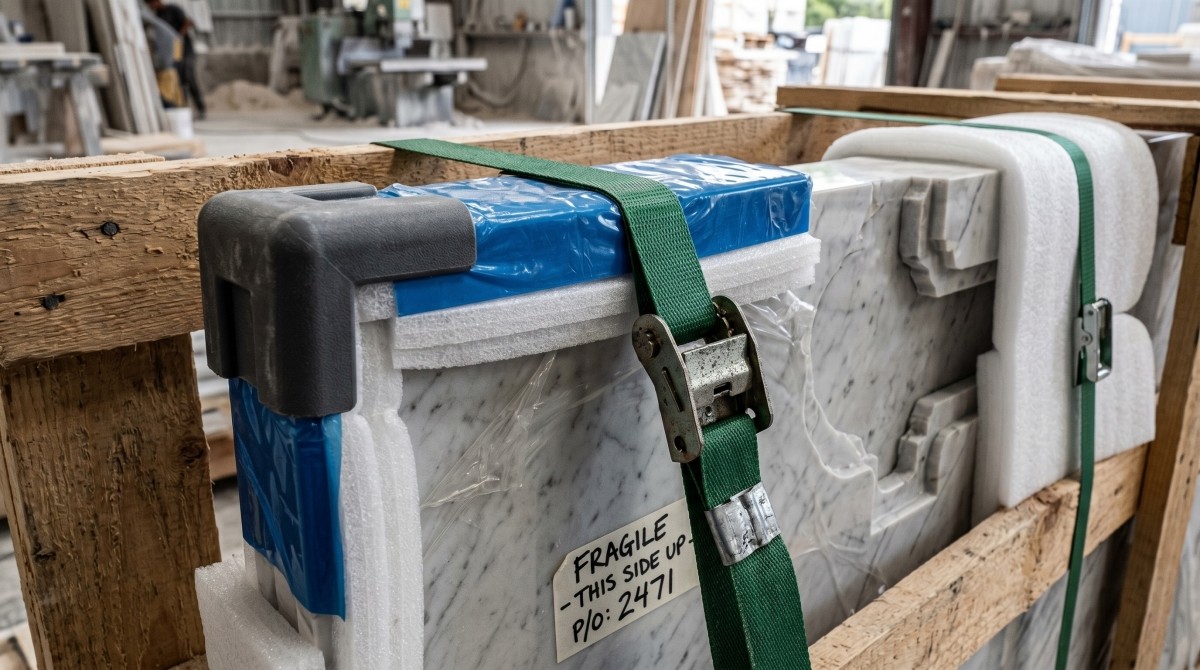
Not all stone products carry the same transport risk.
Thick random slabs, polished cut-to-size marble, honed limestone tiles, quartz tops with cutouts, engineered marble vanity pieces, terrazzo panels, and carved components all behave differently during storage and transit.
Some are vulnerable at the edge.
Some are vulnerable at thin return sections.
Some are heavy but stable.
Some are rigid but fragile around openings.
Some need better face protection.
Some require more careful separation between finished surfaces.
This is why good export packing is never fully generic.
For natural marble, visual surfaces and edge condition often need greater care.
For limestone, corner damage and finish sensitivity may require extra attention.
For quartz and engineered materials, cutouts, polished edges, and finished faces still need protection even when the material body is more uniform.
For cut-to-size project orders, numbering and grouping become as important as physical protection.
Packing has to reflect what the material is, how it was processed, and where it will be used.
By the time the crate is nailed shut, many packing decisions have already been made.
This includes:
If these decisions are weak, the final crate may look acceptable from the outside while still containing hidden risk.
That is one reason buyers should not judge packing quality only by the appearance of the wooden crate. A clean crate is not automatically a well-managed crate.
The logic inside matters more.
A surprising number of project problems come from labeling failure.
A piece may arrive safely but still create confusion if:
In project stone supply, identification is not a minor detail. It is operational control.
The more complex the job, the more valuable good labeling becomes.
This is especially true in:
Clear labeling shortens site decision time.
Weak labeling pushes complexity downstream.
Export packing does not operate in a clean, static environment.
The stone may pass through:
That journey matters.
A package that seems stable in the workshop may behave differently once it is exposed to vibration, shifting, moisture, stacking pressure, or rough handling during transport.
This is why export packing should be evaluated according to the real travel path, not just the moment it leaves the factory.
It is also why buyers who understand long-distance project supply tend to ask more detailed packing questions than buyers focused only on ex-factory price.
Replacement pieces are costly.
They cost money, of course. But they also cost:
If a damaged piece belongs to a sensitive visual area, the replacement problem may become more difficult. The original slab may no longer be available. The batch may have shifted. The site may already be moving ahead. The installer may not want partial rework.
This is one reason good export packing has real commercial value.
It helps reduce not only freight damage, but also the chain of consequences that follow damage.
This is a major difference between stock business and project business.
In stock business, material may be packed mainly for shipment efficiency.
In project business, material should often be packed with installation logic in mind.
That may mean:
This helps the receiving team work more confidently and reduces the risk of errors during unpacking.
When packing reflects the installation process, the order becomes easier to execute.
That is not “extra service.”
It is part of delivering a better project outcome.
Packing should not be the conversation that happens only at the end.
A strong buyer should ask early:
These questions help expose risk while there is still time to improve the result.
Once the material is loaded into the container, many preventable issues become expensive.
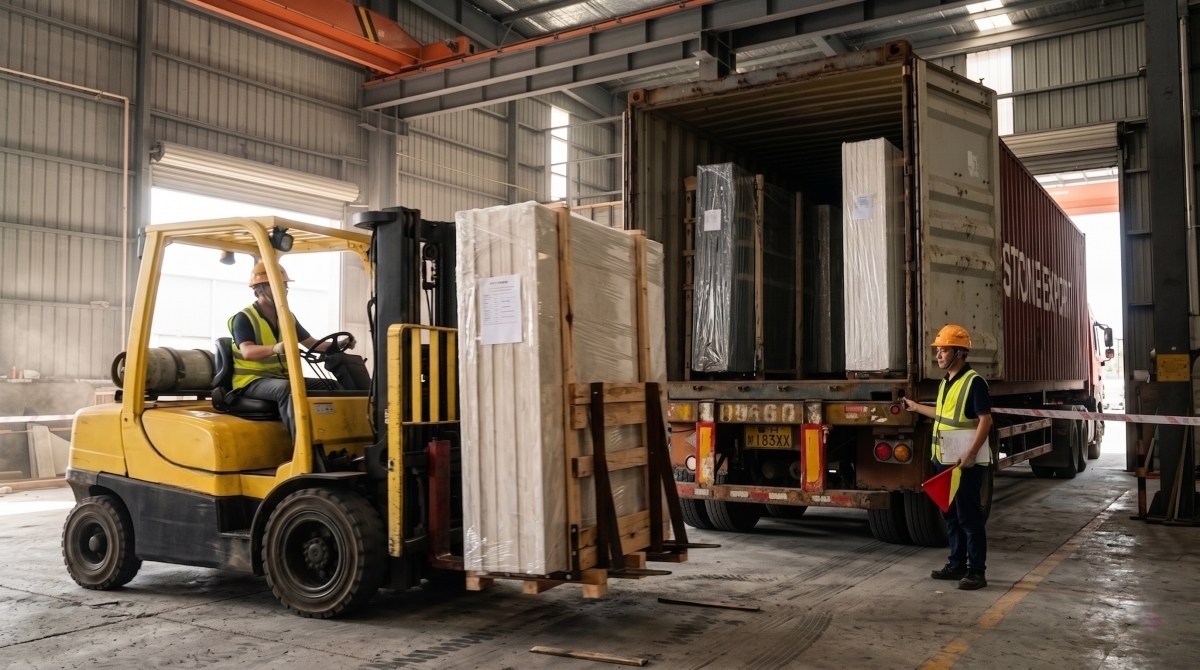
In export stone supply, packing is not the last step after quality.
It is one of the ways quality is made real.
A stone order is only successful when the material arrives not just produced, but protected, organized, and ready for the next stage. That is why thoughtful packing deserves to be treated as part of quality control, project coordination, and customer experience — not as a warehouse formality.
For experienced buyers, this is already obvious.
For growing buyers, learning this early can prevent a surprising amount of loss.



 IPv6 network supported