English
 Español
 Português
 عربي
عربي 한국어
한국어

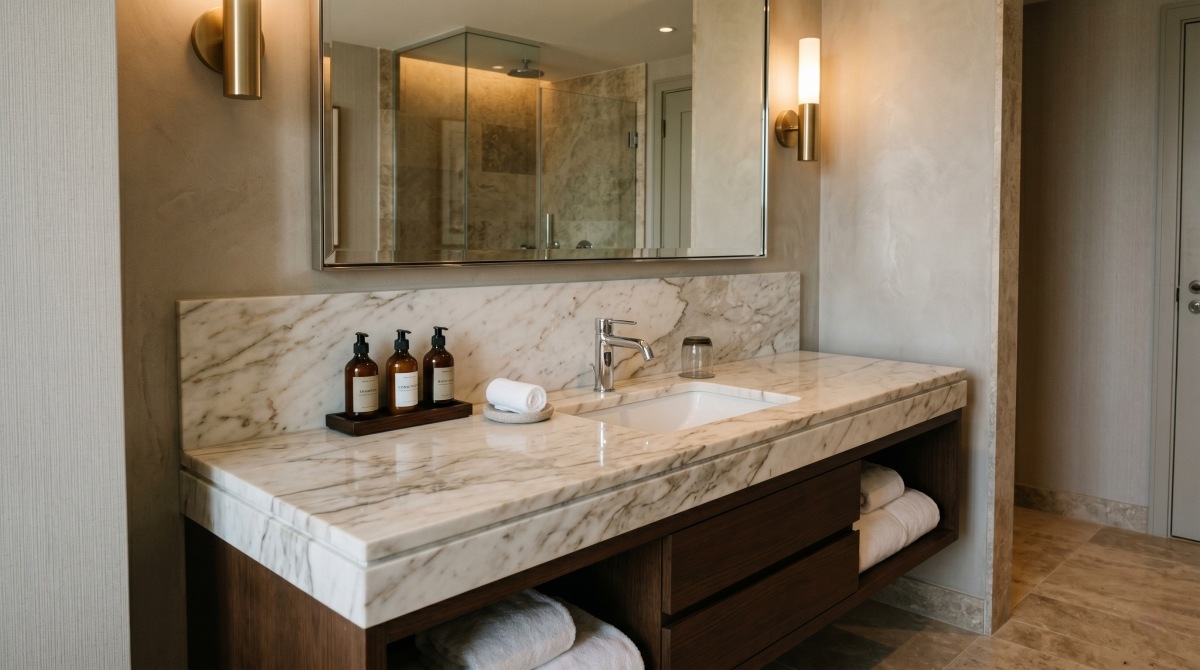
A practical guide to why hotel bathroom vanity tops matter so much in stone supply, covering material selection, fabrication accuracy, cutouts, edge details, packing, and installation control.
Hotel bathroom vanity tops may look like small components, but they are one of the clearest tests of stone supply quality, fabrication accuracy, and project coordination.
In hotel stone supply, the lobby often receives the most attention. It is easy to understand why. A lobby creates the first impression and may use large slabs, dramatic walls, reception counters, flooring patterns, or custom stone details.
But in many hospitality projects, one of the most important stone details is much smaller and far more repetitive: the bathroom vanity top.
A hotel may have one impressive lobby, but it may have dozens or hundreds of guest room bathrooms. Each bathroom may include a vanity top, backsplash, side splash, sink cutout, faucet holes, exposed edges, wall coordination, and packing requirements by room or floor.
Individually, a vanity top may look simple. Across a full hotel project, it becomes a serious test of supplier discipline.
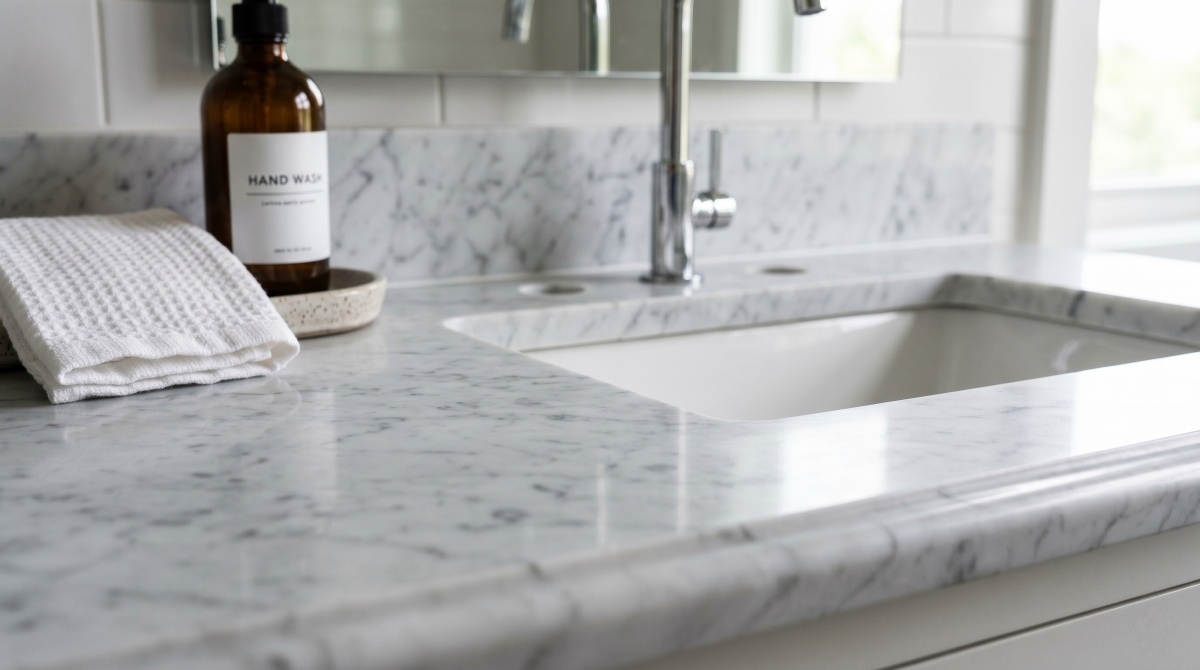
Vanity tops are used closely
A bathroom vanity top is not only viewed from a distance. Guests stand directly in front of it. They touch it, place items on it, look at it under bathroom lighting, and notice its edges, cutouts, finish, seams, and cleaning condition at close range.
That close interaction makes details more important.

One vanity top with a small issue may be manageable. But hotel projects may involve dozens or hundreds of repeated vanity tops.
A slightly inconsistent edge detail becomes a repeated quality issue. A cutout tolerance problem becomes an installation delay. A packing mistake becomes a room-by-room sorting problem.
This is why vanity top supply is a strong test of repeatability.
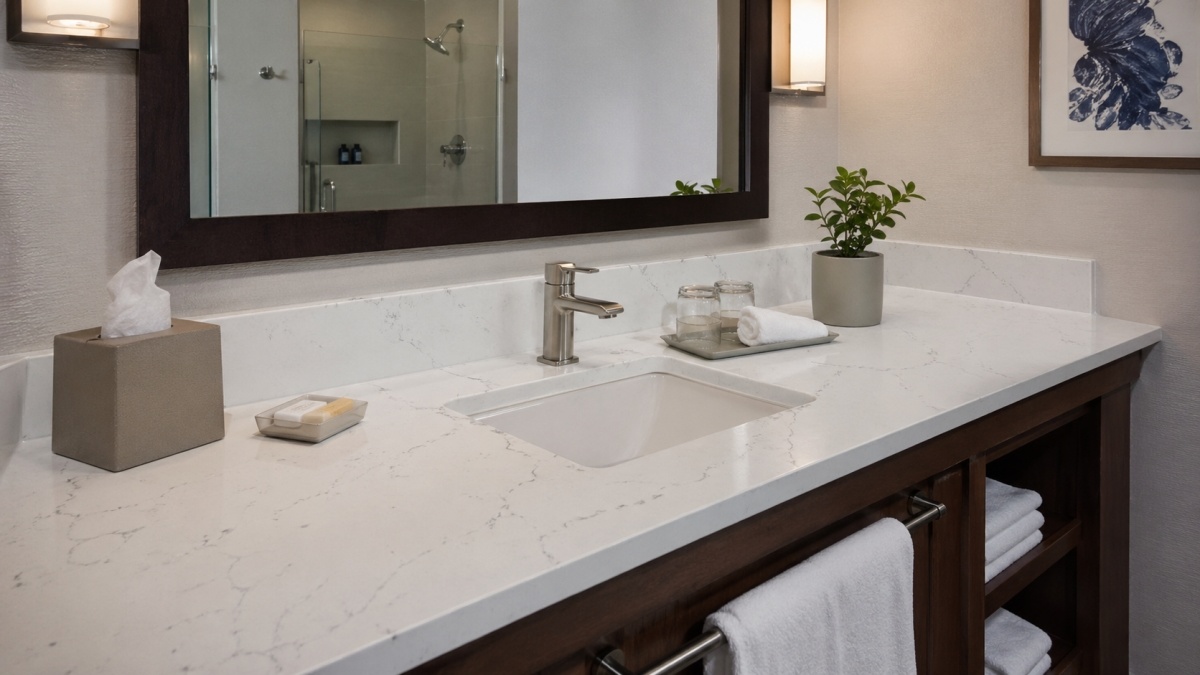
A vanity top material should not be selected only because it looks good in a photo.
Natural marble can offer depth and luxury character, but it requires clear expectation management around natural variation and maintenance. Quartz can provide stronger visual consistency for repeated surfaces. Engineered marble can suit certain hotel programs where visual softness and cost control matter. Terrazzo can create a distinctive design statement, but chip scale and consistency need coordination. Limestone can create a calm natural look, but finish and use conditions should be reviewed carefully.
The best choice is the material that fits the hotel’s design level, use condition, supply logic, and maintenance expectations.
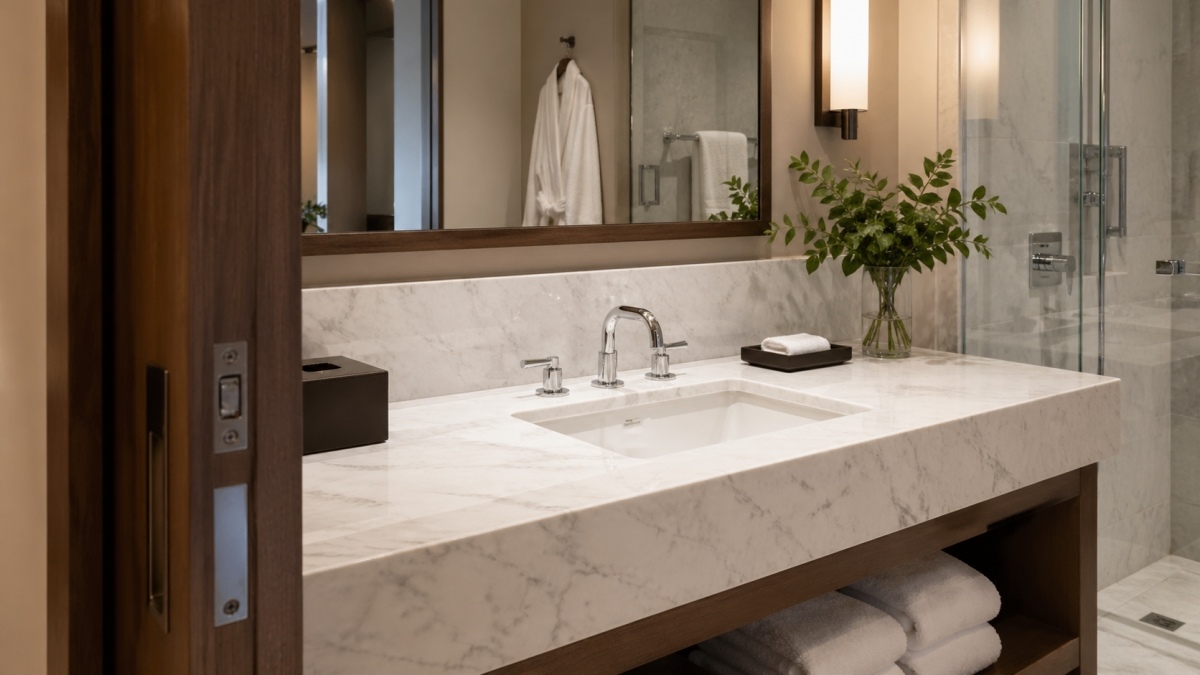
Many vanity top problems begin around the sink.
Before production, the project should clarify sink type, cutout size, faucet hole position, distance from front edge, backsplash requirement, side splash requirement, cabinet support condition, wall tolerance, and confirmed drawings.
A vanity top is not judged only by how well the stone looks. It is judged by whether it fits the real bathroom system.

The edge of a vanity top affects perceived thickness, safety, comfort, cleaning feel, visual refinement, and consistency across rooms.
What matters most in hotel projects is consistency. If the approved edge profile is not repeated accurately, the bathroom program can feel uneven.
Backsplashes and side splashes may look like accessories, but they affect both appearance and installation control.
The project should clarify backsplash height, side splash requirement, whether pieces are separate or integrated, wall condition, joint treatment, and the intended design style.
Across many rooms, vague details become real project friction.
When bathroom vanity tops are part of a larger hospitality stone program, buyers also need to coordinate multiple requirements beyond the stone itself, including fabrication details, quality checking, packing preparation and future replacement needs.
Buyers managing several of these requirements together can review our Hotel Stone Supply Package for Hospitality Projects, which brings material selection, fabrication, dry layout, QC, packing and replacement planning into one project workflow.
Bathroom lighting can reveal uneven polish, inconsistent finish, dull edges, sanding marks, or unexpected tone differences.
For repeated hotel supply, finish should be checked not only as a product feature, but as part of the guest experience.
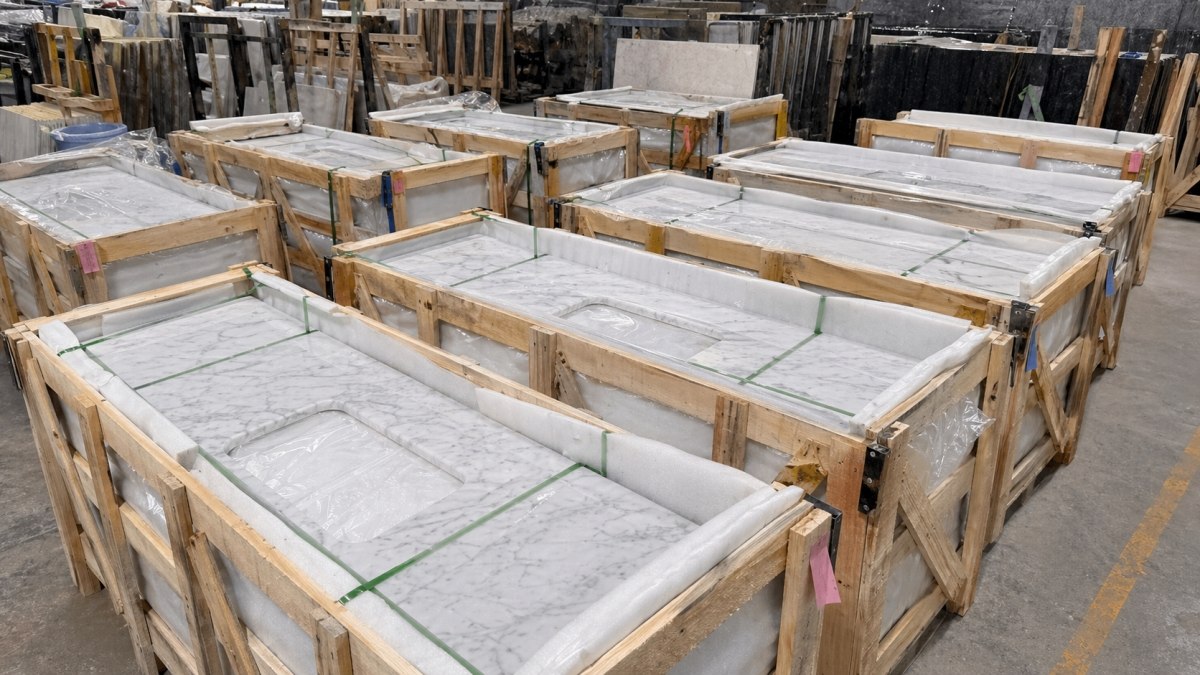
For hotel vanity tops, packing is not just logistics. It is part of project control.
Good packing may include room number grouping, floor grouping, bathroom type grouping, clear piece labels, edge protection, separation of backsplashes and side splashes, readable packing lists, and practical loading sequence.
A vanity top delivered without clear organization may be correct on paper, but difficult on site.
Hotels are long-term operating spaces. Even after installation, the project may need spare material for future replacement, maintenance, damage repair, or later renovation phases.
For materials with visible movement, batch sensitivity, or natural tone variation, spare planning is part of risk control.
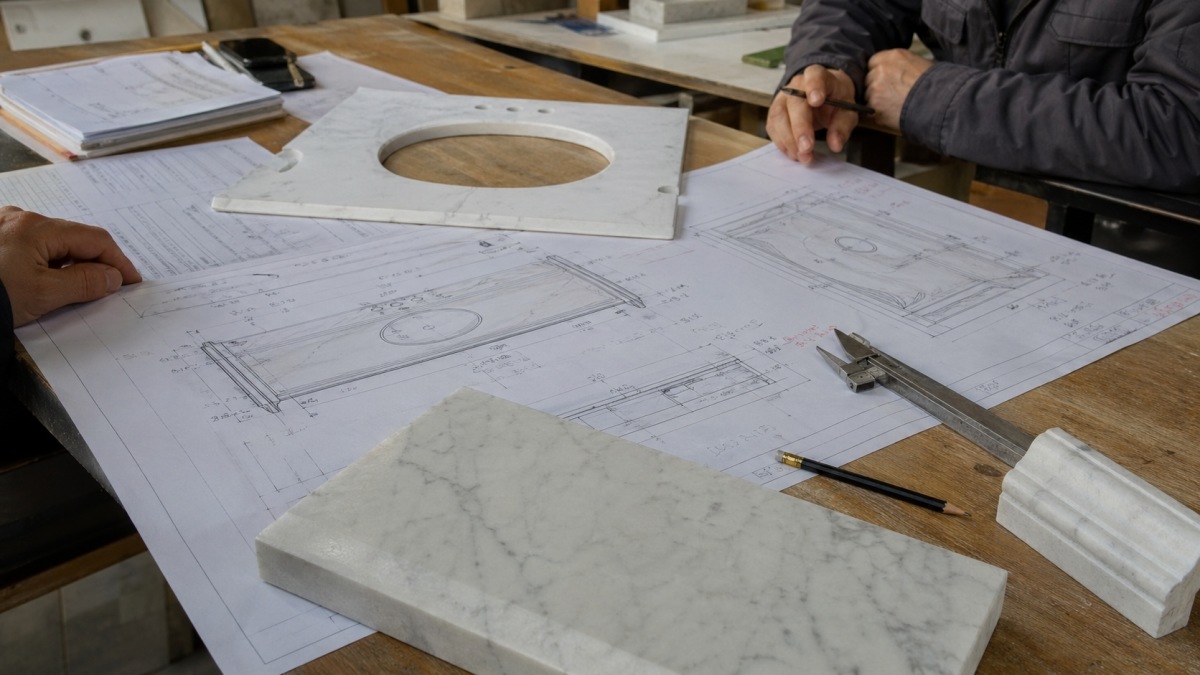
A hotel vanity top is not just a small stone surface.
It is where material selection, fabrication accuracy, functional coordination, guest experience, installation efficiency, and repeatable supply all meet.
One good vanity top may show craftsmanship. A full hotel package of consistent, well-packed, accurately fabricated vanity tops shows project capability.
That is why bathroom vanity tops deserve serious attention in hospitality stone supply.



 IPv6 network supported