English
 Español
 Português
 عربي
عربي 한국어
한국어

A practical guide to why stone shop drawing review matters in project supply, and how early coordination can prevent fabrication errors, site delays, and costly rework.
Stone project delays often begin long before installation. A careful shop drawing review can reduce fabrication mistakes, approval confusion, and costly site rework.
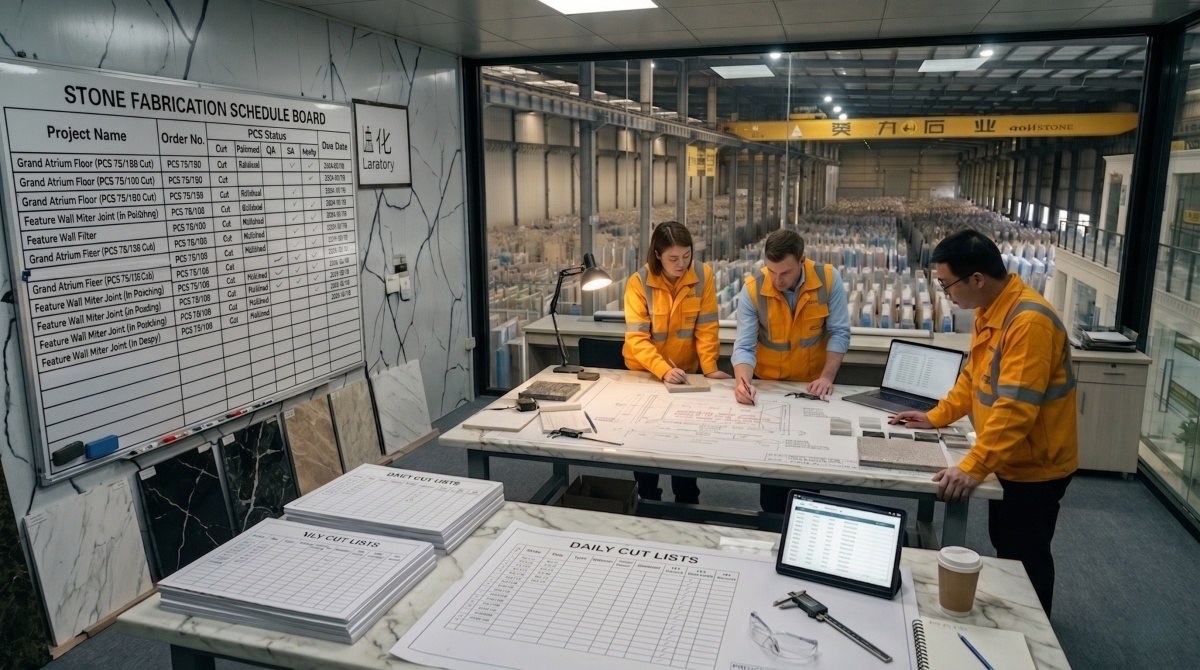
Why a Stone Shop Drawing Review Can Save Weeks of Project Delay
In many stone projects, delay does not begin at the factory. It begins earlier — at the point where drawings are assumed to be ready, questions remain unresolved, and production moves forward anyway.
That is where shop drawing review becomes critical.
To teams with strong project experience, this is obvious. To teams under time pressure, it is often underestimated. A drawing package may look complete enough to keep the schedule moving, but still contain gaps that later turn into fabrication errors, approval disputes, missed dimensions, installation problems, or costly replacement work.
That is why stone shop drawing review is not paperwork for its own sake. It is one of the most practical ways to reduce project risk before the material is cut, packed, shipped, and installed.
Design drawings are often made to communicate intent. But that does not always mean they are ready for fabrication.
Shop drawings serve a different purpose. They have to translate design intent into production logic. That usually means confirming exact finished dimensions, thickness, edge profiles, visible and non-visible faces, joint conditions, cutouts, returns, piece numbering, and installation sequencing where relevant.
When a project team treats design drawings as if they are already full fabrication instructions, problems often move quietly downstream.
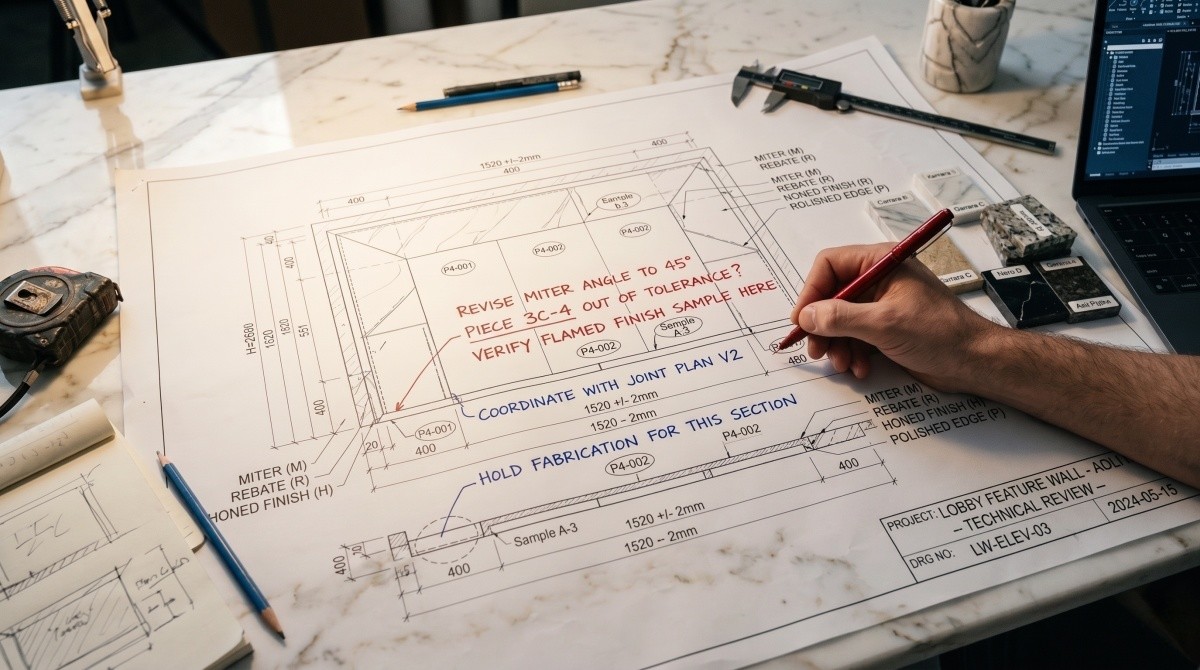
A small ambiguity can become a wrong edge detail, a reversed vein direction, an incorrect opening position, a thickness mismatch, a missing return, an unfinished exposed side, or a piece that cannot fit actual site conditions.
These issues often become visible only after production starts or when installers begin working with the pieces. At that point, every correction is slower and more expensive.
Once a slab has been cut, polished, profiled, reinforced, labeled, packed, and shipped, the cost of change rises quickly. Even when replacement is possible, it affects schedule, freight, visual matching, and labor planning.
This is especially true for cut-to-size flooring, stair components, vanity tops with sink cutouts, wall cladding panels, bookmatched layouts, shaped components, and projects with tight joint control.
Many project delays come from different teams understanding the same drawing differently. The architect may focus on appearance, the contractor on buildability, the buyer on delivery, the factory on fabrication practicality, and the installer on fit and sequence.
Shop drawing review creates a checkpoint where those interpretations can be aligned before assumptions become finished pieces.
A serious review stage often reveals critical questions: which face is finished, which edges are exposed, how veining should run, how corners should be resolved, whether a piece is too fragile as drawn, and how numbering should relate to installation.
These are the details that often decide whether a project runs smoothly or becomes reactive.

Fast approval without clear review often creates a false sense of progress. A drawing approved too quickly can still lead to fabrication stoppage, urgent revision rounds, site hold-ups, replacement orders, or installation resequencing.
Done properly, shop drawing review is not a delay. It is delay prevention.
When drawings are clear, factories can label more accurately, group pieces more logically, separate fragile components properly, and align numbering with shop drawings.
That means better organization later during packing, shipment, and installation.
Stone projects do not become delayed only because factories are slow or shipping is difficult. Very often, delay begins earlier — when unresolved drawing questions are carried forward into production.
That is why stone shop drawing review deserves more respect than it often gets. In practical project terms, it can mean the difference between a controlled order and a reactive one. And in some cases, it can save weeks.




 IPv6 network supported