English
 Español
 Português
 عربي
عربي 한국어
한국어

A stone order does not become safe just because it has arrived.
Arrival is an important stage.
The material has left the factory. It has been packed, loaded, shipped, unloaded, moved, and sometimes stored before reaching the project site or warehouse.
At this point, buyers often feel the difficult part is finished. But if the goods are not checked properly before installation, small problems can become expensive site problems.
That is why stone arrival inspection before installation should be treated as part of project control, not a formality.

Check the Crates Before Unpacking
Before opening crates or moving pieces, buyers should first check the outside condition.
Look for damaged crate corners, broken wooden frames, loose straps, signs of impact, shifted packing, wet or dirty areas, missing marks, unclear crate numbers, and visible mishandling during transport.
If a crate looks damaged, take photos before unpacking.
Do not rush to remove the packaging before recording visible damage.
Match Crate Numbers With the Packing List
The packing list is not just a shipping document.
It should help the buyer understand what has arrived.
Before moving pieces to the installation area, check crate number, number of crates received, piece list, area or room code if provided, slab or panel count, project code if used, missing or duplicated labels, and whether the sequence matches the packing list.
For international stone project supply from China, crate and packing list consistency helps reduce confusion after arrival.
Check Visible Damage Before Installation
After unpacking, inspect the stone before installation begins.
Check for broken corners, chipped edges, cracks, surface scratches, polish damage, damaged cutouts, broken thin parts, corner impact, label loss, and incorrect piece sequence.
This does not mean every small natural mark is a defect. The important point is to separate shipping damage, fabrication error, normal material character, installation handling damage, and site-caused damage.
Check Material Against the Approved Range
Arrival inspection should be connected to the approval record.
For natural marble materials for architectural projects, buyers should check whether the arrived pieces stay within the approved tone, veining, movement, and finish range.
For artificial marble slabs for commercial interiors, buyers should check surface consistency, finish, color direction, and whether the material matches the approved sample or batch expectation.
For quartz stone surfaces for countertops and vanity tops, buyers should check visible faces, edge work, cutouts, backsplash pieces, sink areas, and surface condition before installation.
For terrazzo stone for hotel and retail spaces, buyers should check base color, aggregate distribution, finish, edge condition, and whether pieces remain visually consistent across the intended area.
Check Dimensions Before the Stone Is Fixed
Dimensions should be checked before installation, not after.
For slabs, confirm size and thickness if relevant. For tiles and panels, check key dimensions. For countertops, check length, width, thickness, cutouts, faucet holes, backsplash, side splash, and exposed edges. For stairs, check tread size, riser size, nosing, thickness, and sequence. For wall panels, check layout, piece numbers, joint logic, and direction.
A supplier with real stone manufacturing and fabrication capability should provide pieces according to the confirmed drawings and size list, but buyers should still do a site-side check before installation.

Keep Labels Until the Installer Understands the Sequence
Do not remove all labels too early.
For project stone, labels may connect pieces to floor level, room number, wall elevation, countertop set, staircase sequence, bathroom type, crate number, drawing number, and installation direction.
Labels are not decoration. They are part of installation control.
Recheck Dry Layout for Important Visible Areas
Some areas should be reviewed again before final installation.
For natural marble feature walls, bookmatched panels, lobby floors, staircase packages, and high-visibility areas, dry layout or sequence review can help prevent visible mistakes.
This may include checking vein direction, tone sequence, bookmatch order, panel joints, floor pattern direction, stair tread sequence, and visible area allocation.
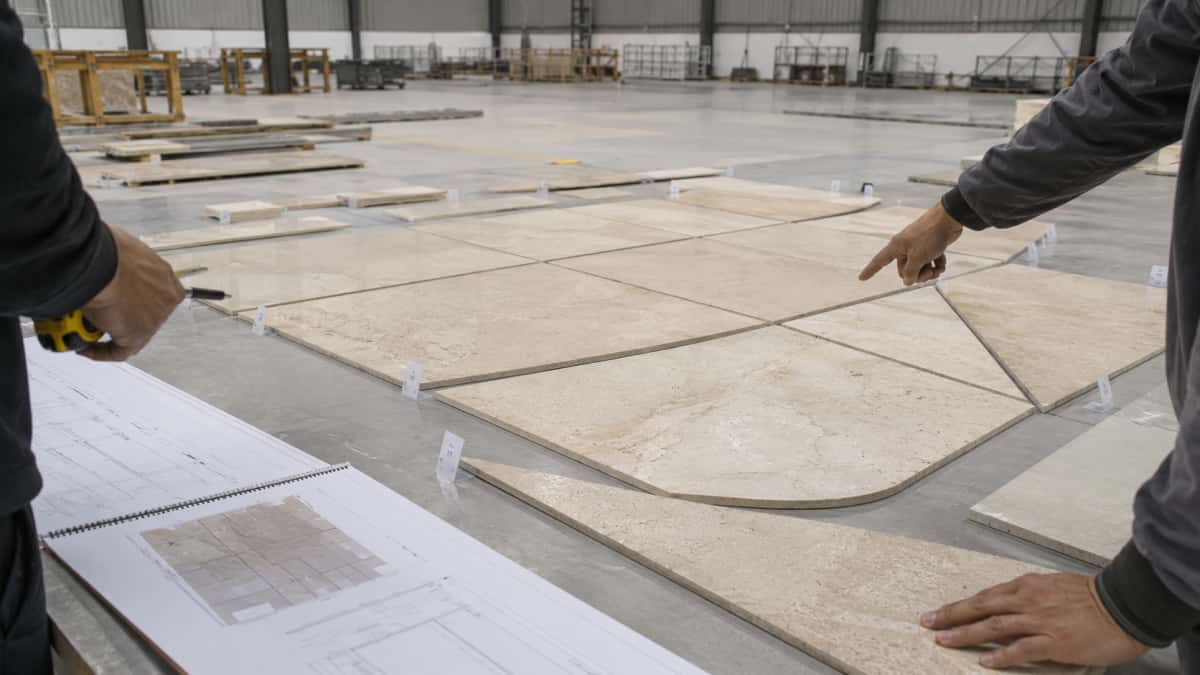
Store Stone Properly Before Installation
Arrival inspection is not only about checking. It is also about storage.
Poor storage can damage stone before it is installed.
Stone should be stored in a clean, stable, dry, and organized area where pieces can be identified easily.
A good supplier can pack carefully, but the site must also handle carefully.
Check Site Conditions Before Installation
Stone can be correct, but the site may not be ready.
Before installation, buyers or contractors should check substrate flatness, wall or floor readiness, moisture condition, structural support, cabinet level for countertops, opening size for sinks or cookers, stair base condition, wall panel support method, joint planning, lighting condition, protection plan after installation, and coordination with other trades.
A stone supplier can provide materials and fabrication support, but installation quality depends strongly on site preparation and installer skill.
Report Problems Quickly and Clearly
If a problem is found, report it before installation.
A useful report should include order number or project name, crate number, piece number, photos of the piece, close-up of the issue, full view of the piece, label photo, packing condition if relevant, measurement photo if size is disputed, and whether the piece has been installed or not.
The earlier the issue is reported, the more options both sides have.
Do Not Install Pieces With Unresolved Problems
If a piece has a visible issue, wrong dimension, unclear label, wrong sequence, or suspected damage, do not install it before the issue is reviewed.
Once installed, it becomes harder to determine whether the problem came from production, transport, site handling, installation, cleaning, or use.
When in doubt, isolate the piece, photograph it, and clarify before installation.
A Practical Arrival Inspection Checklist
Before installation, buyers can use this checklist:
Crate condition checked:
Crate numbers match packing list:
Piece labels checked:
Quantity checked:
Visible damage checked:
Material matches approval:
Finish checked:
Dimensions checked:
Thickness checked where relevant:
Cutouts and holes checked:
Edges and corners checked:
Dry layout needed and reviewed:
Labels kept until sequence confirmed:
Storage area clean and safe:
Site condition reviewed:
Installer understands piece sequence:
Documents and packing list saved:
Problems photographed before installation:
Supplier contacted before installing disputed pieces:
Here Comes Final Thought
Stone arrival is not the end of project control.
It is the bridge between factory supply and site installation.
Before installation begins, buyers should check crate condition, labels, packing list, visible damage, material range, dimensions, finish, dry layout, storage, site readiness, and issue reporting.
A good supplier should support clear records before shipment. A good buyer should protect the material after arrival. A good installer should not install pieces before sequence and site conditions are understood.
For project material supply, documentation, packing coordination, and practical stone order support, buyers can contact Aoli Stone for stone project supply support.



 IPv6 network supported