English
 Español
 Português
 عربي
عربي 한국어
한국어

Terrazzo flooring can be a strong choice for commercial projects, but it should not be approved by color alone. In hotels, restaurants, retail stores, offices, galleries, and public areas, terrazzo flooring must work under real traffic, lighting, cleaning, installation, and maintenance conditions. A small sample may look attractive, but a commercial floor needs a more careful approval process.

Before production begins, project buyers should confirm the terrazzo type, aggregate design, surface finish, thickness, tile or slab format, joint layout, packing method, installation responsibility, and pre-shipment inspection requirements. These details decide whether the flooring will install smoothly, perform correctly, and match the design intent after delivery.
Why Commercial Terrazzo Flooring Needs Careful Approval
Commercial floors are different from small residential areas. They usually cover larger spaces, receive more foot traffic, and are judged from different viewing distances. A terrazzo sample that looks balanced on a desk may look too busy across a large lobby. A polished finish that looks premium in a photo may create glare under strong lighting. A large-format tile may reduce joints, but it may also be harder to handle on site.
The main risk is approving terrazzo as a surface pattern instead of a flooring system.
For commercial projects, terrazzo flooring should be reviewed as a combination of material, finish, size, layout, installation, maintenance, and supply control. If any of these points are unclear, the project may face problems after production or after arrival at site.
Key Approval Point 1: Application Area and Traffic Level
The first question is where the terrazzo flooring will be used. A hotel lobby, restaurant floor, bathroom, office corridor, retail store, and gallery space do not have the same requirements.
Buyers should confirm:
· Is the area high-traffic or low-traffic?
· Is it dry, wet, or sometimes exposed to water?
· Will luggage, carts, furniture, or cleaning machines move across the floor?
· Is the area public, private, indoor, semi-outdoor, or near an entrance?
· Will the floor be viewed from close distance or across a large open space?
A terrazzo design may be suitable for a feature area but too strong for a long corridor. A calm terrazzo may work well for repeated hotel floors but look too plain in a flagship retail space. The application area should guide the material choice, not only the sample photo.
Key Approval Point 2: Aggregate Size and Chip Density
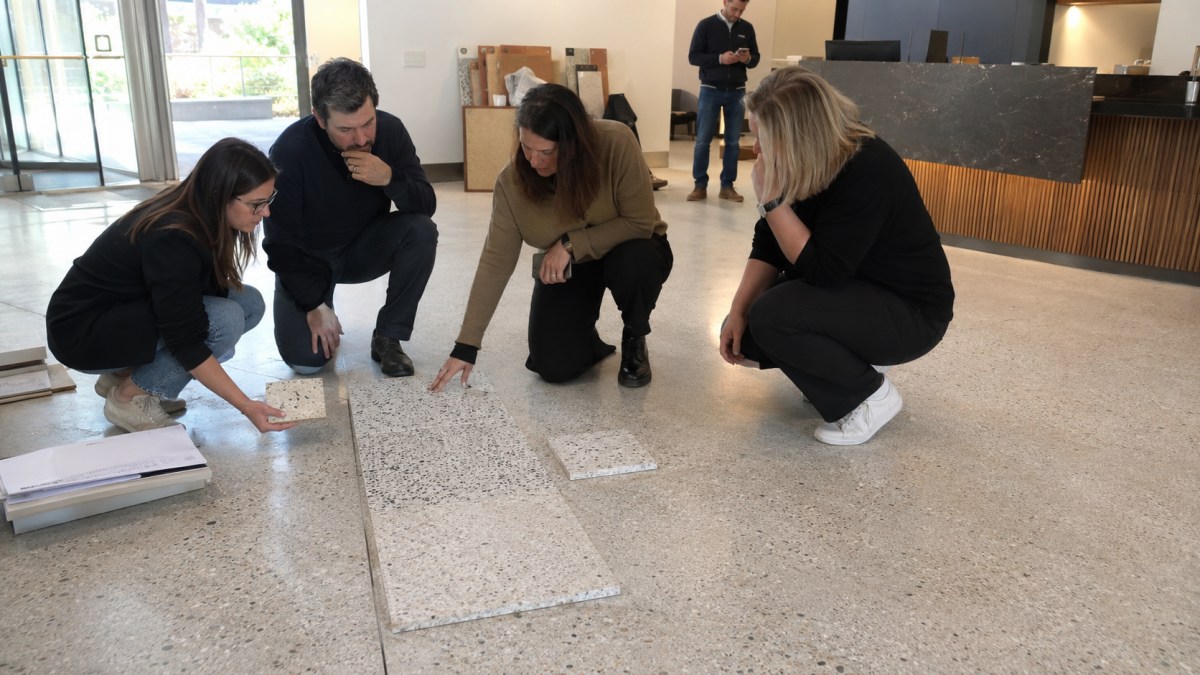
Aggregate size and chip density change how terrazzo flooring feels in a real space. Small aggregate usually gives a calmer and more uniform surface. Medium aggregate gives clear terrazzo character without becoming too dominant. Large aggregate creates a stronger design statement but requires more careful review.
Chip density also matters. A dense terrazzo may feel rich and active, while a sparse terrazzo may feel cleaner and more minimal. Neither is always better.
For commercial flooring, buyers should ask:
· Is the aggregate size suitable for the area size?
· Will the pattern look too busy across a large floor?
· Does the sample show enough chip distribution?
· Is a larger sample, slab photo, tile layout, or mockup needed?
· Will cutting create unattractive partial chips at edges or borders?
A small sample can show the material language, but it cannot always show the final floor scale.
Key Approval Point 3: Honed, Polished, or Another Finish
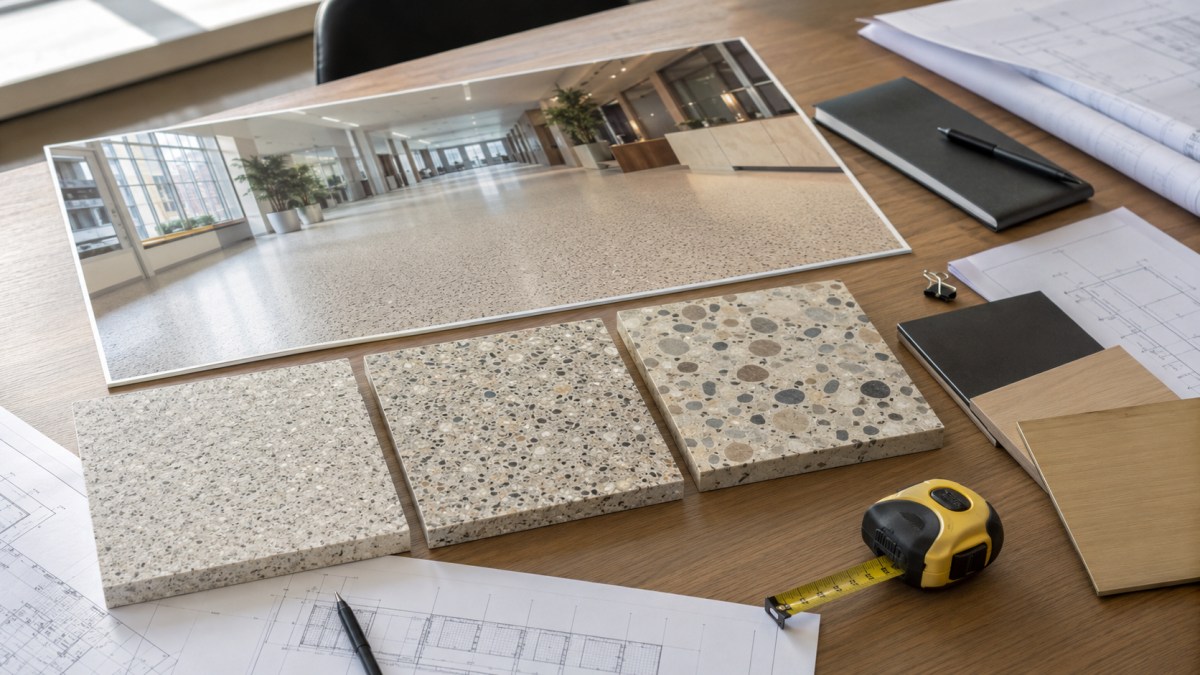
Surface finish is one of the most important approval points for terrazzo flooring. Honed terrazzo gives a matte or low-sheen appearance. Polished terrazzo gives a brighter and more reflective surface. Other finishes may be needed depending on the project and performance expectations.
For commercial floors, finish approval should consider more than appearance.
Buyers should confirm:
· Is strong reflection acceptable in this space?
· Will the floor be exposed to water or heavy traffic?
· Is slip perception or slip-resistance a concern?
· Will the finish show scratches, water marks, cleaning marks, or dulling?
· Does the selected finish change the color and chip contrast?
· Has the finish been reviewed under realistic project lighting?
A polished terrazzo sample may look more attractive in photos, but it may not be suitable for every commercial floor. A honed terrazzo finish may feel more practical, but it still needs sealing and maintenance review.
The finish should be approved together with the application area.

Key Approval Point 4: Tile, Slab, or Cut-to-Size Format
Terrazzo flooring can be supplied as tiles, slabs, or cut-to-size pieces. The format affects installation, joint layout, packing, replacement, and site handling.
Terrazzo tiles are often practical for commercial floors because they are easier to pack, move, install, and replace. Larger slabs or cut-to-size pieces may reduce joints in selected areas, but they also require stronger handling, more careful packing, and confirmed site access.
Buyers should clarify:
· What size is suitable for the floor area?
· Is the project using standard tiles or cut-to-size pieces?
· Can the site receive and move large pieces safely?
· How will joints align with walls, doors, columns, and furniture?
· Are spare pieces needed for future replacement?
· Will the supplier provide dry lay or layout photos before shipment?
Large format is not automatically better. The right format is the one that matches the floor design, site handling, installation team, and export supply plan.
Key Approval Point 5: Thickness and Dimensional Tolerance
Thickness should be confirmed before production, especially for commercial projects where terrazzo flooring must meet door thresholds, elevator areas, stair transitions, skirting, drainage details, or adjacent flooring materials.
Buyers should confirm:
· What thickness is required?
· Is the thickness suitable for the floor build-up?
· Are there transitions to wood, carpet, ceramic tile, metal trim, or other stone?
· What size tolerance and thickness tolerance are acceptable?
· Will the installer need adhesive, mortar bed, leveling system, or special substrate preparation?
If thickness and tolerance are not confirmed early, installation problems may appear at doorways, floor transitions, elevator entrances, and stair connections.
Key Approval Point 6: Joint Layout and Visual Continuity
Joint layout affects the final appearance of terrazzo flooring. Even when the material is beautiful, poor joint planning can make the floor look unprofessional.
Buyers should review:
· Tile size or piece size
· Joint width
· Grout color
· Alignment with walls and columns
· Cut pieces at edges
· Border layout
· Expansion or movement joints
· Relationship with furniture and lighting
If the project expects a seamless look, tile or slab terrazzo may not fully achieve the same result as in-situ terrazzo. If the project accepts visible joints, the joint layout should still be planned carefully.
The floor should be approved as a layout, not only as a material.
Key Approval Point 7: Sample, Mockup, or Full-Area Reference
For commercial terrazzo flooring, sample approval should be handled carefully. A small sample may confirm color, aggregate, and finish, but it may not confirm large-area visual effect, joint rhythm, slip perception, or lighting response.
A larger sample, mockup, slab photo, or tile layout may be needed when:
· The aggregate is large or high contrast
· The chip density is very high or very low
· The project area is large and public
· The finish is polished or strongly reflective
· The design requires close color control
· The project includes stairs, borders, or special cut pieces
· The buyer has strict design intent requirements
For important commercial spaces, the approval process should not stop at one small sample.
Key Approval Point 8: Packing, Labeling, and Pre-Shipment Photos
For international projects, terrazzo flooring approval does not end after production. Buyers should also confirm how the material will be packed, labeled, photographed, and shipped.
This is especially important for tile orders, cut-to-size flooring, stair pieces, or projects with multiple areas.
Buyers should ask:
· Will pieces be packed by area, floor, room, or drawing number?
· Will labels match the packing list and drawings?
· Will edge protection be used?
· Will spare pieces be included?
· Can the supplier provide pre-shipment photos?
· Can the buyer review packing before container loading?
· How will tiles or pieces be protected from movement inside crates?
Good packing does not make a poor material good, but poor packing can damage a good material before it reaches the site.
Key Approval Point 9: Installation Responsibility
Many terrazzo flooring problems come from unclear responsibility. The supplier may provide finished material, but the installer controls substrate preparation, adhesive, leveling, joint width, cleaning, sealing after installation, and final site care.
Before approval, the project team should clarify:
· Who prepares the substrate?
· Who checks floor flatness?
· Who installs the terrazzo flooring?
· Who handles grout or joint treatment?
· Who performs final cleaning?
· Who handles sealing or post-installation care?
· Who is responsible if the site condition causes installation problems?
· What information should be included in the installation method statement?
Material approval and installation responsibility should be discussed together. Otherwise, defects may be blamed on the material even when the issue comes from site conditions or installation method.
Commercial Terrazzo Flooring Approval Table
|
Approval Point |
What Buyers Should Confirm |
Why It Matters |
|
Application area |
Lobby, corridor, retail, restaurant, bathroom, office, public area |
Different areas have different traffic, cleaning, and safety expectations |
|
Aggregate design |
Chip size, density, color contrast, visual scale |
A small sample may not show full-floor effect |
|
Surface finish |
Honed, polished, low-sheen, slip expectation, glare |
Finish affects appearance, maintenance, and safety perception |
|
Format |
Tile, slab, cut-to-size pieces |
Format affects joints, handling, packing, and replacement |
|
Thickness |
Required thickness and floor build-up |
Prevents transition and installation problems |
|
Joint layout |
Tile size, joint width, grout color, alignment |
Controls final visual quality |
|
Mockup or larger sample |
Needed for strong designs or public spaces |
Reduces sample approval risk |
|
Packing and labels |
Area numbering, crate protection, pre-shipment photos |
Supports international shipment control |
|
Installation responsibility |
Supplier, contractor, installer, site team |
Prevents disputes after delivery |
Buyer Checklist Before Approving Terrazzo Flooring
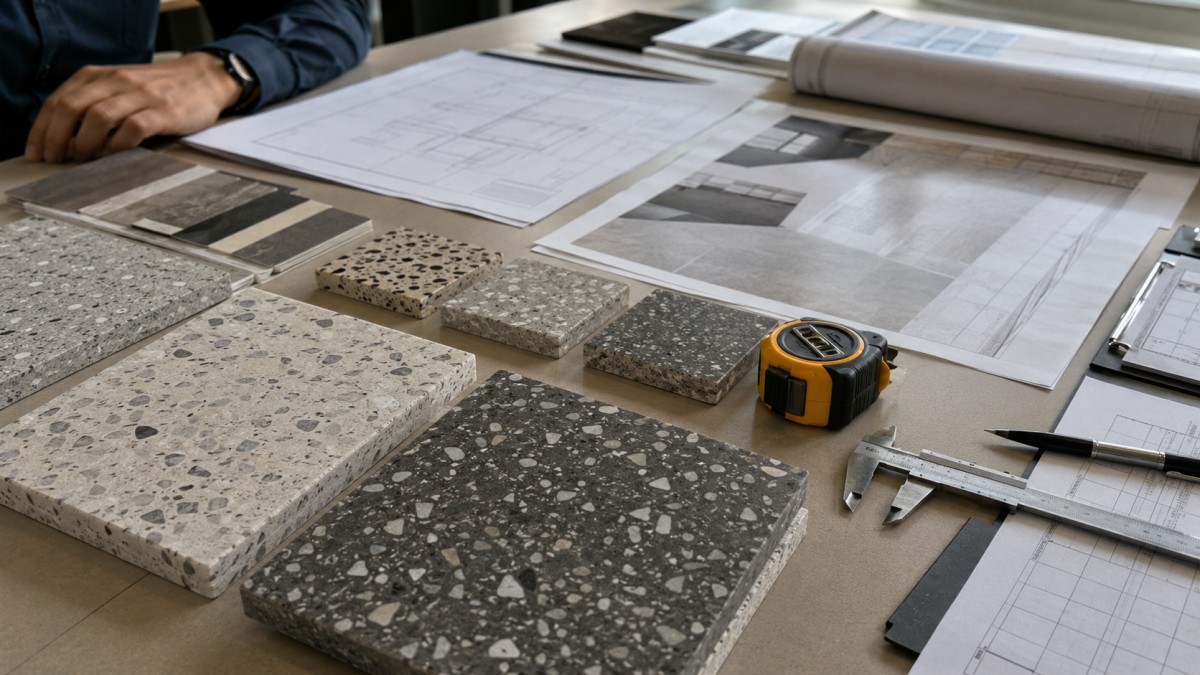
Before confirming terrazzo flooring for a commercial project, buyers should clarify:
1. What is the exact application area?
2. Is the area high-traffic, wet, public, or exposed to heavy use?
3. What terrazzo type is being supplied?
4. What aggregate size and chip density are approved?
5. Is the sample large enough to show the real design scale?
6. What finish is approved: honed, polished, or another finish?
7. Has the finish been reviewed under realistic lighting?
8. What thickness and tolerance are required?
9. What tile size, slab size, or cut-to-size format will be used?
10. Has the joint layout been reviewed?
11. Is a mockup, slab photo, or dry lay photo needed?
12. How will pieces be packed and labeled?
13. Are spare pieces required?
14. What pre-shipment photos should be checked?
15. Who is responsible for substrate preparation, installation, cleaning, and sealing?
If these questions are not answered, the terrazzo flooring approval is not complete.
Red Flags Before Production
A terrazzo flooring project should be reviewed carefully if any of the following situations appear:
· The buyer approves the flooring only from a small sample photo.
· The project does not confirm honed or polished finish in writing.
· The same finish is used for all areas without reviewing traffic or wet conditions.
· The drawing does not show joint layout.
· The selected tile or slab size has not been checked against site access.
· The project expects seamless flooring but uses modular tiles without discussing joints.
· Thickness is not coordinated with doorways, elevators, or adjacent flooring.
· No one confirms packing, labels, spare pieces, or pre-shipment photos.
· Installation responsibility is not clearly divided.
· The supplier promises perfect consistency without explaining normal aggregate or batch variation.
These issues can lead to installation delay, visual disappointment, extra replacement cost, or disputes between buyer, supplier, contractor, and installer.
A Simple Approval Rule
Commercial terrazzo flooring should be approved in this order:
Application area first.
Then aggregate design.
Then finish.
Then format and thickness.
Then joint layout.
Then packing and pre-shipment inspection.
Then installation responsibility.
If the order is reversed, the project may choose a beautiful sample that does not fit the real site.
FAQ
Is terrazzo flooring suitable for commercial projects?
Yes, terrazzo flooring can be suitable for hotels, restaurants, retail stores, offices, galleries, corridors, bathrooms, and public spaces. The project team should confirm finish, traffic level, slip expectation, thickness, joint layout, and maintenance before approval.
Should commercial terrazzo flooring be honed or polished?
There is no single correct answer. Honed terrazzo is often chosen for lower reflection and a calmer appearance, while polished terrazzo gives a brighter and more reflective effect. For floors, buyers should review traffic, lighting, wet conditions, maintenance, and local performance expectations.
Can buyers approve terrazzo flooring from a small sample?
A small sample can help confirm color, aggregate, and finish, but it may not show full-area visual scale. For large commercial areas, strong aggregate designs, or important public spaces, a larger sample, slab photo, tile layout, or mockup is safer.
What should be checked before shipment?
Buyers should check material appearance, finish, thickness, size, labels, packing method, edge protection, spare pieces, and pre-shipment photos before container loading.
Who is responsible for terrazzo flooring installation?
This depends on the project agreement. Buyers should clarify who is responsible for substrate preparation, installation, joint treatment, cleaning, sealing, protection, and final site care before production or shipment.

If your commercial project is reviewing terrazzo flooring, send the application area, drawings, preferred aggregate design, finish, thickness, tile or slab size, quantity, and shipment requirements. A project review before production can help clarify what should be approved before the material is cut, packed, and shipped.



 IPv6 network supported