English
 Español
 Português
 عربي
عربي 한국어
한국어

Choosing terrazzo thickness is not only a price decision. The same terrazzo material may perform very differently when used as a floor tile, wall panel, countertop, stair tread, or large slab. If the thickness is too thin for the application, the project may face breakage, weak edges, installation difficulty, or visible deflection. If the thickness is unnecessarily heavy, the buyer may pay more for material, packing, shipping, handling, and installation without gaining real project value.
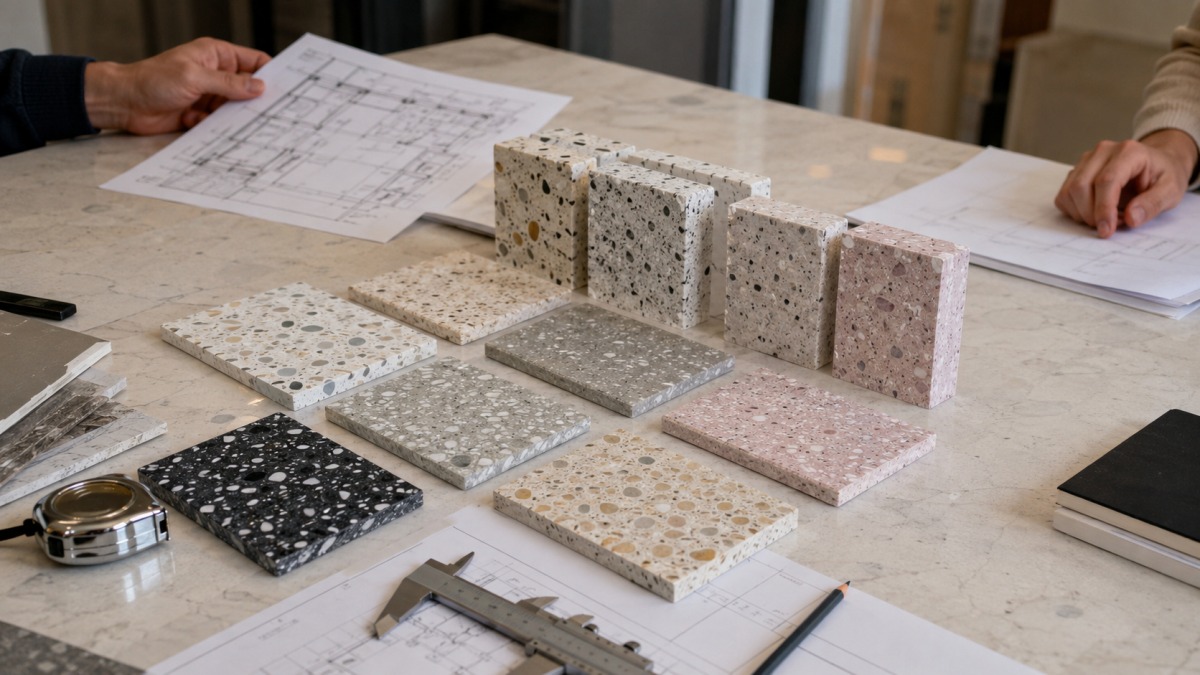
The right question is not simply “What thickness do you have?” A better question is: “What thickness is suitable for this application, this piece size, this edge detail, this support condition, and this installation method?”
Many buyers compare terrazzo thickness like a simple product parameter: 12 mm, 15 mm, 18 mm, 20 mm, 30 mm, or 40 mm. But thickness cannot be judged alone. A 20 mm terrazzo slab may be suitable for one countertop but risky for another if the piece is long, unsupported, or requires a heavy edge profile. A thinner tile may work for wall cladding but may not be suitable for a busy commercial floor. A stair tread may need more strength and edge stability than a flat wall panel.
The confusion usually comes from three problems.
First, buyers often receive quotations from different suppliers based on different assumptions. One supplier may quote 15 mm tiles, while another quotes 20 mm tiles. The price difference looks attractive, but the application risk may not be the same.
Second, drawings sometimes show terrazzo only as a surface material without confirming thickness, edge detail, backing support, installation method, or expected traffic level.
Third, buyers may assume thicker terrazzo is always safer. This is not always true. Excessive thickness can increase weight, packing difficulty, freight cost, and on-site handling risk. The goal is not maximum thickness. The goal is suitable thickness.
Thickness is a project decision, not just a material number.
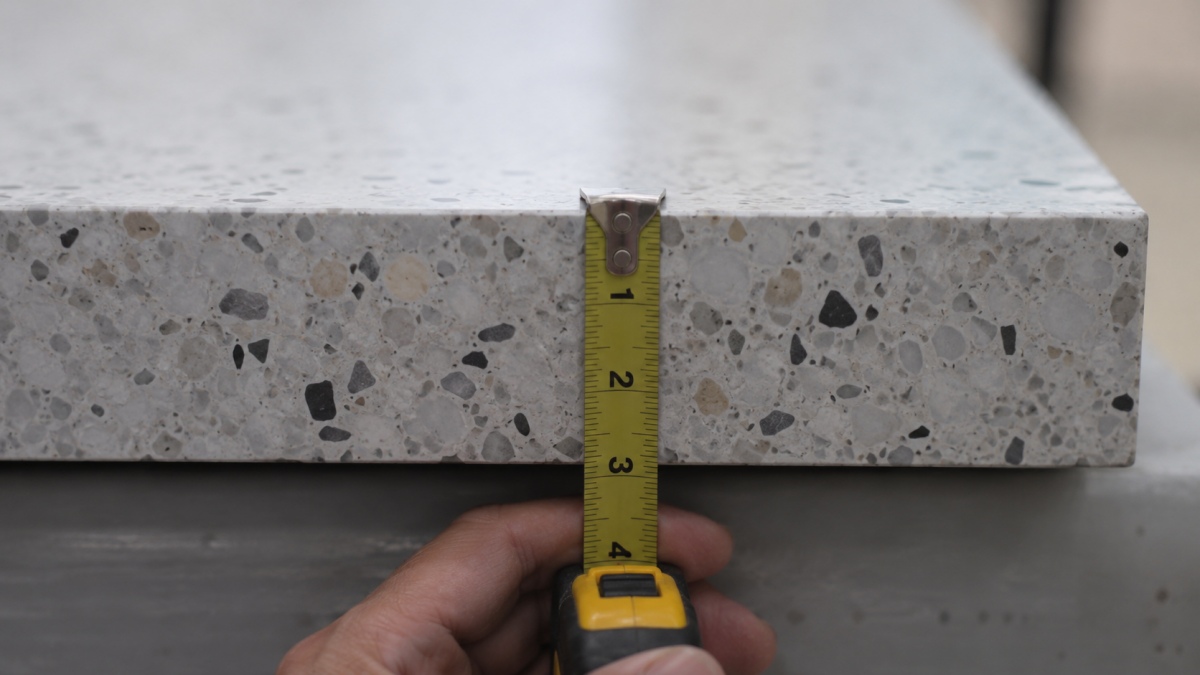
The first factor is where the terrazzo will be used. Floor tiles, wall panels, countertops, stair treads, risers, vanity tops, reception desks, and facade elements do not carry the same load or risk.
For example, a wall panel mainly needs stable fixing and manageable weight. A countertop needs edge strength, support planning, and cutout control. A stair tread needs resistance to foot traffic, edge impact, and installation stress. A large floor tile needs flatness, subfloor condition, joint planning, and traffic suitability.
Before asking for thickness, buyers should define the application area clearly.
A small tile and a large slab cannot always use the same thickness. Larger pieces are more difficult to handle, pack, transport, and install. They may also be more sensitive to bending, corner damage, and breakage during movement.
For large-format terrazzo slabs or cut-to-size panels, thickness should be reviewed together with length, width, weight, fixing method, and packing plan.
Support condition is one of the most important but often ignored factors. A terrazzo piece fully supported by a solid substrate behaves differently from a piece that is partially unsupported or used across a span.
For floors, the substrate must be flat, stable, and suitable for tile installation. For countertops, cabinet support, brackets, overhangs, and cutouts must be reviewed. For stairs, the tread support and nosing detail matter. For wall panels, fixing method and backing structure should be confirmed.
A thickness that is safe with full support may be risky with poor support.
A residential bathroom floor, a hotel lobby floor, a shopping mall corridor, and a restaurant counter do not face the same level of use. Commercial and public areas usually require more conservative decisions because traffic, impact, cleaning frequency, and long-term maintenance demands are higher.
Buyers should tell the supplier whether the project is residential, hotel, retail, restaurant, office, airport, school, or other commercial space.
Thickness affects edge processing. Countertops, stair nosings, vanity tops, reception counters, and furniture pieces often require visible edges. If the material is too thin, some edge profiles may look weak or be difficult to fabricate safely.
Cutouts also matter. Sink holes, faucet holes, cooktop openings, drain holes, and curved corners can reduce local strength. A countertop with several cutouts may need a different thickness or reinforcement plan compared with a simple rectangular panel.
Cement-based terrazzo, resin terrazzo, precast terrazzo slabs, terrazzo tiles, and poured-in-place terrazzo systems may have different thickness logic. Buyers should avoid treating all terrazzo as one identical material.
For export projects involving precast terrazzo slabs, tiles, countertops, or stairs, the supplier should confirm what thickness is available, what thickness is recommended for each application, and whether the requested size can be produced, packed, and delivered safely.
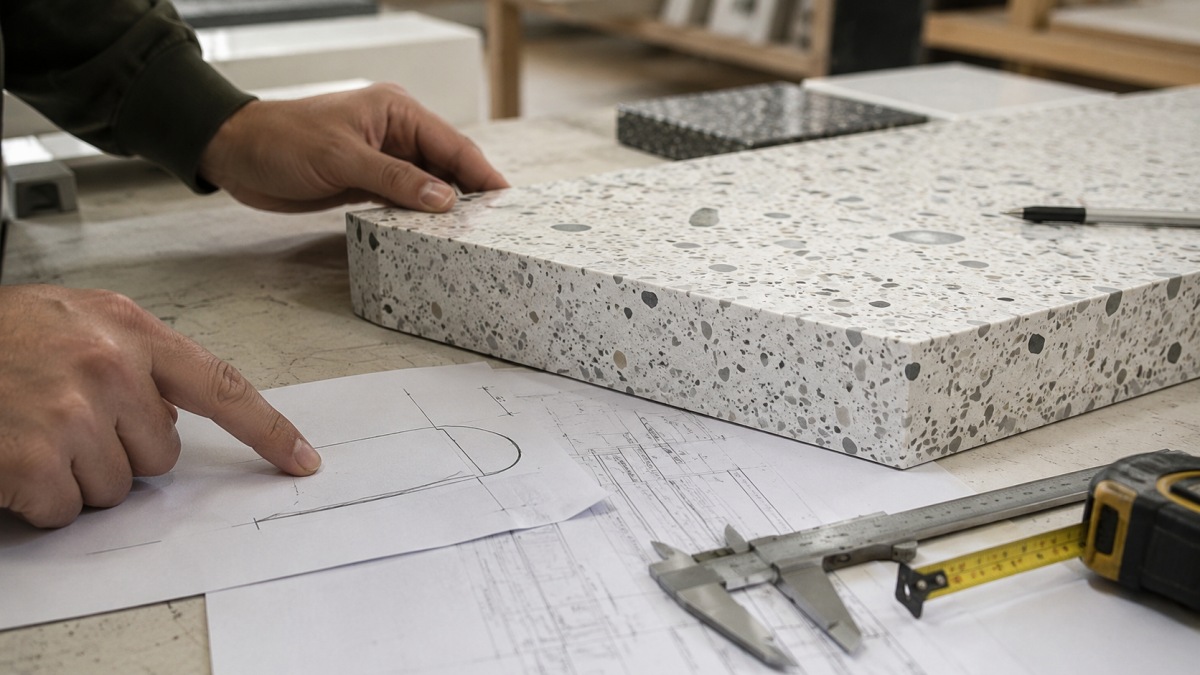
The following table is not a universal standard. It is a practical decision guide for early discussion. Final thickness should be confirmed according to project drawings, local installation standards, support condition, piece size, traffic level, and supplier fabrication capability.
|
Application |
Common Thickness Discussion |
What Buyers Should Check |
|
Wall tiles or small wall panels |
Often lighter thickness is considered when fixing method allows |
Panel size, fixing method, backing wall, weight limit |
|
Interior floor tiles |
Usually needs more attention to traffic, substrate, tile size, and joint planning |
Traffic level, subfloor flatness, installation system, tile format |
|
Large-format slabs |
Thickness should be reviewed with size, handling, packing, and installation |
Slab size, weight, breakage risk, support condition |
|
Countertops and vanity tops |
Often needs stronger thickness or built-up edge depending on design |
Cabinet support, overhang, sink cutout, edge profile |
|
Reception desks and furniture tops |
Thickness depends on visual edge, span, fixing, and fabrication detail |
Support frame, unsupported areas, edge detail, movement |
|
Stair treads |
Usually requires conservative thickness and edge review |
Tread length, nosing, traffic, support, anti-slip finish |
|
Stair risers |
May not need the same thickness as treads if not load-bearing |
Visual alignment, fixing method, joint detail |
|
Exterior or semi-outdoor areas |
Needs careful review of terrazzo type, water, temperature, and surface finish |
Material suitability, slip resistance, drainage, fixing method |
The key point is simple: do not choose thickness by price alone. Choose thickness by application risk.
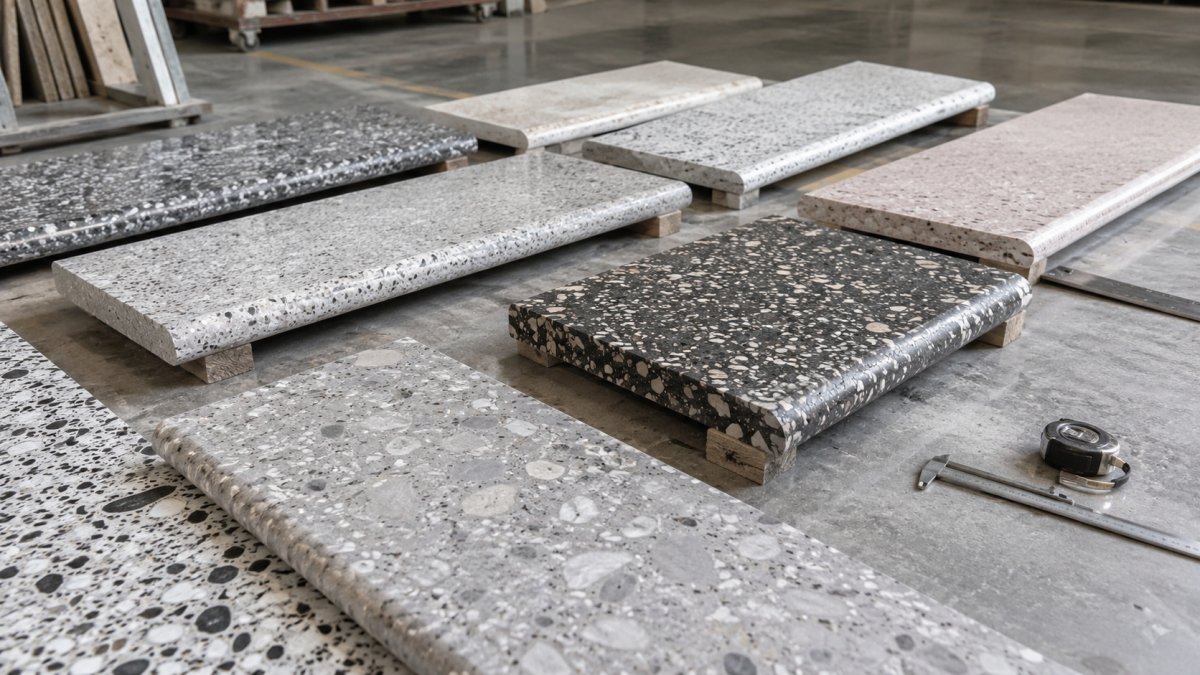
A thinner terrazzo specification may reduce material cost, but it can increase breakage risk, installation difficulty, and replacement cost. If the project later requires thicker material, the buyer may lose time on re-quotation, re-sampling, and design revision.
Low thickness is not a saving if it creates project risk.
One project may include floor tiles, wall panels, stair treads, skirting, countertops, and reception desk pieces. These areas should not automatically use the same thickness.
A stair tread and a wall tile have different jobs. A countertop with sink cutouts and a simple floor tile have different risks. Thickness should follow function.
Some buyers approve the surface material but forget to confirm the edge profile. Later, they ask for a thick visual edge, rounded edge, laminated edge, or special nosing. If the original thickness does not support the desired detail, fabrication becomes difficult or the visual result changes.
Edge detail should be approved before production, not after cutting.
Countertops and vanity tops often require holes and openings. These cutouts reduce material strength around the opening. If the drawing has large sink holes, narrow strips, or weak corners, thickness and reinforcement should be reviewed carefully.
A countertop should not be judged only by its surface size. The cutout layout matters.
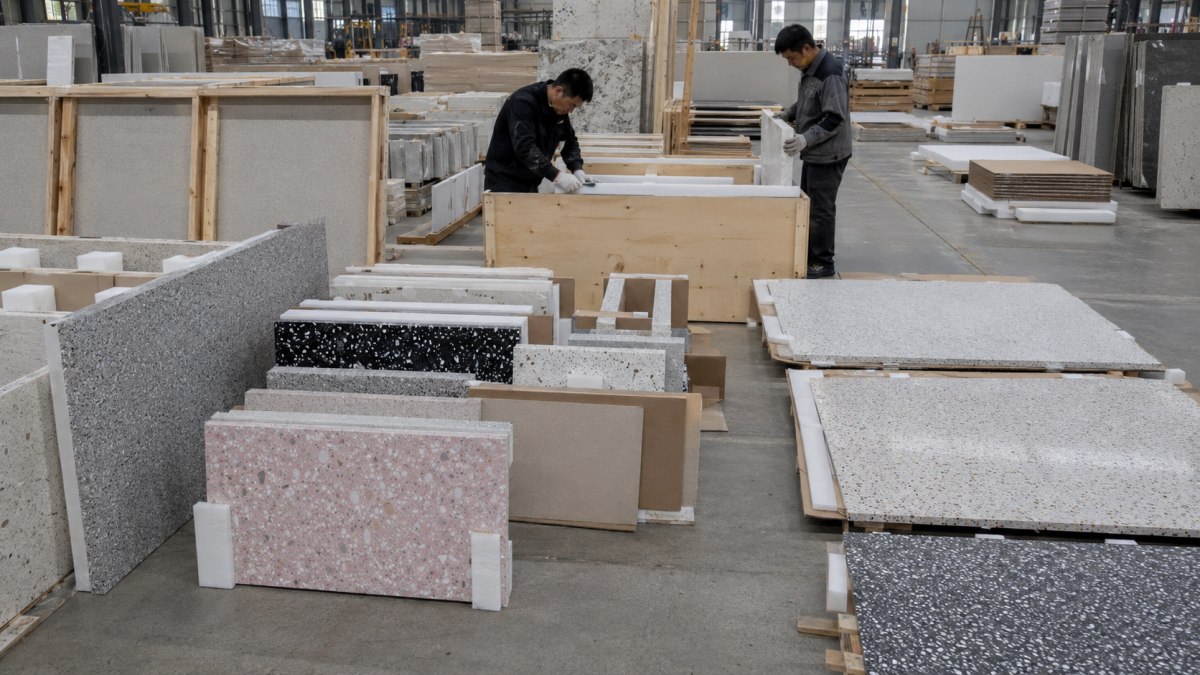
Thicker terrazzo can be stronger, but it also becomes heavier. Large heavy pieces require better packing, handling equipment, and installation planning. Thin pieces may reduce weight but may need more protection during packing and transport.
Export buyers should consider not only production thickness, but also wooden crate design, piece separation, loading method, and unloading conditions.
The supplier can recommend thickness based on drawings and application, but the supplier usually does not control site substrate, adhesive method, installer skill, support frame, cabinet quality, or on-site handling. If these conditions are poor, even a suitable material thickness may fail.
Thickness selection must be coordinated with installation responsibility.
Thickness problems often become disputes when responsibility is not clear. The table below helps buyers separate supplier-side and installer-side responsibilities.
|
Issue |
Supplier Responsibility |
Installer Responsibility |
|
Material thickness |
Produce according to approved thickness and agreed tolerance |
Check received goods before installation |
|
Thickness recommendation |
Advise based on drawings, application, size, and fabrication limits |
Confirm site conditions and installation method |
|
Fabrication drawings |
Follow approved cut sizes, edge profiles, holes, and piece numbers |
Review drawings against site dimensions before installation |
|
Edge processing |
Fabricate approved edge detail within material capability |
Protect edges during handling and installation |
|
Cutouts |
Produce holes and openings according to approved drawings |
Ensure site support around cutouts if required |
|
Packing |
Pack pieces according to size, thickness, and breakage risk |
Unload and move pieces carefully on site |
|
Substrate condition |
Can remind buyer that substrate must be suitable |
Responsible for flatness, stability, adhesive, leveling, and fixing |
|
Stair installation |
Supply approved tread, riser, nosing, and finish |
Control alignment, support, bonding, jointing, and site protection |
|
Countertop support |
Can review drawings and suggest risk points |
Ensure cabinet, frame, brackets, and overhang support are correct |
A responsible supplier should not blindly accept every requested thickness. If a specification looks risky, the supplier should ask for drawings, application details, and installation information before confirming.
A responsible installer should not treat terrazzo as a self-supporting structural element unless the design has been engineered for that purpose.
Before confirming terrazzo thickness, buyers should check:
· What is the application area: floor, wall, countertop, stair, furniture, or facade?
· Is the project residential, commercial, hospitality, retail, or public space?
· What are the exact length, width, and quantity of each piece?
· Is the terrazzo fully supported or partially unsupported?
· Are there overhangs, long spans, or weak narrow strips?
· Are there sink holes, faucet holes, cooktop openings, drain holes, or special cutouts?
· What edge profile is required?
· Is the visible edge expected to look thick or thin?
· Is the finish honed, polished, matte, brushed, or anti-slip?
· Will pieces be installed on floor, wall, cabinet, stair base, metal frame, or concrete substrate?
· Is the substrate flat, stable, and suitable for installation?
· Are local installation standards or project specifications already defined?
· Does the supplier need to provide dry lay photos, piece numbering, or packing photos?
· Does the installer agree with the selected thickness and installation method?
· Has the buyer confirmed whether weight affects packing, shipping, unloading, or site handling?
If any of these answers are unclear, thickness should not be finalized only by quotation price.
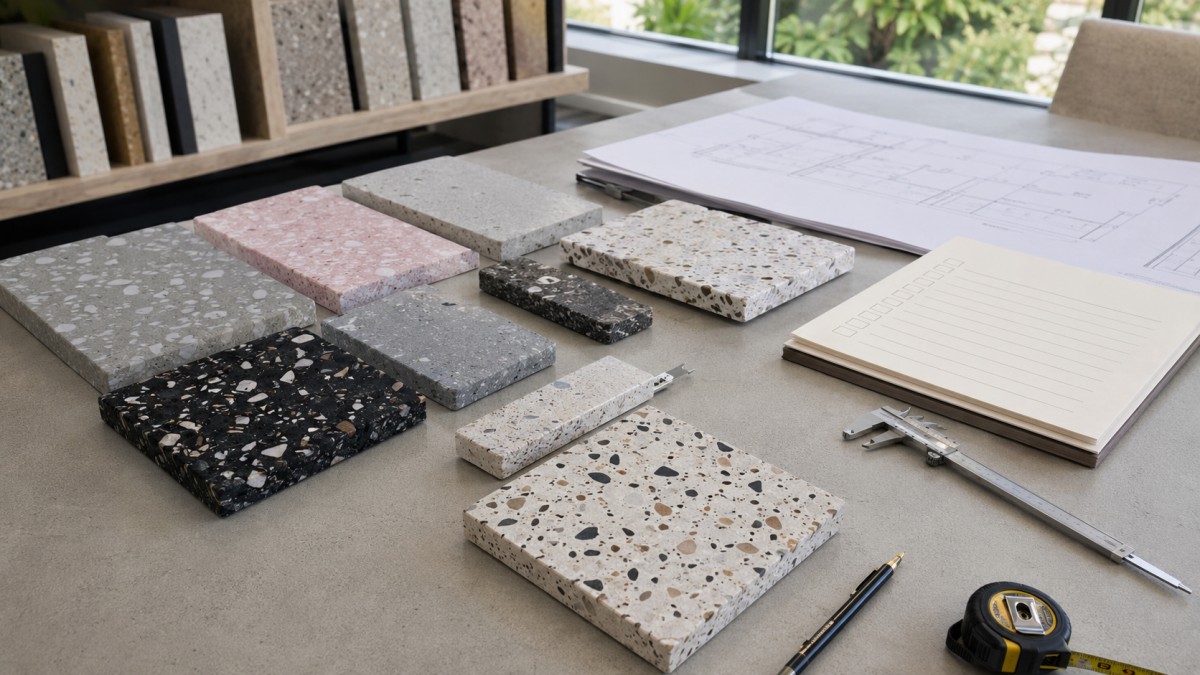
To receive a useful terrazzo quotation, buyers should send more than color and quantity. The following information helps the supplier recommend a suitable thickness and avoid application mismatch:
· Application area
· Project type and use intensity
· Required sizes or drawings
· Quantity by size
· Preferred thickness, if already specified
· Surface finish
· Edge profile
· Cutout drawings
· Stair tread and riser drawings, if applicable
· Countertop support or cabinet information, if applicable
· Floor or wall installation condition, if known
· Indoor, outdoor, or semi-outdoor use
· Packing requirement
· Whether pieces need numbering or dry lay photos
· Any local project specification or architect requirement
The more complete the information, the more accurate the quotation. A cheap quotation based on missing details may become expensive later.
If your project includes terrazzo slabs, tiles, countertops, stairs, wall panels, or cut-to-size pieces, send your specification for review before finalizing thickness. Include the application area, sizes, finish, edge profile, cutouts, support condition, and quantity. A clear specification helps confirm whether the selected terrazzo thickness is suitable for production, packing, shipment, and installation.
There is no single best thickness for all terrazzo tiles. Floor tiles, wall tiles, large-format tiles, and heavy-traffic areas may need different decisions. Thickness should be reviewed with tile size, traffic level, substrate, and installation system.
Not always. Countertops may require edge profiles, cutouts, overhangs, and cabinet support. These details can make countertop thickness different from floor tile thickness.
No. Thicker slabs may improve edge strength or visual weight, but they also increase material weight, freight cost, handling difficulty, and installation demand. Suitable thickness is better than maximum thickness.
The buyer, designer, supplier, and installer should confirm thickness together. The supplier can advise based on fabrication and material risk, while the installer must confirm site support and installation conditions.
Yes. If thickness is not confirmed, different suppliers may quote different assumptions. This makes price comparison unreliable and can lead to later changes in cost, production time, or installation planning.



 IPv6 network supported