English
 Español
 Português
 عربي
عربي 한국어
한국어

In many stone projects, the most expensive mistakes are not caused by the stone material itself. They are caused by unclear drawings before production starts.
A slab can be beautiful. A factory can have good machines. A supplier can pack the order carefully. But if the stone shop drawings before production are not checked properly, the final result may still go wrong.
Wrong size. Wrong edge. Wrong hole position. Wrong stair direction. Wrong wall panel sequence. Wrong countertop cutout. Wrong room code. Wrong vein direction. Wrong quantity.
These are not small details. In real projects, one wrong drawing can delay installation, increase air freight cost, create replacement work, or force the contractor to make risky site adjustments.
For international stone buyers, shop drawing review is not just a technical step. It is a commercial risk-control step.

1. What are stone shop drawings?
Stone shop drawings are the working drawings used to turn design intent into actual production.
They are different from general architectural drawings.
Architectural drawings show the design concept, dimensions, layout, and intended space. Stone shop drawings must go further. They need to tell the supplier and factory exactly how each piece should be made, numbered, finished, packed, and installed.
A good stone shop drawing usually includes:
material name
stone type
finish
size
thickness
quantity
room or area code
piece number
edge detail
hole position
cutout position
groove or slot detail
direction mark
visible face
vein direction if needed
joint position
installation sequence
packing reference
For simple slab orders, shop drawings may not be necessary. But for cut-to-size stone, stairs, countertops, wall panels, flooring layouts, hotel bathrooms, reception desks, lift surrounds, or custom stone pieces, drawings become essential.
This is where professional stone supplier drawing coordination becomes valuable. The supplier should not only sell stone. The supplier should help reduce mistakes between design, fabrication, packing, and installation.
2. Why should buyers review drawings before production?
Some buyers think drawing review is the supplier’s responsibility. This is only partly true.
The supplier can check whether the drawing is clear for fabrication. But the buyer, contractor, designer, or site team must confirm whether the drawing matches the actual project condition.
The supplier may not know:
the final site measurement
changes made by the contractor
wall thickness changes
cabinet changes
plumbing adjustments
floor level changes
metal frame positions
elevator door details
lighting slot changes
owner-approved design revisions
If the buyer approves the wrong drawing, the factory may produce exactly what was approved — but the pieces may still not fit the site.
That is why drawing approval should not be treated as a quick signature. It should be a serious stone fabrication drawing review before cutting starts.
The purpose is not to slow the project. The purpose is to avoid producing the wrong stone faster.
3. Start with the latest site dimensions
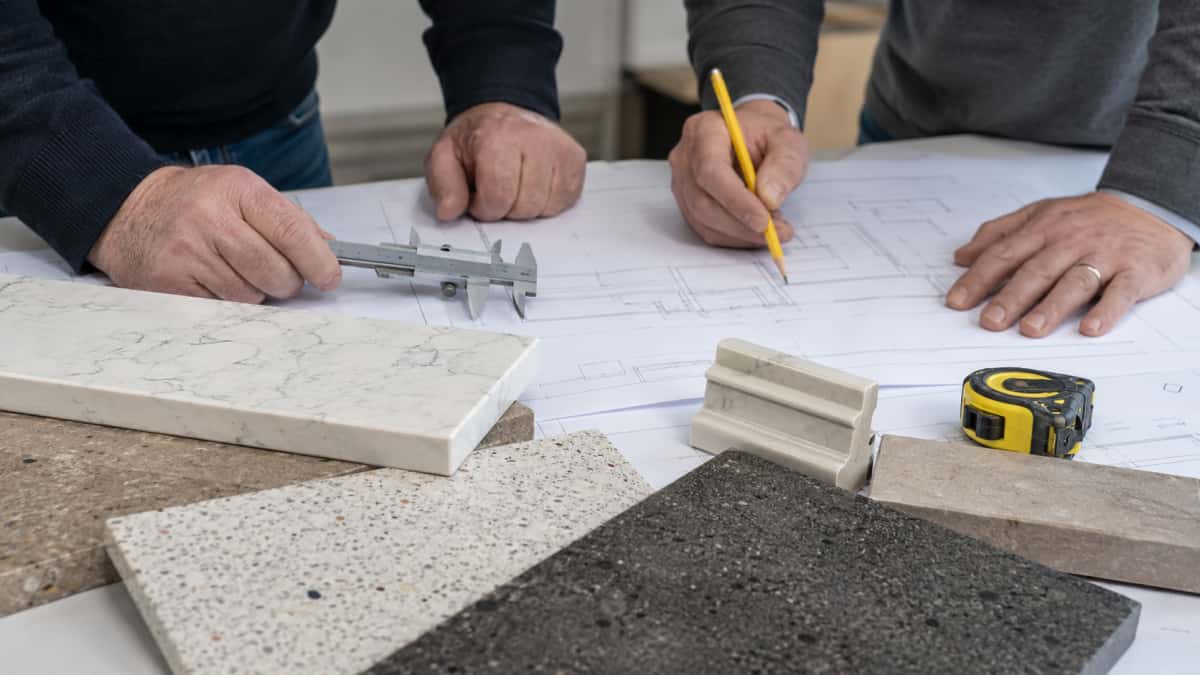
Before checking beauty, color, or vein direction, the buyer should first confirm whether the drawing uses the latest site dimensions.
This sounds obvious, but it is one of the most common sources of stone project mistakes.
In many projects, the original architectural drawing is not the same as the final site condition. Walls may be adjusted. Floors may be leveled. Cabinets may change. Steel structures may move. Plumbing points may shift. The design may be revised after material selection.
If the stone is produced from an outdated drawing, the problem may only appear during installation.
Buyers should check:
Are these drawings based on final site measurement?
Who measured the site?
When was the site measured?
Were wall and floor levels checked?
Were built-in cabinets, doors, elevators, and metal frames already installed?
Are these dimensions final or still subject to change?
Are tolerances allowed for installation?
Does the drawing show whether dimensions are finished sizes or rough opening sizes?
For stone projects, “almost correct” dimensions are not enough. Stone is not fabric, paint, or wallpaper. It cannot be stretched to fit the site.
4. Confirm material type before approving details
Different stone materials require different drawing logic.
A shop drawing for natural marble is not the same as a drawing for quartz stone. A terrazzo floor layout is not the same as a sintered stone wall panel layout. A limestone cladding detail should not be reviewed like an artificial marble vanity top.
Before approving drawings, buyers should confirm the exact material type.
Natural marble
For natural marble, the drawing should consider natural variation, vein direction, slab selection, dry-lay sequence, bookmatch requirements, and visible areas. If the project needs a continuous pattern across walls or floors, this must be shown before production.
A natural marble shop drawing review should not only ask, “Is the size correct?” It should also ask, “Will the finished layout make sense visually?”
Granite
Granite drawings often focus on size, thickness, finish, edge details, fixing method, and practical installation. For exterior, flooring, steps, or high-traffic areas, the drawing should clearly show thickness, anti-slip finish if required, exposed edges, and installation direction.
Granite is durable, but durability does not replace drawing accuracy.
Quartz stone
Quartz stone is often used for countertops, vanity tops, islands, bar counters, and commercial surfaces. For these applications, drawings must clearly show cutouts, faucet holes, sink openings, edge profiles, backsplash, overhang, joint position, and support requirements.
For quartz stone countertop drawing confirmation, the buyer should pay special attention to hole positions and cutout corners. A beautiful quartz slab can still fail the project if the sink or cooktop cutout is wrong.
Artificial marble / agglomerated marble
Artificial marble and agglomerated marble are often selected for controlled color, marble-look style, commercial interiors, wall panels, floors, countertops, and cut-to-size pieces. Drawings should confirm piece size, finish, thickness, edge polishing, batch consistency, room codes, and installation sequence.
For artificial marble and agglomerated marble project drawings, the drawing review should focus on repeatable production accuracy and clear area separation. This is especially important when many similar pieces are used across hotel rooms, apartments, commercial corridors, or retail interiors.
Terrazzo stone
Terrazzo drawings should pay attention to layout, joint lines, size control, aggregate visual balance, surface finish, skirting, stair details, and transition points with other materials.
For terrazzo stone layout and size control, the buyer should not only check dimensions. The buyer should also check whether the layout creates a balanced visual field after installation.
Sintered stone
Sintered stone drawings should consider panel size, thin-panel handling, cutout risk, corner protection, support, installation system, edge exposure, and transportation safety. Large-format sintered stone panels require careful planning before fabrication and installation.
The drawing should not assume the panel can be handled like an ordinary small tile.
Limestone
Limestone drawings should consider thickness, finish, edge detail, fixing method, sealing requirements, pores, natural texture, and application environment. For wall cladding, columns, fireplaces, or architectural features, the drawing should also show visible face and joint rhythm.
Limestone has a softer architectural feeling, but the project still needs hard technical clarity.

5. Check every size, not only the main size
Many drawing mistakes happen because only the largest dimension is checked.
A buyer may confirm length and width but miss the smaller details: hole distance, edge return, groove depth, backsplash height, radius corner, stair nosing, panel direction, or joint gap.
For cut-to-size stone drawings, every important dimension should be reviewed.
Buyers should check:
overall length
overall width
thickness
finished size
visible face
left and right direction
hole position
sink or cooktop cutout
faucet hole diameter
backsplash height
edge profile
groove depth
slot location
stair tread depth
riser height
nosing detail
wall panel joint
skirting height
tolerance requirement
The mistake is often not in the big dimension. It is in the small dimension that nobody checked.
A professional review should slow down at those details before production starts.
6. Edge details must be shown clearly
Stone edge detail confirmation is one of the most important parts of drawing review.
Edges affect appearance, safety, cost, fabrication method, packaging, and installation. A wrong edge detail can make a countertop look cheap, a stair feel unsafe, a vanity top fail to match the cabinet, or a wall panel look unfinished.
The drawing should clearly show whether the edge is:
straight polished edge
eased edge
beveled edge
bullnose
half bullnose
mitered edge
laminated edge
chamfered edge
rounded corner
groove edge
visible polished edge
hidden unpolished edge
The buyer should also confirm which edges are visible after installation.
This matters because not every edge needs the same finish. A hidden edge inside a cabinet is different from a visible front edge. A stair nosing is different from a wall panel side edge. A reception counter edge is different from a floor tile edge.
If the drawing does not show visible and hidden edges clearly, the factory may polish the wrong sides or leave the wrong edge unfinished.
7. Cutouts and holes need special attention
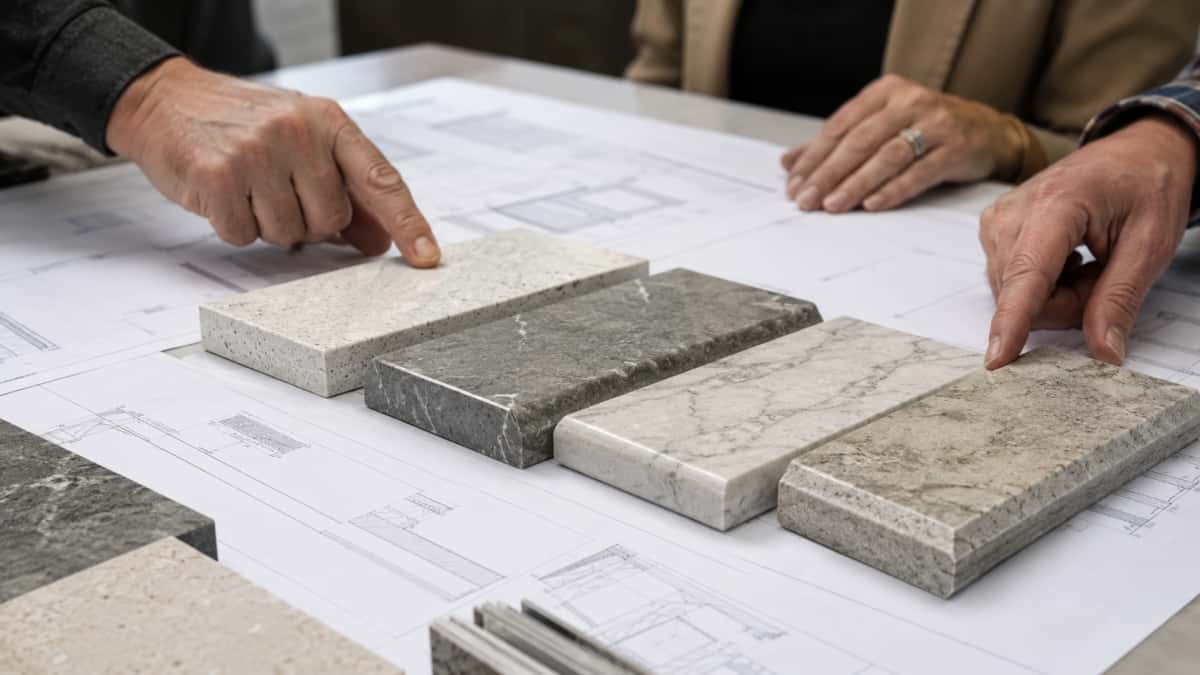
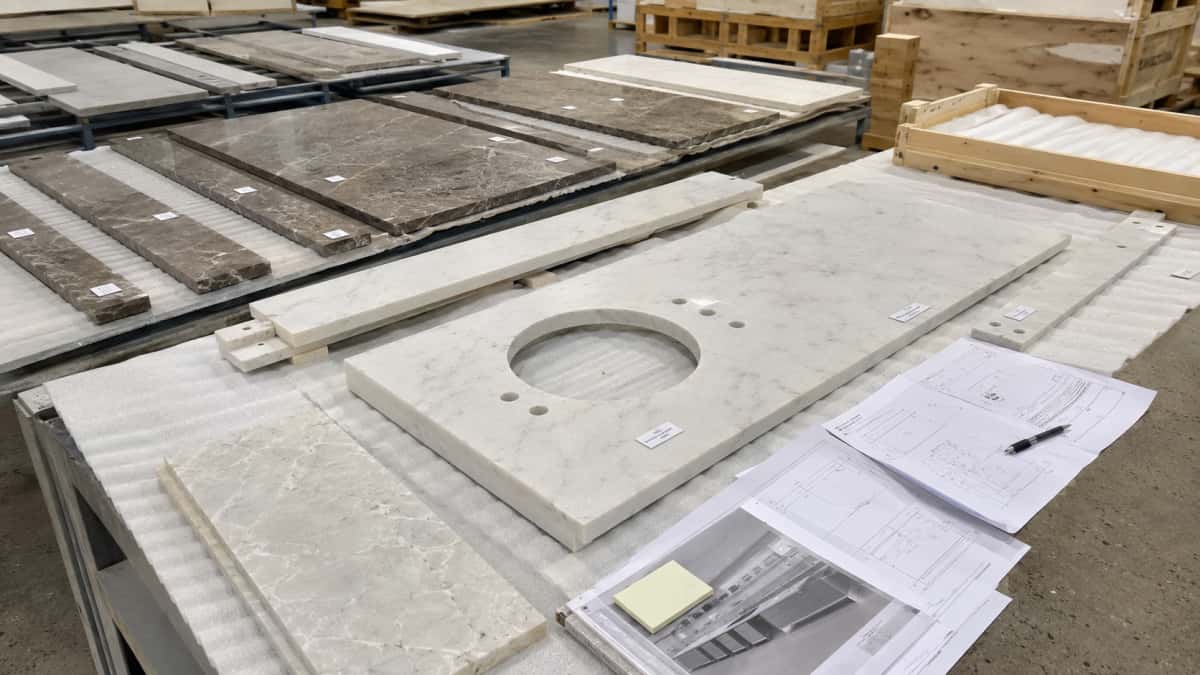
Stone countertop and vanity top cutout drawings deserve extra attention because mistakes are difficult to fix after production.
A countertop may have the correct size and material, but if the sink opening is wrong, the piece may become unusable. A vanity top may look perfect, but if faucet holes do not match the hardware, the project may stop on site.
Before approving drawings, buyers should confirm:
sink model
basin type
undermount or top-mount installation
cooktop model
faucet hole number
faucet hole diameter
distance from back edge
distance from side edge
cutout radius
corner reinforcement if needed
backsplash position
wall return
overhang
joint position
cabinet support
whether appliances are final
The safest approach is to check cutout drawings against actual sink, faucet, basin, and appliance information.
Do not approve stone cutouts based only on memory.
8. Direction matters more than many buyers expect
Stone pieces are not always reversible.
A panel may have a left side and a right side. A stair piece may have a front and back. A vanity top may have a wall side and exposed side. A marble wall panel may need vein direction. A bookmatched layout may depend entirely on sequence.
The drawing should make direction clear.
Useful marks include:
front side
back side
top side
bottom side
visible face
polished face
vein direction
installation direction
room side
wall side
sequence number
left / right orientation
This is especially important when the project includes natural marble, bookmatched panels, staircases, curved pieces, column cladding, elevator surrounds, or custom wall panels.
If direction is not marked, the factory may still produce the correct size, but the installer may not know how to place the piece.
A correct piece installed in the wrong direction is still a project mistake.
9. Quantity and piece numbering must match the packing plan
Shop drawings should not be separated from packing logic.
For international projects, especially container shipments, the piece number should connect with the packing list and crate number. This helps the site team identify the correct piece after arrival.
The buyer should check whether the drawings include:
piece number
area code
room code
floor number
quantity
crate reference if available
installation sequence
replacement or spare piece mark if needed
For hotel, apartment, villa, mall, casino, airport, office, or public building projects, many pieces may look similar. Without numbering, the receiving and installation teams can easily mix them.
Good drawing coordination reduces confusion later.
This is why drawing review should connect with cut-to-size stone fabrication capability. Fabrication is not only cutting stone. It also includes turning drawings, labels, packing, and production details into a workable project system.
10. Do not approve unclear drawings
A dangerous drawing is not always wrong. Sometimes it is simply unclear.
Unclear drawings create assumptions. Assumptions create mistakes.
Buyers should not approve drawings that do not clearly show:
exact material
exact finish
exact thickness
exact size
edge details
visible faces
hole positions
cutout dimensions
quantity
piece numbers
installation area
direction
revision date
approval status
A drawing with missing details should be returned for clarification before production.
This is not being difficult. It is protecting the project.
If a detail is important on site, it should be visible in the drawing before fabrication.
11. Check revision control carefully
In real projects, drawings change.
That is normal.
The problem begins when the wrong revision is used for production.
Before approval, the buyer should confirm:
Is this the latest revision?
Who issued it?
Who checked it?
What changed from the previous version?
Are old versions clearly cancelled?
Did the supplier receive the latest version?
Did the factory confirm the latest version before cutting?
Did the contractor approve the final version?
Revision control is especially important when communication happens across email, WhatsApp, WeChat, PDF files, CAD files, and screenshots.
A screenshot is not always enough for production. A final approved drawing should be clear, dated, and controlled.
If several people are sending different versions at the same time, production risk increases quickly.
12. Review joints and transitions with other materials
Stone rarely exists alone in a project.
It connects with metal, wood, glass, doors, cabinets, elevators, waterproofing, lighting, wall panels, carpets, tiles, and mechanical systems.
Shop drawings should consider these transitions.
Buyers should check:
where stone meets metal
where stone meets wood
where stone meets glass
where stone meets cabinet
where stone meets wall paint
where stone meets carpet
where stone meets tile
where stone meets elevator door
where stone meets lighting groove
where stone meets drainage
where stone meets waterproofing layer
Many site problems happen at transitions, not in the middle of a slab.
For example:
A vanity top may not align with the cabinet.
A stair riser may conflict with metal trim.
A wall panel may cover a lighting slot.
A countertop overhang may block a drawer.
A floor pattern may not align with a doorway.
A stone skirting may conflict with wall panels.
The drawing should make these connection points clear before production.

13. Who should approve the drawings?
Drawing approval should not be left to one person if the project is complex.
A practical approval process may include:
project buyer
contractor
site measurement person
installer
designer or architect
supplier technical team
factory production team
owner’s representative if required
Not every person needs to comment on every detail. But the right people should review the details related to their responsibility.
For example:
The designer checks appearance, layout, and visible details.
The contractor checks site dimensions and installation conditions.
The installer checks fixing logic and sequence.
The buyer checks quantity, material, and commercial scope.
The supplier checks whether the drawing can be fabricated.
The factory checks production feasibility.
If the project is small, the process can be simple. If the project is large, drawing approval should be more formal.
The most important rule is this: the person approving the drawing must understand what is being approved.
14. A practical checklist before approving stone shop drawings
Before production starts, buyers should check the following points:
1.Is the material name correct?
2.Is the stone type correct?
3.Is the finish correct?
4.Is the thickness correct?
5.Are the dimensions based on the latest site measurement?
6.Are all sizes clearly shown?
7.Are edge details clearly shown?
8.Are visible and hidden edges identified?
9.Are hole positions correct?
10.Are cutout dimensions correct?
11.Are sink, faucet, basin, and appliance details final?
12.Are left and right directions clear?
13.Is vein direction marked where needed?
14.Are bookmatch or dry-lay sequences shown if required?
15.Are piece numbers included?
16.Are room codes or area codes included?
17.Does quantity match the order?
18.Are joints and transition points checked?
19.Is this the latest drawing revision?
20.Has the correct person approved the drawing?
21.Does the supplier understand the approval clearly?
22.Has the factory confirmed before production?
This checklist will not solve every project problem. But it can reduce many avoidable mistakes.
15. When should buyers ask the supplier for help?
Buyers should ask the supplier for help when the drawings are incomplete, when the material behavior is not fully understood, or when site conditions may affect fabrication.
A supplier should not replace the architect or installer. But an experienced stone supplier can help identify practical risks before production.
Useful questions to ask include:
Is this edge detail suitable for the selected material?
Is this cutout too close to the edge?
Is this panel size safe for handling?
Should this marble layout be dry-laid before packing?
Is this thickness suitable for the application?
Should this piece be divided into smaller sections?
Is the packing sequence clear for installation?
Are there details that need final site confirmation?
Are there risks in producing from this drawing?
Good suppliers do not only accept drawings. They read them.
For buyers preparing a project with stone flooring, wall panels, stairs, countertops, vanity tops, or custom pieces, it is better to contact Aoli Stone for drawing review before production starts than to solve avoidable problems after the stone is already cut.
Here Comes Final Thought
Stone shop drawings are not paperwork. They are the bridge between design, material, fabrication, packing, and installation.
If the drawings are clear, the project has a much better chance of moving smoothly. If the drawings are vague, even good materials and good machines cannot protect the project from mistakes.
Natural marble needs vein and layout control. Granite needs finish, thickness, and practical edge clarity. Quartz stone needs accurate cutouts and countertop details. Artificial marble and agglomerated marble need repeatable size and batch control. Terrazzo stone needs layout and aggregate balance. Sintered stone needs panel handling and cutout planning. Limestone needs finish, edge, and natural texture understanding.
The safest time to find a drawing problem is before production starts.
After cutting, the stone may already be beautiful — but it may also be wrong.



 IPv6 network supported