English
 Español
 Português
 عربي
عربي 한국어
한국어

In a stone project, installation responsibility should be clarified before production starts, not after the materials arrive on site. Many disputes around stone installation do not come from the stone itself, but from unclear responsibility between the buyer, supplier, installer, contractor, and site team. For project buyers ordering cut-to-size stone, stone panels, flooring, wall cladding, stairs, countertops, or custom stone elements, confirming the scope of responsibility early is one of the most practical ways to reduce installation risk.
A stone supplier may control material selection, fabrication accuracy, dry lay inspection, piece labeling, packing, and export documentation. But the supplier usually does not control site dimensions, wall flatness, substrate condition, adhesive selection, lifting methods, or the installer’s workmanship. This is where many project problems begin: each party assumes another party has already checked the details.

Stone is not a flexible material. Once marble panels, limestone cladding, quartz countertops, terrazzo tiles, or sintered stone pieces are cut to size, every confirmed dimension, joint line, edge detail, hole position, and layout direction becomes important.
A few millimeters may not sound serious in an email, but it can become expensive on site. A wrong joint assumption can affect the whole wall elevation. An unclear stair nosing detail can delay installation. A missing note about grain direction can change the visual result of an entire lobby.
The best time to solve installation responsibility is before production, not after the first incorrect piece is lifted into place.
For this reason, buyers should treat cut-to-size installation planning as part of the ordering process, not as a separate issue that only starts when the installer arrives.
The biggest mistake is assuming that “stone supply” and “stone installation” are the same responsibility.
They are connected, but they are not the same.
A stone supplier is usually responsible for producing and delivering the stone according to approved documents. An installer is responsible for installing the stone according to site conditions, drawings, setting-out lines, fixing methods, and local construction requirements. The buyer or project contractor is usually responsible for confirming the final scope, approving drawings, coordinating trades, and managing site readiness.
If this gap is not discussed early, the project may face disputes such as:
Stone does not forgive vague responsibility. It records every unclear decision in physical form.
A professional stone supplier can reduce many risks before the material leaves the factory. This is where supplier experience matters.
The supplier usually controls:
For buyers who care about installation risk control, these factory-side records are not small details. They become evidence when the site team needs to understand what was produced, how it was packed, and how it should be checked after arrival.
However, even a good supplier cannot control everything. A supplier can reduce risk, but cannot make an uneven wall flat. A supplier can label each piece clearly, but cannot force an installer to follow the label sequence. A supplier can cut according to approved drawings, but cannot know about a late site change unless the buyer communicates it before production.
The installer’s responsibility is different. Installation is not only about placing stone pieces into position. It involves site judgment, method selection, handling, adjustment, and protection.
The installer usually controls:
This is why stone project handover should include more than delivery documents. The handover must help the installer understand piece numbers, drawing references, layout direction, and inspection timing.
If the installer receives crates without clear site instructions, or if the project team opens crates without keeping the packing order, the risk increases quickly.
The buyer, developer, contractor, or project manager often plays the most important coordination role. They may not cut the stone or install it, but they control the decision chain.
Before production starts, the buyer should confirm:
Good buyer supplier installer coordination does not mean every party does everything. It means every party knows what they are responsible for before mistakes become expensive.
Before confirming production, buyers can use a simple responsibility matrix. This does not replace a formal contract, but it helps reveal blind spots.
| Installation-Related Item | Buyer / Contractor | Stone Supplier | Installer / Site Team |
|---|---|---|---|
| Final site measurement | Confirms who measures and approves final dimensions | Produces according to approved dimensions | Checks site dimensions before installation |
| Shop drawing approval | Approves final version and communicates changes | Follows approved drawings | Reviews installation logic and reports conflicts |
| Material selection | Confirms stone type, finish, color range, and tolerance | Selects and fabricates according to approval | Checks material before installation |
| Substrate condition | Ensures wall/floor/site readiness | May provide general advice only | Checks flatness, moisture, level, and fixing suitability |
| Joint width | Confirms design and tolerance | Cuts according to approved joint logic | Controls joint width on site |
| Pattern or vein direction | Approves layout or dry lay requirement | Arranges and labels pieces if agreed | Installs according to approved layout |
| Piece labels | Requires labels and records | Provides labels and packing logic | Keeps labels until pieces are installed |
| Packing and loading | Requests packing records when needed | Packs and documents crates | Checks condition after unloading |
| Site handling | Provides site access and storage plan | Cannot control site handling after delivery | Handles, moves, and protects materials on site |
| On-site cutting | Approves whether adjustment is allowed | May advise based on material properties | Performs adjustment if qualified |
| Protection after installation | Defines responsibility before handover | Usually not responsible after installation | Protects installed stone unless otherwise agreed |
This matrix often exposes the real issue: the project does not fail because nobody cares. It fails because several people care about different parts, but nobody owns the connection between them.
Before approving production, buyers should ask practical questions, not only commercial ones.
A drawing approved by a designer may not be enough. The installer should understand how the stone will be installed, where the first piece starts, how corners return, how joints align, and whether the substrate can support the design.
For wall cladding, this is especially important around corners, door frames, elevator openings, columns, niches, and feature walls.
For flooring, the installer should check border lines, expansion joints, room transitions, drainage slopes, and alignment with other materials.
For stairs, the installer should check tread, riser, nosing, landing, side panels, and the relationship between stone thickness and site structure.
Cut-to-size stone is only as reliable as the confirmed dimensions.
If production starts from old drawings, tender drawings, or unverified site dimensions, the supplier may produce accurately but still deliver pieces that do not fit the actual site.
This is not a material problem. It is a coordination problem.
Buyers should confirm whether dimensions are taken from architectural drawings, shop drawings, or final site measurement. If the building is still under construction, they should decide whether to wait for final measurement or accept a defined tolerance risk.
Stone installation depends heavily on the condition behind or below the stone.
A marble wall panel may be beautiful, but if the wall is not flat, the final surface may look uneven. Limestone flooring may be well cut, but if the floor base is not level, lippage can appear. Quartz countertops may be accurately fabricated, but if cabinets are not level, installation problems may follow.
The stone supplier can provide material and fabrication accuracy. The installer and contractor must confirm site readiness.
This should be written clearly before production or delivery.
Adhesive, mortar, anchors, brackets, frame systems, clips, or other fixing methods are usually selected according to site conditions, local standards, stone type, size, weight, thickness, and application.
A supplier may provide general material advice, but final fixing responsibility normally belongs to the installer, contractor, engineer, or local project team.
This is especially important for exterior cladding, large-format wall panels, wet areas, staircases, countertops, and high-traffic commercial flooring.
Piece labels are only useful if the site team keeps them visible and follows the layout.
For natural marble, limestone, onyx, terrazzo, and other materials with visible variation, the installation sequence affects the final appearance. If labels are removed too early or crates are opened randomly, the project may lose the logic created during factory dry lay.
For better stone site coordination, buyers should confirm how labels, layout drawings, packing lists, and inspection photos will be shared with the installer before installation begins.
Several mistakes appear again and again in stone projects.
A supplier may advise on material characteristics, cutting direction, packing, thickness, edge details, and general handling. But this is not the same as taking responsibility for site installation.
If the buyer wants the supplier to provide installation guidance, training, remote support, or on-site supervision, this must be discussed separately and written into the scope.
A buyer may approve drawings from a design perspective, but the installer may later discover practical site issues. This creates avoidable tension.
The installer should review the final drawings before production, especially for complex areas such as curved walls, staircases, columns, shower areas, vanity tops, reception counters, elevator lobbies, and exterior façades.
Stone fabrication follows fixed information. If door openings change, wall thickness changes, cabinet positions move, or joint widths are revised after production, the supplier cannot be responsible for the old approved information becoming outdated.
Buyers should create a clear change-control process.
For cut-to-size stone, packing order is part of the project logic. Randomly opening crates, mixing pieces, or discarding labels can make installation slower and riskier.
The person who receives the stone should photograph crate conditions, check the packing list, preserve labels, and report damage before installation.
The stone may be installed correctly, but later damaged by other trades, dust, paint, metal tools, scaffolding, water, or poor protection.
Protection after installation should not be left to goodwill. It should be assigned before the project reaches that stage.
Good stone coordination is not about blaming people later; it is about removing blind spots early.
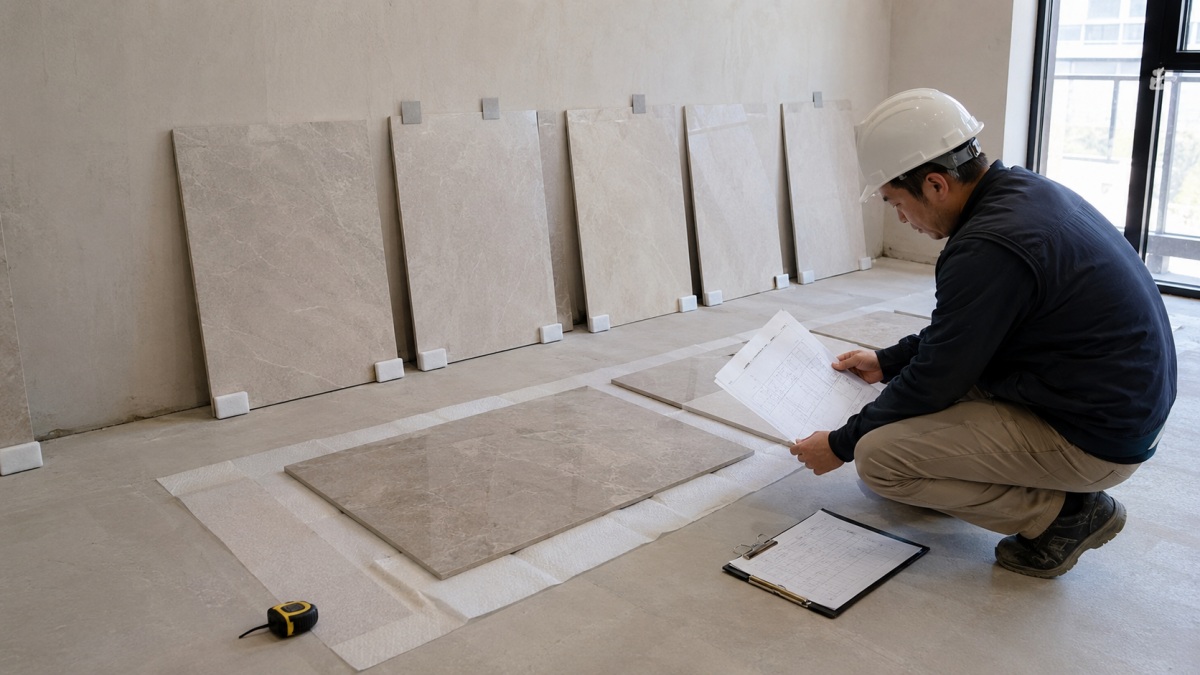
A responsible supplier should not pretend to control every part of installation. That would be unrealistic and risky for both sides.
What a professional supplier can do is provide better project support before the stone reaches the site.
This may include:
For project buyers, this kind of support can reduce confusion. It does not replace the installer, but it gives the installer better information to work with.
Before confirming production, buyers can use the following checklist:
This checklist is simple, but it protects the project from vague assumptions.
Simple tile orders may only need basic coordination. But complex projects need stricter responsibility control.
Buyers should pay extra attention when the project includes:
The more customized the stone is, the less room there is for unclear responsibility.
A standard slab can be adjusted in many ways. A custom-cut project piece cannot be treated so casually.
Installation responsibility is not a small technical detail. It is part of project risk control.
When buyers clarify who measures, who approves, who installs, who checks, who protects, and who records each stage, the whole stone project becomes more predictable. The supplier can produce with clearer information. The installer can work with better records. The contractor can manage site conditions more responsibly. The buyer can reduce disputes before they become expensive.
For stone projects, good communication is not a decoration around the order. It is part of the order itself.
If you are preparing a cut-to-size stone, marble, limestone, quartz, terrazzo, or sintered stone project, Aoli Stone can help review material scope, fabrication details, packing logic, and pre-shipment documentation before production begins. You can contact our team to discuss your project drawings, material requirements, and responsibility checklist before confirming the order.
Usually, no. A stone supplier is normally responsible for supplying and fabricating the stone according to approved documents. Installation is usually handled by the buyer’s installer, contractor, or local site team. If installation guidance or supervision is required, it should be agreed separately in writing.
The buyer, contractor, or appointed installer should confirm final site measurements. The supplier can produce according to the approved size list, but the project team must make sure those dimensions match the real site condition.
Yes. For cut-to-size stone projects, the installer should review shop drawings before production starts. This helps identify issues related to joint width, fixing method, substrate condition, installation sequence, and site adjustment.
If the supplier produced according to approved drawings or confirmed size lists, later site changes are usually not the supplier’s responsibility. This is why buyers need a change-control process before and during production.
Yes, a supplier can provide general advice about material characteristics, fabrication details, handling, packing, piece labels, and layout records. However, final installation method and site execution should be confirmed by the installer, contractor, or qualified local professional.
Buyers can reduce disputes by confirming responsibility before production. The most important points are final measurements, approved drawings, installer review, substrate readiness, fixing method, joint width, piece labels, arrival inspection, site storage, and protection after installation.



 IPv6 network supported