English
 Español
 Português
 عربي
عربي 한국어
한국어

A cut-to-size stone order becomes accurate long before the first slab is cut. For hotel bathrooms, wall panels, countertops, stair treads, flooring pieces, reception counters, lift surrounds, and commercial interiors, the quality of the quotation depends on the quality of the information sent by the buyer. Clear drawings, size lists, edge details, openings, material requirements, and packing instructions help the supplier understand the real project scope instead of guessing from a few photos.
The common problem is not that buyers ask for a quotation too early. Early discussion is useful. The real problem is asking for a final price when the supplier has not received enough information to define the work. A reference image may show the design style, but it does not show thickness, edge profile, exposed sides, sink cutouts, installation sequence, packing logic, or who takes responsibility for site dimensions. In cut-to-size stone supply, unclear information usually becomes extra cost later.

Cut-to-size stone is not only a material order
When buyers order full slabs, the supplier mainly prepares material for later fabrication. When buyers order cut-to-size pieces, the supplier is preparing project-specific components before shipment. That is a different level of responsibility.
A cut-to-size order may include straight cutting, shaped cutting, edge processing, sink openings, faucet holes, stair nosing, wall panel sizing, dry layout, piece numbering, room grouping, protective packing, and pre-shipment checking. This is why cut-to-size project supply should be discussed as a production workflow, not only as a unit price.
The more finished the stone piece is before shipment, the more complete the information must be before production.
A buyer does not need perfect shop drawings at the first message. But to receive a reliable quotation, the buyer should send enough information for the supplier to understand what must be made, how it will be used, and how it should be packed.
Start with the project area, not only the stone name
A useful inquiry begins with the application area. The same material may require very different processing depending on whether it is used for a bathroom vanity top, corridor floor, lobby wall, staircase, exterior cladding, or restaurant counter.
A simple message like “Please quote white marble cut to size” is not enough. A better message explains:
This is for a hotel bathroom wall.
This is for an apartment kitchen countertop.
This is for a lobby floor with large-format pieces.
This is for stair treads and risers.
This is for reception counter cladding.
This is for commercial wall panels packed by floor and area.
Application affects thickness, finish, edge detail, tolerance, packing, and risk. A polished marble wall panel, a quartz vanity top, and a terrazzo floor tile may all be “cut to size,” but they are not the same production task.
The supplier needs to know where the stone will live.
Send floor plans when the stone relates to space layout
A floor plan helps the supplier understand the relationship between stone pieces and the overall project. It shows room positions, floor areas, corridors, walls, stairs, counters, and installation zones.
For flooring projects, a floor plan helps clarify area boundaries, direction, quantity, joint positions, and whether pieces should be packed by room, floor, or zone. For hotel and apartment projects, it also helps identify repeated rooms and special areas.
A floor plan does not need to be beautiful. It needs to be readable. The supplier should be able to understand which areas use stone, which material is used in each area, and how the size list relates to the project.
If the floor plan is still changing, buyers should say so clearly. A supplier can provide a budget estimate, but final cut-to-size production should wait until dimensions are confirmed.
Send wall elevations for wall panels and feature areas
Wall elevation drawings are critical for wall cladding, bathroom walls, lift surrounds, reception backgrounds, bookmatched marble walls, and decorative panels. A floor plan shows where the wall is. An elevation shows what happens on the wall.
For wall panels, buyers should send:
Wall length and height
Panel division
Thickness
Finish
Joint width if required
Edge exposure
Outlet positions
Switch positions
Door and opening positions
Bookmatch or vein direction requirement
Panel numbering requirement
Installation sequence if important
For natural marble feature walls, the elevation is especially important because vein direction and slab layout can affect the final appearance. Natural marble cut-to-size wall panels should not be treated as simple rectangles when the project requires visual matching, dry lay, or bookmatch review.
A wall panel order can be dimensionally correct and visually wrong at the same time. That is why layout information matters.

Send countertop drawings for kitchens, vanities, and commercial counters
Countertop drawings require more detail than many buyers expect. A top piece is not only length and width. It may include sink cutouts, faucet holes, backsplash pieces, exposed edges, side returns, waterfall panels, joint positions, cooktop openings, support conditions, and polishing requirements.
For quartz, artificial marble, natural stone, granite, sintered stone, or terrazzo countertops, buyers should provide:
Overall top size
Thickness
Material name or color reference
Finish
Edge profile
Exposed edge sides
Sink type
Sink cutout size
Faucet hole position
Cooktop opening if any
Backsplash height and thickness
Side splash if required
Waterfall side panels if required
Joint position
Overhang requirement
Undermount or topmount sink detail
Packing method by room or unit
For quartz countertop fabrication details, sink openings, edge profiles, and joint logic should be confirmed before production. A wrong opening position can make a finished piece unusable, even if the material itself is correct.
A countertop quotation without cutout information is usually only a rough estimate.
Provide a size list, but do not rely on size list alone
A size list is one of the most important documents for cut-to-size stone orders. It should show piece number, length, width, thickness, quantity, finish, edge details, and application area. But a size list alone can be dangerous if it is not connected to drawings.
A good size list should include:
Item number
Area or room code
Stone material
Piece name
Length
Width
Thickness
Quantity
Finish
Edge type
Cutouts or holes
Special notes
Packing group
Spare quantity if required
For example, “800 x 600 x 20 mm, 40 pieces” is not enough if some pieces need polished long edges, some need sink holes, and some belong to different rooms. The supplier needs to know whether these are floor tiles, vanity tops, wall panels, stair treads, or window sills.
A size list tells the supplier what to make. Drawings tell the supplier why and where it belongs.
Mark exposed edges clearly
Edge information is one of the most common sources of mistakes in cut-to-size stone orders. Buyers may assume the supplier knows which sides need polishing, beveling, bullnose, eased edge, miter edge, laminated edge, or special profile. The supplier should not guess.
For every piece, buyers should mark:
Which sides are visible
Which sides need polishing
Which sides are against a wall
Which sides are joined to another piece
Which edges need beveling or chamfering
Which pieces require bullnose or special profiles
Which edges must remain straight cut
Whether edge samples or drawings are available
This is especially important for vanity tops, stair treads, counters, wall caps, window sills, table tops, and exposed panels.
One unmarked exposed edge can become a visible project defect.
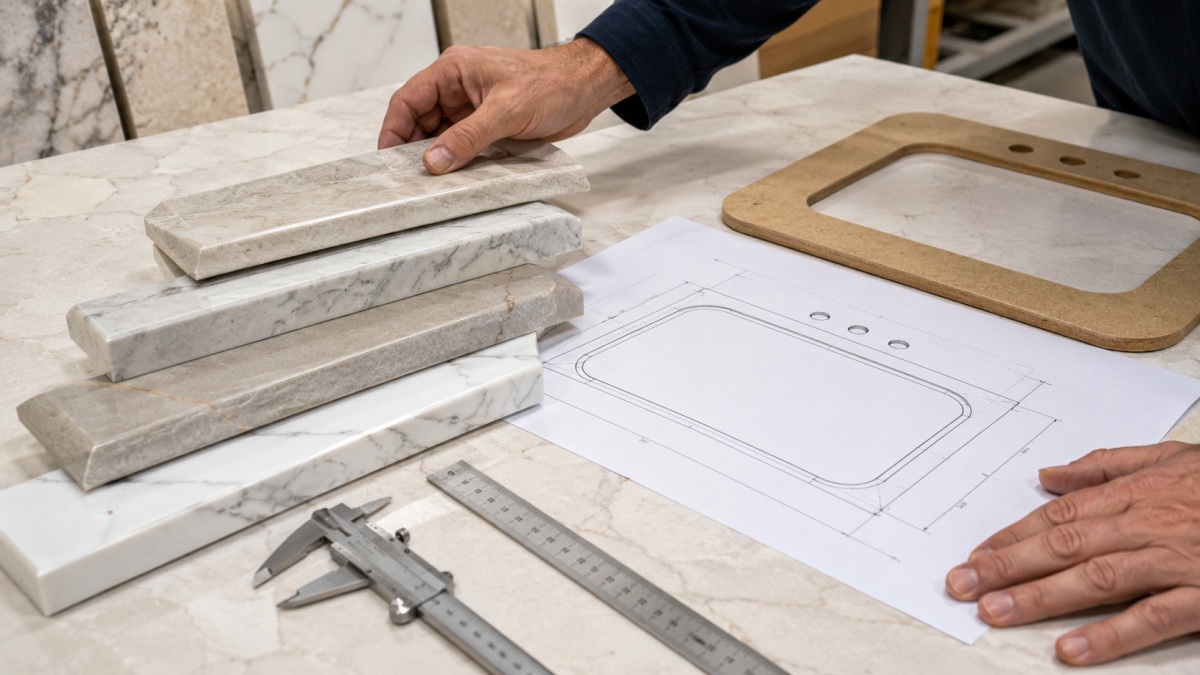
Show sink openings, faucet holes, sockets, drains, and other cutouts
Cutouts should never be described only by words when drawings are available. A supplier needs accurate position, size, shape, radius, distance from edges, and relation to the finished piece.
Common cutouts include:
Bathroom sink openings
Kitchen sink openings
Faucet holes
Cooktop openings
Floor drains
Wall sockets
Switch boxes
Pipe holes
Shower niches
Access panels
Lighting openings
Custom metal insert areas
Fixing holes if required
Buyers should also clarify whether cutouts need polished inside edges, eased edges, reinforcement, or special packing protection.
For sintered stone, quartz, and countertop pieces, cutout positions are especially sensitive. For natural marble, edge and cutout areas may need careful handling because veining, fissures, and stress points can affect fabrication risk depending on the material.
A cutout is not a small detail. It is often the part of the stone piece most likely to fail if information is unclear.
Confirm thickness, finish, and surface direction
Thickness affects strength, weight, edge appearance, packing, installation, and cost. Finish affects visual appearance, slip behavior, cleaning, touch, and maintenance. Surface direction affects the look of veined marble, linear limestone, some terrazzo designs, and bookmatched layouts.
Buyers should confirm:
Thickness for each area
Polished, honed, matte, brushed, flamed, sandblasted, or other finish
Whether the finish is suitable for the application
Vein direction
Pattern direction
Bookmatch direction
Face side and back side
Special anti-slip requirement if relevant
Whether the finish should match previous samples
Not every finish is suitable for every material or every area. A polished surface may look elegant on a wall but may not be the right choice for a wet floor. A textured finish may work for safety but change the color impression.
Surface finish is not only a visual decision. It is also an application decision.
Explain material choice and expected variation
Cut-to-size stone can be made from natural marble, granite, quartz stone, artificial marble, terrazzo, sintered stone, limestone, and other materials. But each material has different behavior.
Natural marble may have natural variation, vein movement, color range, fissures, and bookmatch requirements. Granite may require attention to finish, thickness, and exterior suitability. Quartz stone is often more consistent, but countertop cutouts and heat or outdoor limitations should still be reviewed. Artificial marble can support repeated pieces and controlled tone, but the application area and maintenance expectation should be confirmed. Terrazzo depends on chip size, aggregate distribution, cutting position, and visual scale. Sintered stone requires careful processing and handling. Limestone needs caution in exterior, wet, or high-traffic conditions depending on type and finish.
For hotel bathrooms, commercial interiors, vanity areas, and repeated pieces, artificial marble cut-to-size project pieces can be useful when the buyer needs a controlled visual effect and organized supply. For restaurants, retail spaces, public interiors, and design-led floors or counters, terrazzo stone project pieces should be reviewed with aggregate scale, edge exposure, and installation area in mind.
The material name alone does not tell the supplier everything. The project use gives the material meaning.
Clarify quantity, spare pieces, and replacement logic
Cut-to-size orders should include exact quantities, but buyers should also think about spare pieces. For large projects, a small number of additional pieces may be useful for breakage, site adjustment, future replacement, or installation mistakes.
This is especially important when the material has batch variation or natural movement. If a buyer orders only the exact quantity and later needs replacement pieces, the same batch may no longer be available. Even with engineered stone, slight batch differences can appear.
Buyers should discuss:
Exact quantity
Spare quantity
Critical pieces
Replacement strategy
Whether extra slabs should be shipped
Whether pieces should be grouped by batch
Whether installation sequence affects replacement
Spare pieces are not always necessary, but the decision should be conscious. Saving a few pieces at the order stage can sometimes create a larger cost later.
Give clear numbering and packing instructions
Packing is not only about protection. For cut-to-size project orders, packing is also about installation organization.
A good packing instruction may group pieces by:
Room number
Floor number
Area code
Wall elevation
Bathroom type
Apartment unit
Stair sequence
Countertop set
Installation phase
Container loading priority
This helps the receiver unload, sort, inspect, and install the pieces more efficiently. For large orders, piece numbering should match the size list and drawings. If the project needs room-by-room packing, that instruction should be given before production and packing, not after the crates are closed.
For international buyers, stone fabrication and quality inspection should include size checking, surface review, edge checking, label consistency, and packing logic before shipment.
Good packing makes the receiving side less chaotic.
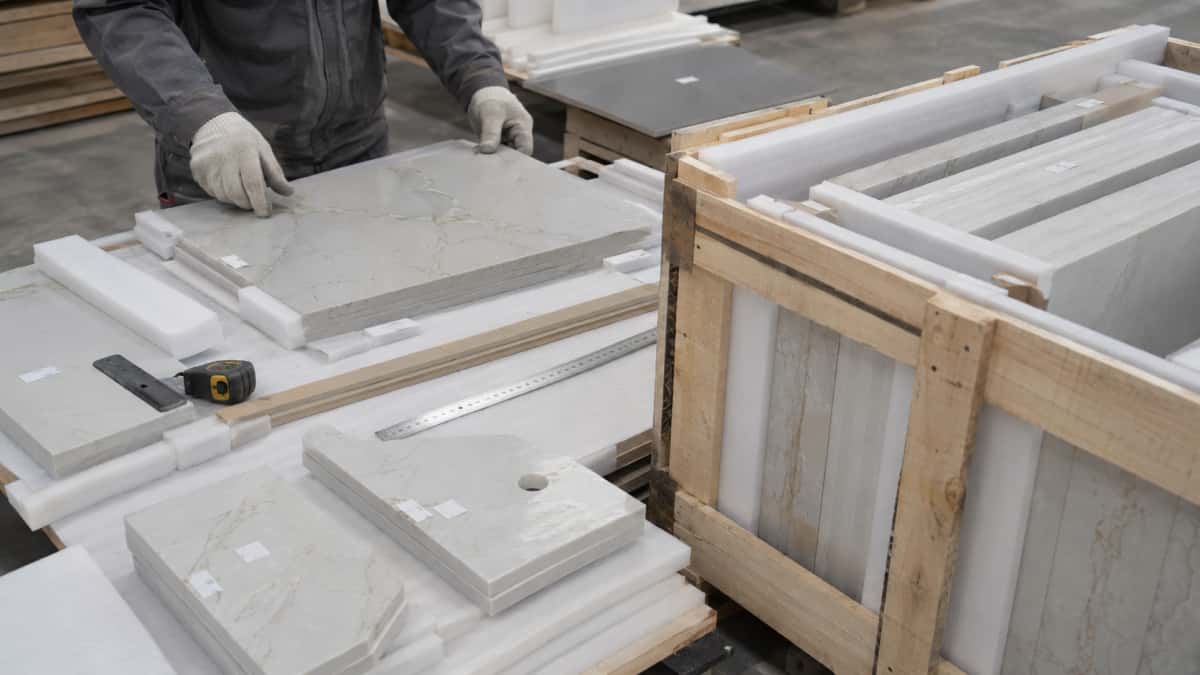
State tolerance requirements and site responsibility
Stone is a natural or engineered building material, not a paper drawing. Real projects need tolerance control. Buyers should confirm whether the required dimensions follow project drawings, supplier standard tolerance, local installation tolerance, or a specific technical requirement.
The buyer should also clarify:
Who takes site measurements
Whether dimensions are final
Whether the supplier should follow drawings exactly
Whether installer adjustment is expected
Whether expansion joints or installation gaps are included
Whether wall or floor conditions are already checked
Whether on-site trimming is allowed
One of the biggest cut-to-size risks is the gap between drawing and site reality. A piece can be produced correctly according to the confirmed drawing and still not fit if the site measurement was wrong.
Factory accuracy cannot fix wrong site information.
What buyers should send for the first quotation
For the first quotation, buyers do not need to send perfect final documents, but they should send enough information for a realistic estimate.
A practical first inquiry should include:
Project type
Application area
Material name or reference image
Approximate quantity
Required thickness
Preferred finish
Main piece sizes
Drawings if available
Whether cutouts are required
Edge requirement if known
Destination port
Expected timeline
Packing requirement if known
Photos of similar design intent
If drawings are not ready, say clearly: “Drawings are not final yet. Please quote as a budget estimate first.” This helps avoid misunderstanding.
A supplier can support early pricing. But final production should not begin until the production documents are confirmed.
What buyers should confirm before production
Before production starts, buyers should confirm:
Final drawings
Final size list
Material selection
Thickness
Finish
Edge profile
Cutout details
Quantity
Spare pieces
Piece numbering
Packing method
Labeling method
Destination and shipping requirement
Pre-shipment photo or inspection requirement
Any approved sample or color range
This stage should not be rushed. Many expensive problems in stone projects come from small details that were “almost confirmed.”
Almost confirmed is not confirmed.
Common mistakes that cause quotation or production problems
Mistake 1: Sending only inspiration photos
Inspiration photos help explain style, but they do not define production. A photo cannot tell the supplier exact size, thickness, edge profile, cutout position, finish, or packing sequence.
Mistake 2: Asking for a final price from incomplete drawings
Incomplete drawings can support a budget estimate, not a final production quotation. If the buyer changes dimensions later, cost and delivery time may change.
Mistake 3: Ignoring exposed edges
Many buyers mark piece size but forget to mark which sides are visible. This can lead to unpolished edges appearing after installation.
Mistake 4: Treating all cutouts as simple holes
Cutouts affect strength, edge finishing, packing risk, and installation. Sink holes, faucet holes, drains, and sockets should be drawn clearly.
Mistake 5: Forgetting packing sequence
If pieces arrive without clear labels or area grouping, the installation team may waste time sorting. In large projects, poor packing logic can create real site delay.
Mistake 6: Assuming all materials can be handled the same way
Natural marble, granite, quartz stone, artificial marble, terrazzo, sintered stone, and limestone do not behave the same way. The same drawing detail may carry different risk depending on material.

A simple document checklist
For most cut-to-size stone orders, buyers should prepare these documents:
Floor plan
Wall elevation
Countertop drawing
Stair drawing if needed
Size list
Material selection sheet
Finish requirement
Edge profile drawing or photo
Cutout drawing
Quantity list
Area code or room code
Packing instruction
Installation sequence if relevant
Destination and shipping information
Reference photos
Approved sample photo if available
The goal is not to make the inquiry complicated. The goal is to prevent avoidable mistakes.
FAQ
Can I ask for a cut-to-size quotation without final drawings?
Yes, but the quotation should be treated as an estimate. A supplier can provide a budget range based on available information, but final pricing and production should wait until drawings, sizes, finishes, edges, cutouts, and quantities are confirmed.
What is the most important document for cut-to-size stone orders?
The size list is important, but it should be supported by drawings. A size list shows what to cut. Drawings show where the pieces belong and how they relate to the project.
Do I need to provide edge profile drawings?
If the edge is visible or specially shaped, yes. Edge profile drawings or reference photos help avoid misunderstanding. At minimum, buyers should mark which sides are exposed and which sides require polishing or profiling.
Should I send CAD drawings or PDF drawings?
Both can be useful. PDF drawings are easier for general review. CAD files can help with technical checking when available. The key is that dimensions, notes, and piece codes must be clear.
Do I need to provide cutout details for sinks and faucets?
Yes. Sink openings, faucet holes, cooktop cutouts, drains, sockets, and pipe holes should include size, position, shape, distance from edges, and edge finishing requirements. Vague cutout information is one of the most common causes of production mistakes.
How should cut-to-size pieces be packed?
Packing should follow project logic. Pieces can be packed by room, floor, area, wall elevation, stair sequence, bathroom type, or installation phase. The packing list should match the drawings and size list.
Can the supplier help review drawings before quotation?
A professional supplier can help review whether the provided information is enough for quotation and production discussion. The supplier should not silently guess missing details. If information is unclear, the buyer and supplier should confirm it before production.
Here Comes Final thought
Cut-to-size stone supply is not difficult because cutting stone is mysterious. It becomes difficult when the information is incomplete.
The better the drawings, the better the quotation. The clearer the edge and cutout details, the lower the fabrication risk. The better the numbering and packing logic, the smoother the receiving and installation process.
A good cut-to-size order is not created by one message asking for a price. It is built through clear project information.
For larger hospitality and commercial projects, clear project information is only one part of successful stone supply. Buyers also need a coordinated workflow covering material selection, fabrication preparation, dry layout, quality checking, packing organization, and future replacement planning.
Buyers managing multiple hotel stone requirements together can review our Hotel Stone Supply Package for Hospitality Projects, which brings these processes into one coordinated project workflow.
If you are preparing a cut-to-size stone order for hotel bathrooms, commercial interiors, wall panels, countertops, flooring, stairs, or project-specific stone components, Aoli Stone can help review the drawings, size list, material choice, edge details, packing logic, and production requirements before quotation and fabrication. You can send drawings for quotation review when your project information is ready, or send early documents first for a practical discussion.



 IPv6 network supported