English
 Español
 Português
 عربي
عربي 한국어
한국어

Stone buyers often compare several quotations before placing an order.
That is normal.
A project buyer may contact three, five, or even ten suppliers. Some quotes arrive quickly. Some are cheaper. Some are more detailed. Some look professional but are hard to compare. Some include freight. Some do not. Some include fabrication. Some only include slabs. Some mention packing clearly. Some leave it unclear.
At first, the decision may look simple: choose the lowest price.
But in stone project supply, the lowest number is not always the lowest real cost. It may be correct. It may also be incomplete.
That is why buyers should compare stone supplier quotations for project buyers by quotation basis, not only by final price.

First Check Whether the Quotations Are for the Same Material
The most common mistake is comparing quotations that are not based on the same material.
Two suppliers may both write “white marble,” but the actual materials may be different. One may quote natural marble. Another may quote artificial marble. One may quote a better selected slab range. Another may quote a commercial grade.
For natural marble materials for architectural projects, price can change according to origin, block quality, slab selection, veining, color range, thickness, finish, and whether the order requires matching or bookmatching.
For artificial marble slabs for commercial interiors, price can change according to color, base material, slab size, thickness, finish, production batch, and whether the order is slabs or cut-to-size pieces.
For quartz stone surfaces for countertops and vanity tops, buyers should check whether the quotation covers only slabs or also cutouts, edge profiles, backsplash, polishing, packing, and countertop-related details.
For terrazzo stone for hotel and retail spaces, the quotation may depend on aggregate size, base color, thickness, finish, tile or slab format, and whether the material is used for flooring, wall panels, counters, or stairs.
If the material is not the same, the price comparison is already weak.
Thickness and Size Can Change the Real Cost
A quotation for 18 mm stone is not the same as a quotation for 20 mm stone. A quotation for standard slab size is not the same as a quotation for oversized slabs. A quotation for tiles is not the same as a quotation for cut-to-size panels.
Buyers should check quoted thickness, slab size, tile size, panel size, usable area, wastage allowance, quantity unit, and whether the supplier quoted gross area or net finished area.
A cheaper quote may become more expensive later if wastage, breakage allowance, or cut-to-size loss has not been considered.
Finish Must Be Compared Clearly
Surface finish affects appearance, production, cost, cleaning, and use condition.
Before comparing price, buyers should check whether each quote includes the same finish.
A polished finish may not cost the same as honed, brushed, sandblasted, flamed, grooved, leathered, or other special finishes. Not every finish is available for every material. Some finishes need extra processing time.
A quotation without finish confirmation is not ready for serious comparison.
Slabs and Cut-to-Size Orders Should Not Be Compared Directly
A slab quotation and a cut-to-size quotation are different things.
A slab quote usually covers raw or finished slabs in a stated size and finish. The buyer may still need local cutting, edge work, polishing, and installation preparation.
A cut-to-size quote may include fabrication work such as cutting, edge polishing, holes, grooves, sink cutouts, stair nosing, miter edges, numbering, dry layout, and project packing.
This is where stone manufacturing and fabrication capability becomes important.
A cut-to-size price may look higher than a slab price, but it may include work that the slab price excludes.
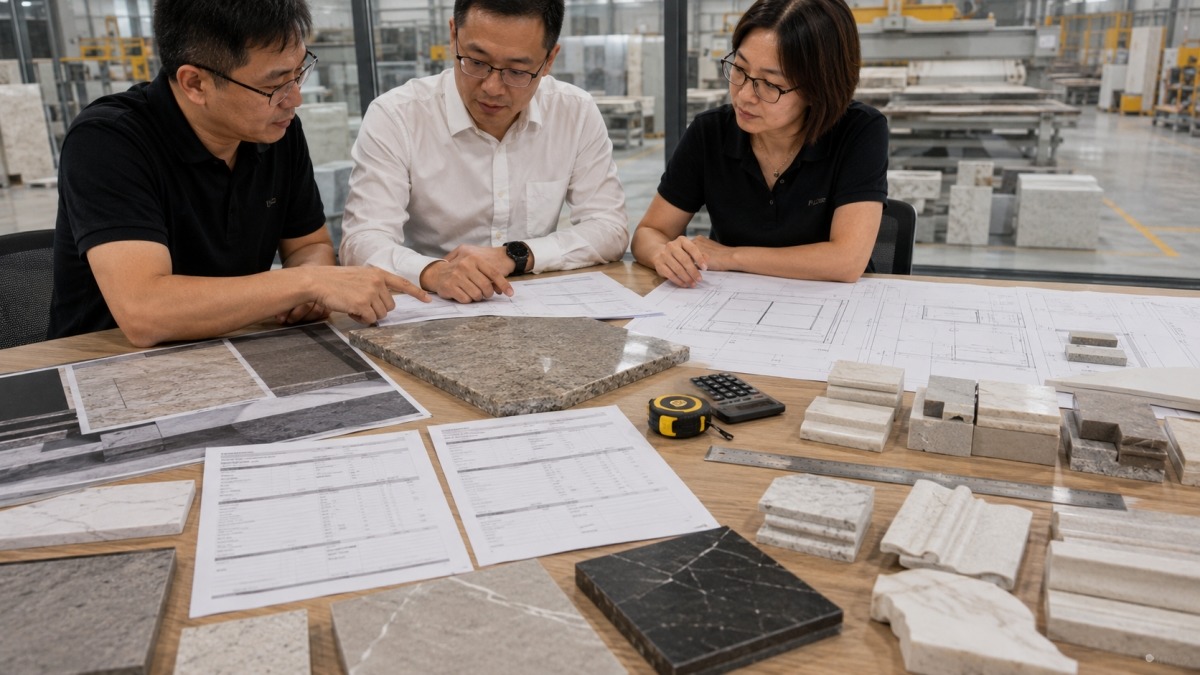
Edge Work and Cutouts Are Often Hidden Price Differences
Many quotation disputes come from small details that were not small in production.
Sink cutouts, faucet holes, cooker holes, drain grooves, polished edges, beveled edges, bullnose edges, mitered corners, laminated edges, stair nosing, skirting, backsplash, side splash, waterjet cutting, CNC shaping, dry layout, and piece numbering can all affect price.
A quotation should not only say “stone price.” It should show whether fabrication details are included.
Packing Can Make a Cheap Quote Risky
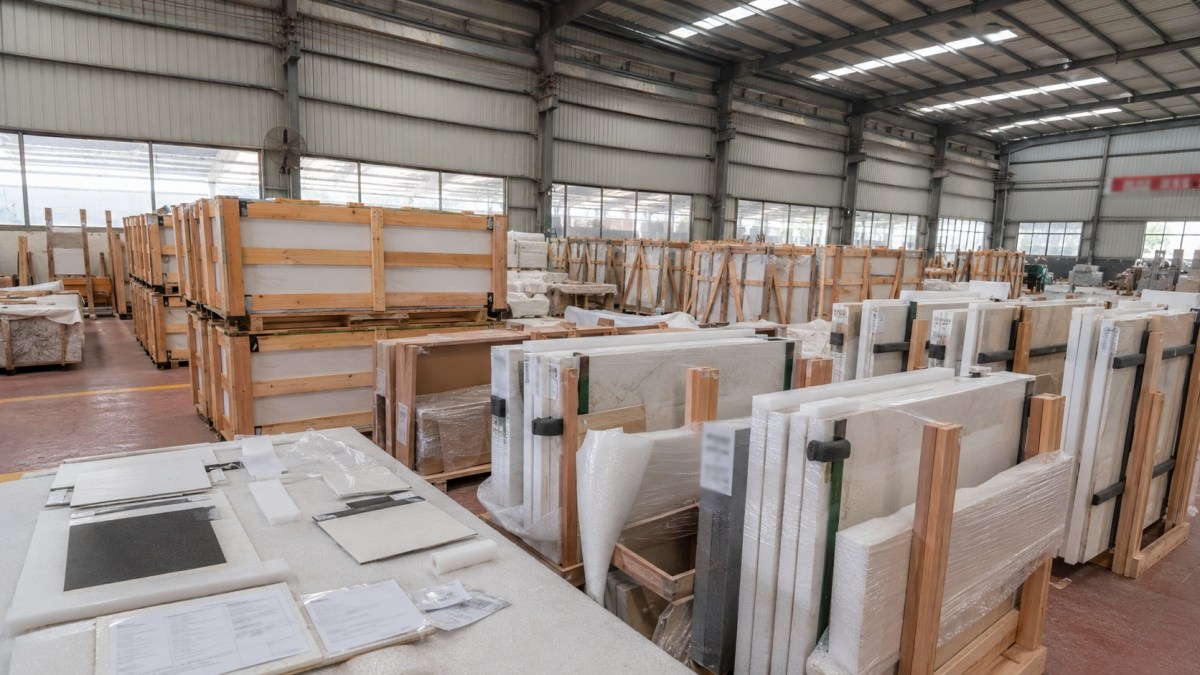
Stone is heavy and breakable. Edges, corners, polished faces, cutouts, and long pieces need protection.
Packing is not just a shipping detail. It is part of project risk control.
For international stone project supply from China, packing clarity can reduce damage risk and site confusion.
A low quotation with weak packing may cost more after damage, delay, replacement, or sorting problems.
Delivery Terms Must Be the Same
Two quotations may have very different delivery bases.
One may be EXW. One may be FOB. One may be CIF. One may include sea freight only to port. One may include sample freight but not bulk shipment.
Buyers should check Incoterm, loading port, destination port, freight inclusion, local charges, container method, sample shipment cost, quotation validity, currency, and payment term.
A quotation is only comparable when the delivery basis is clear.

Documents and Certificates Should Be Checked Early
Some buyers need test reports, certificates, product documents, export documents, or compliance support before confirming an order.
Buyers can review stone certificates and downloadable documents to understand what supporting files may be available for relevant material categories.
Documents do not replace project review, but document support should be clear before the buyer makes a final comparison.
Lead Time Should Be Compared Honestly
The fastest delivery is not always the safest delivery.
Sometimes fast is possible because stock is available. Sometimes it is fast because the supplier has real production capacity. But sometimes it is fast because the quotation ignores selection, sample approval, drawing review, fabrication, inspection, packing, or documentation.
A realistic lead time is better than a beautiful promise that cannot be kept.
Supplier Communication Is Part of the Quotation
A quotation is more than a number. It is also a communication sample.
Before placing an order, buyers can observe whether the supplier asks practical questions, understands the application, separates included and excluded items, explains risks clearly, provides photos or documents when needed, and understands packing and export requirements.
A supplier who cannot communicate clearly before the order may not communicate better after the deposit.
A Simple Quotation Comparison Checklist
Before choosing a supplier, buyers can compare these points:
Material name and category:
Slab / tile / cut-to-size:
Thickness:
Size:
Quantity basis:
Finish:
Application:
Fabrication included:
Edge work included:
Cutouts / holes included:
Dry layout / numbering included:
Packing method:
Documents included:
Trade term:
Destination:
Freight included:
Lead time:
Payment term:
Quotation validity:
Supplier questions and clarity:
Remaining risks:
Sometimes the lower price is still the right choice. Sometimes the higher price includes real work and lower risk.
The goal is not to always choose expensive. The goal is to choose with clear understanding.
Here comes a conclusion
Stone quotation comparison should not be reduced to one number.
A serious buyer should compare material, thickness, size, finish, fabrication, packing, documents, delivery terms, lead time, and supplier communication.
The cheapest quotation may be correct if the basis is complete and equal. A higher quotation may be reasonable if it includes real project work. A vague quotation may be risky even when the price looks attractive.
Good buying is not about rejecting low prices. It is about knowing what the price actually includes.
For quotation review, material comparison, cut-to-size details, document support, and project supply discussion, buyers can contact Aoli Stone for quotation review and project supply support.



 IPv6 network supported