English
 Español
 Português
 عربي
عربي 한국어
한국어

Terrazzo can be used for restaurant counters, reception desks, café tables, hotel furniture and bathroom vanity areas. This sometimes leads buyers to group all horizontal terrazzo surfaces under one simple product description: “terrazzo tops.”
That description is convenient, but it is not enough for specification or production.
Terrazzo countertops, custom terrazzo tabletops and terrazzo vanity tops may use the same material family, aggregate design and surface finish. They still require different decisions about shape, dimensions, support, visible edges, cutouts, joints, fixtures, handling and packing.
The practical principle is:
Approve the material once, but review each product type according to how it will actually be used and supported.
Buyers can begin by reviewing Aoli Stone’s factory-produced terrazzo formats for counters, tables and vanity areas when comparing slab supply with finished or cut-to-size pieces.
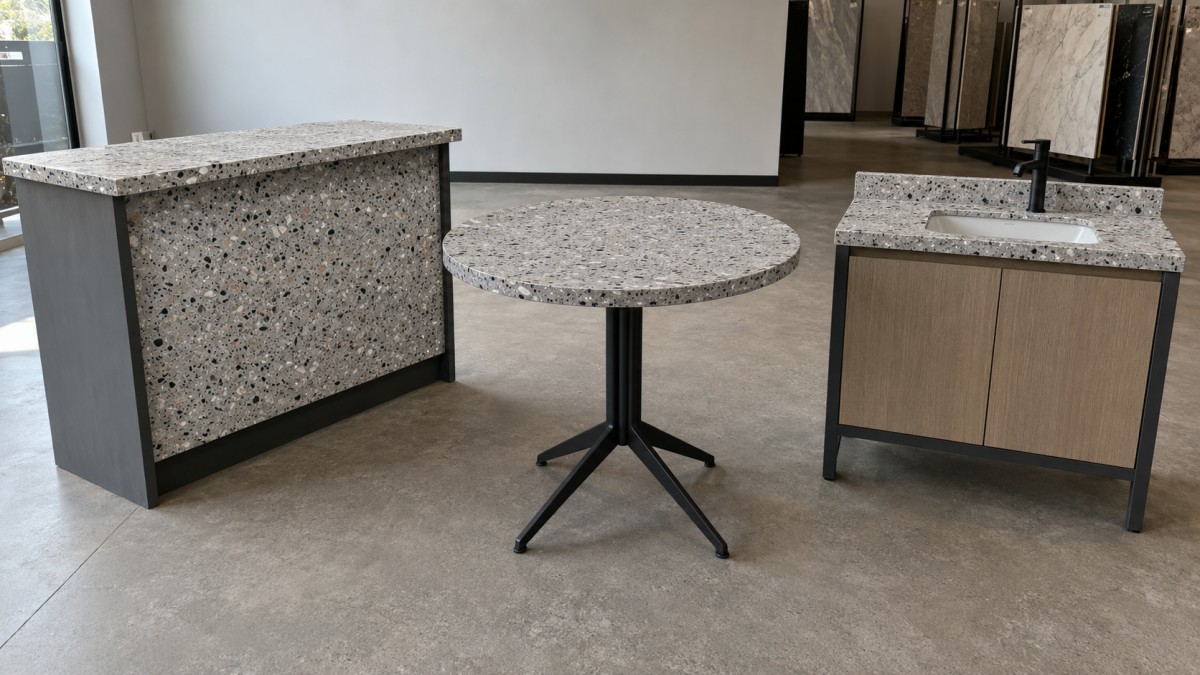
They Are All Tops, but They Are Not the Same Product
A counter is normally connected to cabinetry, a service structure or a built-in architectural element.
A tabletop is normally supported by a separate base, frame, pedestal or set of legs. It may also need to be moved, replaced or installed as a furniture component.
A vanity top must coordinate with a bathroom cabinet, basin, faucet, wall condition, plumbing position and often a backsplash or side splash.
These differences affect more than installation. They influence:
· Finished dimensions
· Piece shape
· Thickness
· Visible edge treatment
· Joint position
· Cutouts
· Support information
· Handling method
· Packing design
· Approval documents
· Responsibility boundaries
A buyer who sends only a terrazzo color reference and overall length has not provided enough information for a reliable quotation.
Terrazzo Countertops: Built-In Surfaces and Service Conditions
Terrazzo countertops may appear in restaurants, cafés, hotel reception areas, retail counters, offices and other commercial interiors.
Their most important characteristic is that they are usually connected to a fixed cabinet, steel frame, wall, service unit or built-in structure.
The project team should clarify:
· The final counter plan
· Straight, L-shaped, curved or segmented geometry
· Finished dimensions
· Countertop orientation
· Front and rear edges
· Visible ends
· Cabinet or supporting-frame position
· Seam positions
· Overhangs
· Equipment or service openings
· Backsplash or upstand details
· Site access
· Installation sequence
Long commercial counters may need to be divided into several pieces. The best division is not always determined by slab size alone. Cabinet lines, structural support, openings, viewing direction, site access and packing safety may all affect the final decision.
Terrazzo countertop fabrication also requires clear information about which edges remain visible. A finished front edge, wall-side edge and hidden cabinet edge do not necessarily require the same processing.
Buyers can review Aoli Stone’s restaurant terrazzo counter and flooring application reference
when considering how a terrazzo counter may relate visually to the surrounding commercial interior.
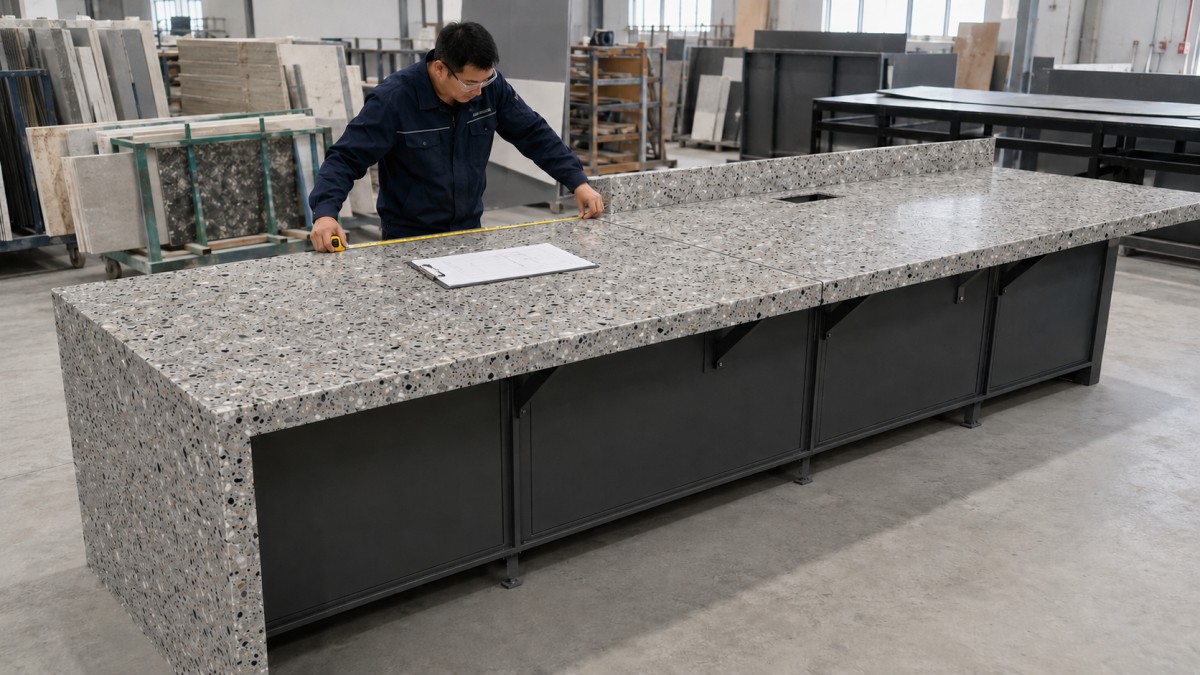
What Is Unique About a Countertop Order?
Compared with a tabletop or vanity top, a commercial counter is more likely to involve:
· Long or connected runs
· Multiple pieces
· Service-side and customer-side edges
· Equipment openings
· Cable or utility access
· Seams over supported locations
· Large overhangs or raised counter sections
· Relationship with wall finishes or floor materials
· Site assembly
The supplier can review drawings, dimensions, piece division, edge requirements and production feasibility. The project team must still confirm permanent support, site measurements, installation conditions and local requirements.
Custom Terrazzo Tabletops: Furniture Geometry and Base Coordination
A tabletop is not simply a small countertop.
The top is normally part of a furniture assembly, and its behaviour depends on the relationship between the terrazzo piece and the table base.
Custom terrazzo tabletops may be:
· Round
· Oval
· Square
· Rectangular
· Racetrack-shaped
· Irregular
· Geometric
· Made with straight or curved sides
· Produced as single pieces or coordinated sets
The buyer should provide more than the top dimensions. The supplier also needs to understand:
· Table-base type
· Base dimensions
· Support contact area
· Fixing or connection concept
· Position of the base under the top
· Whether the top is centred or offset
· Intended edge profile
· Corner radius
· Finished face
· Underside visibility
· Quantity by shape and size
· Whether different tables must visually coordinate
A large round or oval stone top may look simple in an interior rendering, but its weight distribution, handling and base relationship require project review.
The stone supplier should not approve the safety or stability of a table base from an image alone. The qualified furniture or project team should confirm the frame, fixing, support and anti-tip requirements.
Buyers can review this custom terrazzo and stone tabletop fabrication reference to see how a custom tabletop may involve material composition, cutting, fitting, polishing and finished-edge work.
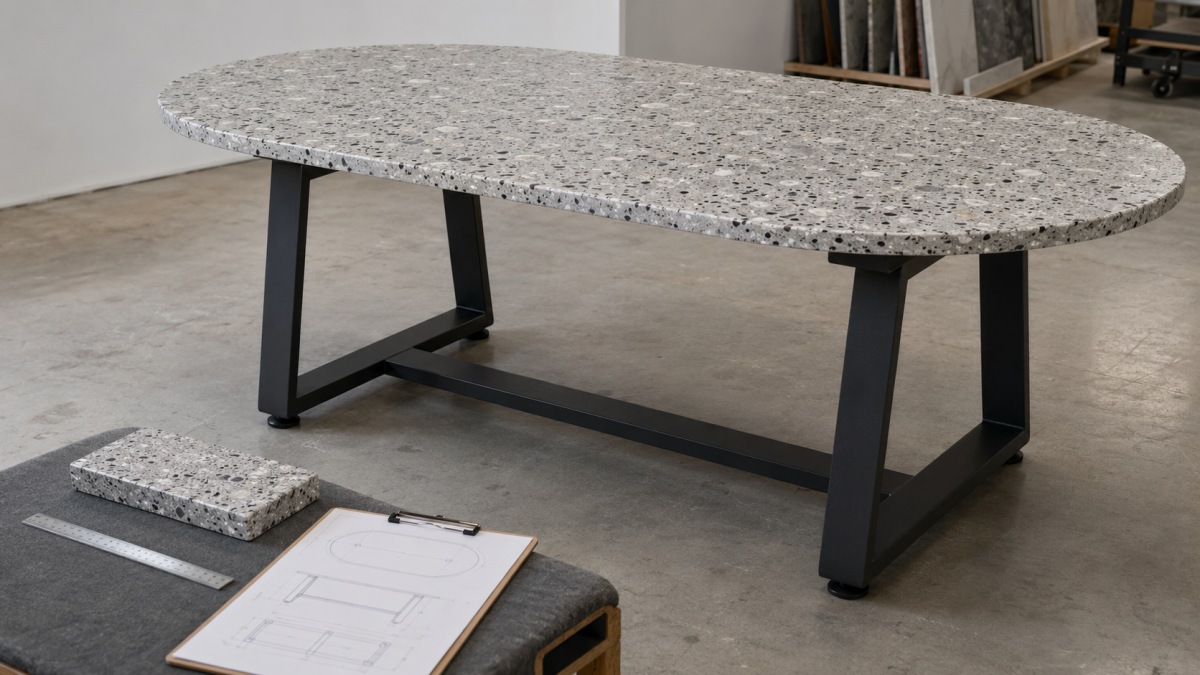
Compared with a built-in counter, a tabletop is more likely to require:
· A fully visible perimeter
· Curved or shaped cutting
· Comfortable edge and corner treatment
· Coordination with a separate base
· Review of centre of gravity
· Handling as an individual furniture component
· Repeated visual consistency across several tables
· Individual protective packing
For restaurant or hotel orders, the buyer should also identify whether all tabletops use one size or whether several furniture schedules are involved.
Terrazzo Vanity Tops: Fixtures, Cabinets and Bathroom Coordination
Terrazzo vanity tops are usually smaller than long commercial counters, but their fabrication details can be more concentrated.
The top may need to coordinate with:
· A single basin
· Double basins
· Vessel basins
· Undermount basins
· Drop-in basins
· Faucet holes
· Soap-dispenser holes
· Wall-mounted taps
· Backsplashes
· Side splashes
· Cabinet dimensions
· Plumbing clearances
· Wall-to-wall conditions
The basin type is especially important.
A vessel basin may require a drain opening and faucet information. An undermount basin may require a shaped opening, finished internal edge and clear relationship between the basin and top. A drop-in basin uses a different opening and usually hides part of the cut edge.
Approximate catalogue dimensions should not replace the final basin drawing or physical template when precise fabrication is required.
For repeated hotel rooms, apartment units or bathroom types, the buyer should identify:
· Room or unit type
· Left-hand and right-hand arrangements
· Single- and double-basin versions
· Wall-side edges
· Exposed sides
· Backsplash dimensions
· Faucet-hole pattern
· Quantity by type
· Spare quantities
· Required labelling sequence
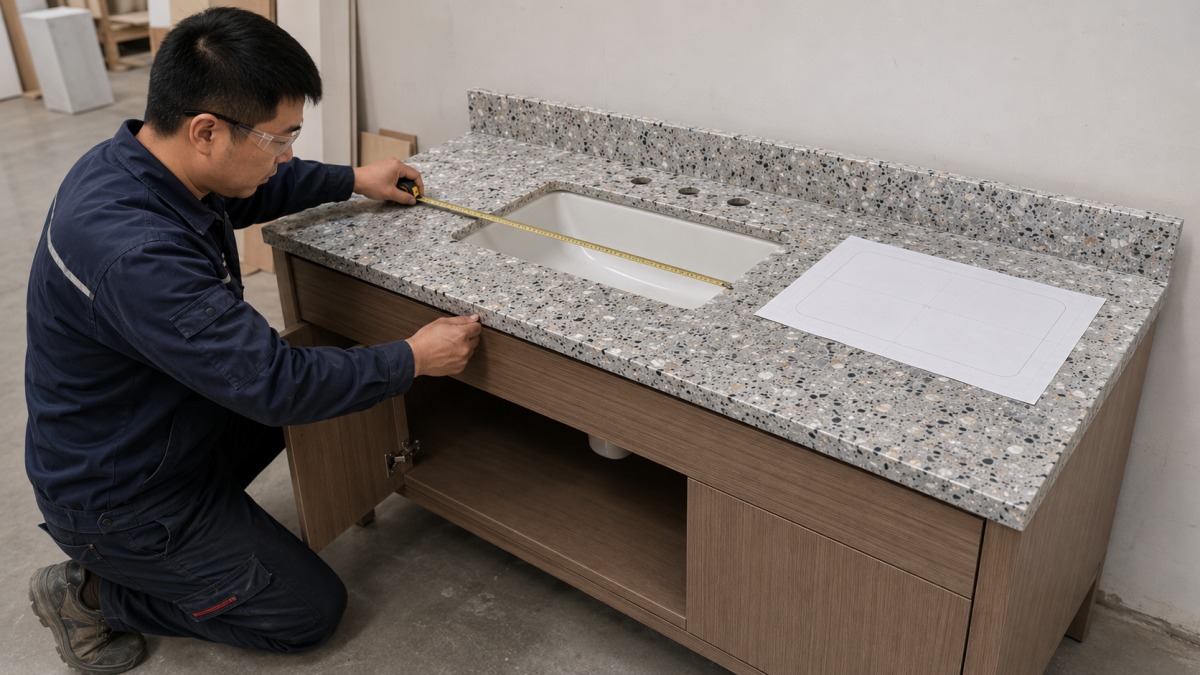
Compared with a tabletop or general counter, a vanity-top order is more likely to require:
· Exact basin coordination
· Faucet and accessory holes
· Finished internal cutout edges
· Backsplash and side-splash pieces
· Repeated room-type production
· Left- and right-hand versions
· Cabinet and wall-condition review
· Unit-specific labels and packing
The supplier can review the material, fabrication drawing, opening dimensions, visible edges, finish, piece identification and packing. Plumbing, waterproofing, cabinet support and site installation remain project-specific responsibilities.
Comparison: Three Products, Three Approval Priorities
|
Review Point |
Commercial Countertop |
Custom Tabletop |
Vanity Top |
|
Main product role |
Fixed architectural or service surface |
Furniture component |
Bathroom cabinet surface |
|
Typical geometry |
Long, L-shaped, segmented or curved |
Round, oval, square, rectangular or irregular |
Rectangular, wall-to-wall, single- or double-basin |
|
Main support |
Cabinet, steel frame or built-in structure |
Separate table base, legs or pedestal |
Bathroom cabinet or wall-related support |
|
Main fabrication risk |
Seams, openings, long pieces and unsupported areas |
Shape, perimeter edge, weight and base position |
Basin opening, faucet holes and backsplash fit |
|
Most visible edges |
Customer-facing front and exposed ends |
Usually the full perimeter |
Front edge, exposed sides and basin opening |
|
Common openings |
Equipment, cable or service openings |
Sometimes base or fixing-related details |
Basin, faucet, drain and accessory holes |
|
Main drawing need |
Plan, section, seam and support layout |
Top shape plus table-base information |
Vanity drawing plus basin and faucet details |
|
Main packing concern |
Long pieces, narrow areas and seam sequence |
Individual edge protection and shape support |
Cutout protection and room-type identification |
|
Approval focus |
Built-in coordination |
Furniture geometry |
Fixture and cabinet coordination |
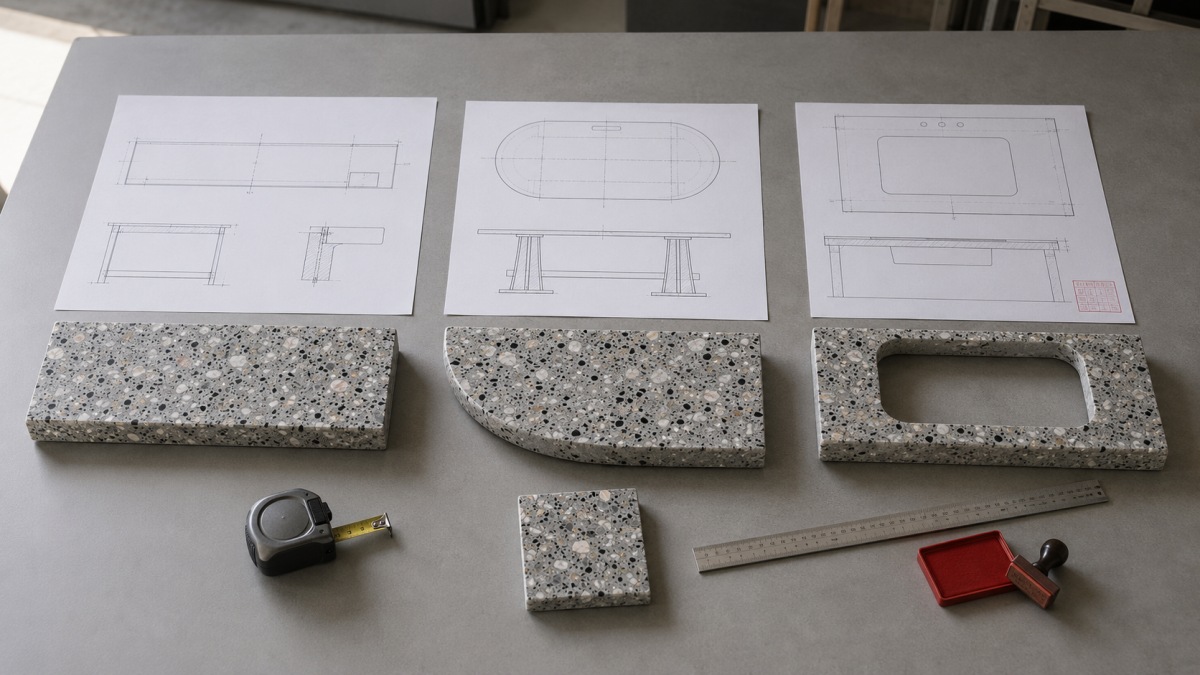
Different specifications do not prevent visual coordination.
A hotel, restaurant or retail project may use one terrazzo color family across:
· Reception counters
· Café tables
· Bathroom vanity tops
· Wall panels
· Flooring
· Skirting
· Decorative blocks
· Display furniture
The project team can preserve a consistent material identity by confirming:
· Base-color direction
· Aggregate colors
· Aggregate scale
· Aggregate density
· Finish
· Acceptable appearance range
· Relationship between the different surface areas
However, the material should be reviewed at the scale of each finished product.
A close-up sample may show aggregate colors clearly but cannot confirm how the pattern will look across a long counter, circular tabletop or vanity top with a large basin opening.
Buyers can review additional terrazzo applications for hospitality and design interiors
when planning a coordinated material family across several custom interior elements.
Sample Approval Should Match the Finished Product
One small flat sample is rarely enough to approve every detail of a custom top.
Consider reviewing:
· Larger material area
· Front-edge sample
· Seam mockup
· Counter section
· Opening position
· Surface finish
Consider reviewing:
· Full or scaled top shape
· Corner or radius
· Perimeter edge
· Underside appearance
· Relationship with the base
· Repeated appearance across several tables
Consider reviewing:
· Basin type
· Cutout edge
· Faucet-hole position
· Backsplash joint
· Wall-side condition
· First completed room type
The more complex the geometry, the more important it becomes to distinguish material approval from fabrication approval.
Slab Supply or Finished Cut-to-Size Pieces?
Buyers should decide whether they need:
1. Full slabs for local fabrication
2. Standard rectangular blanks
3. Semi-finished pieces
4. Fully fabricated tops
5. Tops supplied with matching backsplashes or edge pieces
6. Several product types packed as one project order
Full-slab supply may be practical when the buyer has a trusted local fabricator, final site dimensions are not yet available or local adjustment is expected.
Finished cut to size terrazzo may be practical when:
· Drawings are approved
· Sizes are stable
· Repeated pieces are required
· Factory fabrication offers clearer control
· Edge profiles and cutouts can be confirmed
· Project-specific labels are required
· The packing sequence can be planned before shipment
The correct supply format depends on drawings, quantity, dimensions, site conditions, installation responsibility and local fabrication capability.
Fabrication Information Should Be Product-Specific
A general “top schedule” is not enough when the order contains counters, tabletops and vanity tops.
Each product should have its own drawing or schedule.
Include:
· Piece number
· Finished dimensions
· Orientation
· Visible edges
· Seam position
· Openings
· Backsplash
· Overhang
· Support references
Include:
· Table model
· Shape
· Diameter or length and width
· Thickness
· Edge profile
· Corner radius
· Base drawing
· Base position
· Quantity
Include:
· Room or unit type
· Finished size
· Basin model
· Cutout dimensions
· Faucet-hole details
· Exposed edges
· Backsplash
· Left- or right-hand orientation
· Quantity
Aoli Stone’s fabrication review for shaped tops, edges, cutouts and packing can help buyers understand how confirmed drawings, sizes and project instructions relate to cutting, finishing, inspection and export preparation.
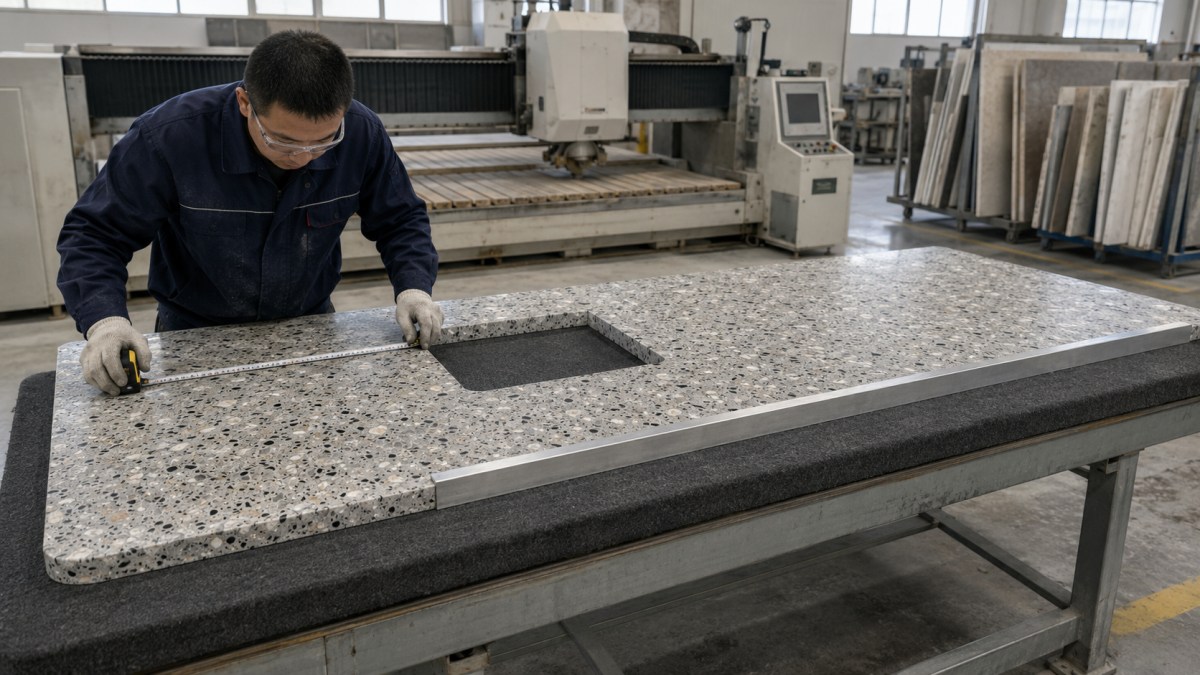
Packing Requirements Also Differ
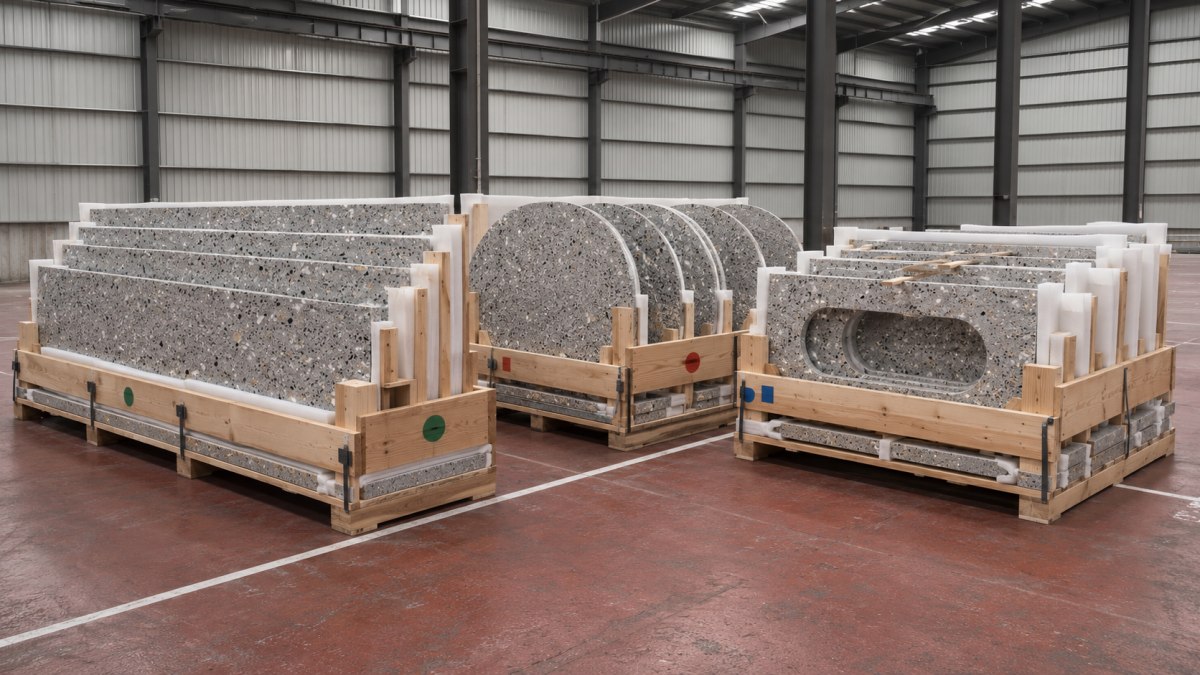
A long counter, a circular tabletop and a vanity top with a basin opening should not automatically be packed in the same way.
Packing may need to address:
· Long pieces
· Narrow sections
· Finished front edges
· Seam sequence
· Openings
· Installation order
Packing may need to address:
· Fully exposed perimeter edges
· Curved shapes
· Individual-piece protection
· Separation between repeated tops
· Relationship with separately packed bases
Packing may need to address:
· Basin-opening reinforcement
· Faucet holes
· Backsplash pieces
· Room or unit labels
· Left- and right-hand versions
· Repeated bathroom types
The packing plan should follow the actual geometry and installation sequence rather than treating all finished tops as standard rectangular pieces.
A terrazzo supplier for custom interior projects should be evaluated on more than whether it can send a color sample.
Buyers should review whether the supplier can discuss:
· Terrazzo material type
· Available slab and fabricated formats
· Approved-sample control
· Drawings and size schedules
· Product-specific dimensions
· Edge profiles
· Cutouts
· Surface finish
· Piece identification
· Inspection
· Export packing
· Responsibility boundaries
Buyers should also separate the supplier’s role from the roles of the architect, furniture manufacturer, cabinet contractor, plumbing team and installer.
The stone supplier may fabricate accurately according to an approved drawing, but it cannot correct an incorrect table-base design, unverified cabinet dimension or wrong basin model.
Procurement teams can review supplier documentation for inorganic terrazzo evaluation when completing internal supplier and material checks.
What Buyers Should Send Before Requesting a Quotation
Start by identifying the product type:
· Commercial counter
· Reception desk
· Restaurant service counter
· Tabletop
· Vanity top
· Mixed custom-top order
Then provide the relevant information.
Information required for all product types
· Terrazzo color or reference
· Application
· Finished dimensions
· Thickness
· Quantity
· Surface finish
· Visible edges
· Destination
· Required delivery schedule
· Packing requirements
· Drawings or reference images
· Cabinet or frame drawing
· Seam positions
· Overhangs
· Service or equipment openings
· Backsplashes
· Site-access limits
· Table-base drawing
· Base dimensions
· Base location
· Top shape
· Corner radius
· Fixing concept
· Quantity by table model
· Basin brand and model
· Basin drawing or template
· Faucet model and hole pattern
· Backsplash dimensions
· Cabinet dimensions
· Left- and right-hand arrangements
<span style="font-famil



 IPv6 network supported